
Welcome to Global Data Center Hub. Join investors, operators, and innovators reading to stay ahead of the latest trends in the data center sector in developed and emerging markets globally.
TL;DR
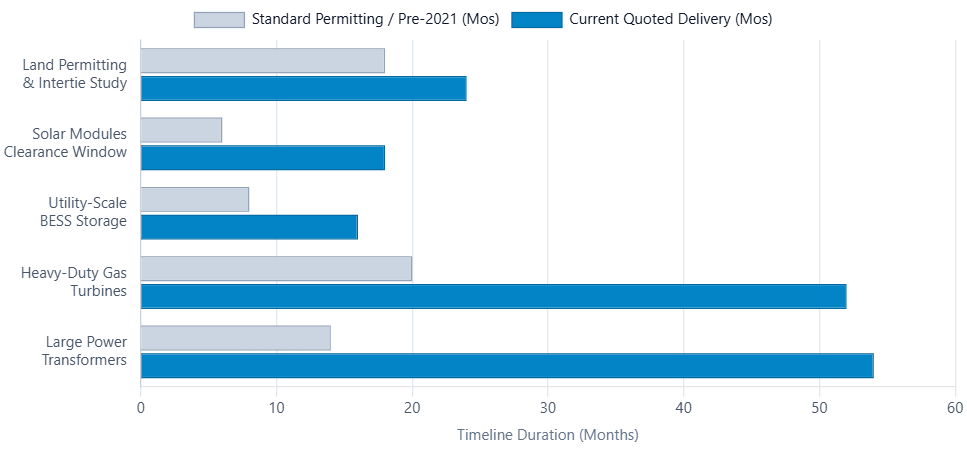
Equipment lead times now run longer than permitting and interconnection timelines, which makes the factory queue the binding constraint on data center delivery. Large transformers, generator step-up units, and heavy-frame gas turbines have moved from months of lead time to multi-year delivery windows.
The industry still orders electrical hardware after financial close, and that sequence no longer works. The equipment queue is now longer than the entire approval cycle it was built to follow.
Disciplined capital reserves manufacturing slots with non-refundable deposits before permits are granted and prices the deposit as an option premium on access. Balance-sheet buyers absorb that forfeiture risk, so the factory allocates capacity by balance-sheet strength.
The factory sets your delivery date
The factory queue now decides when your data center opens.
Power equipment lead times have outpaced the permitting and interconnection process, so the item ordered last is the item that arrives last.
Project finance was built on the opposite assumption.
It treated electrical hardware as a purchase that follows financial close, sequenced behind site control, offtake, and the system impact study.
Apply that sequence today, and you will complete a building that cannot be energized for years.
The shell is finished. The debt is drawn. The revenue is zero.
Three buyers, one supply base
The constraint is intensifying because demand arrived from several directions at once.
AI campuses, utility grid renewal programs, and industrial electrification are all bidding for the same transformers, switchgear, and turbine slots.
No buyer can substitute a different product.
So, the question is not how much capital has been committed to data centers.
The question is where that capital converts into energized capacity, and who controls the hardware that makes the conversion possible.
We made a version of this argument when chip allocation, not leasing, set absorption timing.
The bottleneck is a furnace
The bottleneck sits upstream of the assembly line.
Large power transformers depend on grain-oriented electrical steel, made by a small number of specialized mills, and the United States satisfies only a minority of its own consumption internally.
Coil winding remains a manual trade. A custom utility-intertie unit is not a catalog item. The order enters a queue now measured in years.
Turbines are worse. The constraint sits in hot-section castings, the blades and vanes that survive firing temperatures above 1,600 degrees Celsius.
Those parts come from a narrow tier of specialized foundries.
Expanding that tier requires vacuum melting furnaces and metallurgical labor that left the industry during the thermal downturn of the 2010s.
AI-grade workloads make this sharper. Density raises the load per square foot, which pushes projects toward larger step-up units and higher-voltage interties.
Larger units carry the longest lead times in the category. The more advanced your compute design, the further back you sit in the queue.
Consider a composite that repeats across secondary markets.
A regional developer secures land, signs an anchor tenant, and holds the transformer order until the transmission utility finishes its system impact study.
The order is then placed. The delivery window falls two years past rent commencement, and the lease carries no relief clause for equipment delay.
Scarcity is not a pricing problem
The industry has long assumed that equipment scarcity is a cost problem.
That assumption held when factories carried spare capacity and a buyer willing to pay a premium could move up the queue.
It does not hold now, because the constraint is physical throughput.
A buyer willing to pay more does not move up the queue, because the queue is set by furnace hours.
Capital cannot conjure a casting furnace.
Adding manufacturing capacity takes years after the funding is committed, and every OEM expanding today is expanding into a book that is already full.
Policy closed the side doors
Trade policy has narrowed the escape routes at the same time. Section 301 tariffs on Chinese lithium-ion cells for storage stepped up at the start of 2026.
Content rules under the One Big Beautiful Bill Act require 2026 storage projects to source most components outside the foreign-entity-of-concern definition, with the threshold rising later.
Solar carries its own lower threshold. A Section 232 investigation into imported polysilicon sits over the wafer supply that Western module assembly still depends on.
In Europe, the Net-Zero Industry Act sets a binding domestic manufacturing benchmark for 2030 and adds non-price criteria that penalize concentrated sourcing.
The pattern is clear. Compliance is a qualification process, and qualification takes time you didn't budget for.
Regulators have closed one of the faster workarounds.
When a co-location arrangement was tested at a large nuclear site, the federal energy regulator rejected the amended interconnection agreement, finding that the structure pushed transmission costs onto other ratepayers.
Sponsors who underwrote behind-the-meter co-location to bypass the queue must now re-underwrite it under standard network tariffs.
What binds, by lens
For independent operators, the binding variable is qualification, not price. You cannot standardize what you have not specified, and you cannot order what you have not specified. Freeze the electrical package early, at a common collection and transmission voltage, and a bespoke engineering order becomes repeatable. Operators that hold the specification open until the tenant signs forfeit the only lever that moves them up a manufacturing queue.
For private equity and infrastructure investors, the binding variable is the gap between the delivery date and the model. A project underwritten to distribute in year two behaves very differently when first revenue lands in year four. Interest during construction accrues against a drawn balance for two extra years. Coverage tightens, and a return profile underwritten in the low teens compresses toward single digits with no change to the operating assumptions. The schedule is the return.
For public equity, the dispersion is already visible in where the economics sit. Value has migrated from the asset to the supplier. Order books at the equipment level now carry multi-year visibility, a rare quality in a cyclical industry. Developers without secured hardware struggle to attract construction partners. This is the same dispersion that opened around route diversity in fiber. The spread between a platform that holds delivery slots and one that holds only announcements is not a valuation opinion. It reflects what each company can actually build.