

Welcome to Global Data Center Hub. Join investors, operators, and innovators reading to stay ahead of the latest trends in the data center sector in developed and emerging markets globally.
TL;DR
Chip allocation, not construction, now sets when a data center starts earning. A powered shell can be delivered in eighteen to twenty-four months, while a fully configured accelerator cluster is gated by advanced packaging and high-bandwidth memory capacity no developer controls. The interval between substantial completion and rent commencement is where levered development returns are decided.
A signed pre-lease is not de-risked revenue, and the market still prices it as though it were. Roughly three-quarters of capacity under construction in primary markets is committed before delivery, but committed capacity is not energized capacity, and energized capacity is not paid capacity. Pre-leasing percentages disclose demand, not the timing of cash flow.
Disciplined capital underwrites to rent commencement and requires proof of chip allocation before releasing construction draws. Firm commencement terms move silicon delivery risk to the tenant, and buildings designed for a liquid-cooling transition survive a hardware generation change that strands fixed-specification assets. Both are contract terms, not forecasts.
Absorption in data centers is now set by chip allocation, not by construction schedules.
The old underwriting paradigm treated substantial completion as the moment risk ended and revenue began.
Apply that paradigm today and you will fund a finished, powered, cooled building that sits dark for two or three quarters while your tenant waits in a queue it does not control.
Two Clocks Have Come Apart
The gap is widening because two clocks have come apart. A powered shell can be delivered in eighteen to twenty-four months.
A fully configured accelerator cluster, from order to racked and running, often takes longer.
The tenant’s place in that line is set by a supplier the developer never meets.
So the question worth asking is no longer where capacity is being built.
It is where capacity is actually being energized, and who carries the asset until it is.
The Bottleneck Sits Above the Landlord
The constraint sits upstream of anything a developer controls.
Advanced accelerators are gated at three chokepoints: lithography equipment, advanced packaging, and high-bandwidth memory.
Packaging is the tightest of the three.
Memory is close behind, because each gigabyte of high-bandwidth memory consumes several times the wafer capacity of standard DRAM.
New capacity at those nodes tends to get absorbed by the next chip generation.
Supply of the generation already in the field eases very little.
Allocation Decides Before Manufacturing Does
On top of the manufacturing layer sits an allocation layer. The dominant chip designer distributes output through a tiered system.
The largest cloud buyers take the majority of leading-edge supply under multi-year advance commitments.
Sovereign programs and specialist compute platforms split most of what remains.
Everyone else waits and waits at the back.
Consider a developer that delivered a large campus on schedule in a secondary US market. Shell, power, cooling, all complete and commissioned.
The tenant, a specialist compute platform, had signed a five-year take-or-pay contract eighteen months earlier.
Its upstream allocation slipped two quarters. Rent commencement slipped with it.
The developer carried construction debt on a finished asset earning nothing, and the equity return fell by several hundred basis points on a schedule variance nobody had modeled.
A Generation Change Is a Re-Engineering Event
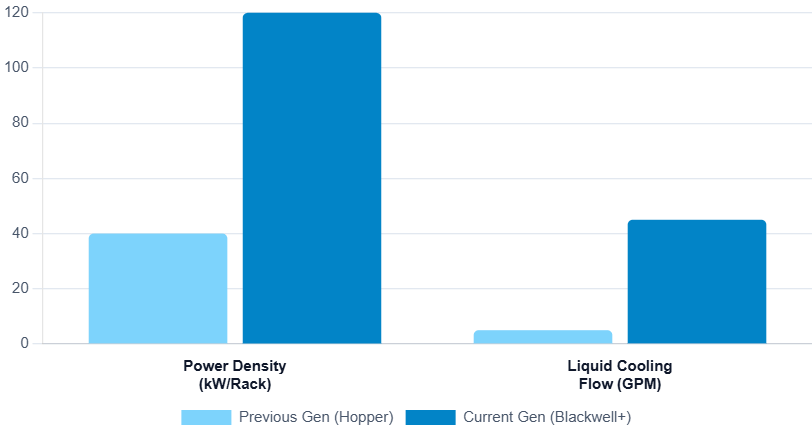
The generation problem compounds this. A previous-generation deployment sits comfortably at forty to fifty kilowatts a rack on air cooling.
The current generation demands more than one hundred kilowatts a rack and mandates direct liquid cooling, with coolant distribution units and manifold networks the older design never anticipated.
When a tenant’s allocation shifts generation mid-build, the developer does not get a schedule delay.
The developer gets a re-engineering event, priced at construction-stage rates.
Committed Is Not Energized
The industry has long assumed that a signed pre-lease is de-risked revenue.
That assumption held when tenant fit out was measured in weeks and the equipment was commodity hardware available on demand.
It does not hold now, because the tenant’s hardware sits in a queue the tenant does not control and the landlord cannot see.
Roughly three-quarters of capacity under construction in primary markets is committed before delivery. Committed is not energized and energized is not paid.
Capital Cannot Buy Queue Position
Time is the real cost here, more than price. Grid interconnection is the longest pole.
Queues at PJM and ERCOT run four to five years, longer than the useful life of the chips that will eventually fill the building.
Substation equipment and transformers carry multi-year lead times of their own.
Where chips arrive and power does not, operators power-cap or rotate fleets, which strands a meaningful share of installed capacity even with the silicon physically on site.
Friction also runs through labor and permits. Skilled electrical and mechanical trades for high-density fit-out are scarce in every hub that matters.
Environmental review and permitting add quarters. None of these compresses with capital.
You cannot pay your way to the front of an interconnection queue, and you cannot pay your way to the front of an allocation queue either. A named-market version of that constraint: Eskom’s Number Is Not 6 Gigawatts. It Is 40 Percent.

Three Lenses, One Interval
For independent operators, the binding constraint is specification under uncertainty.
You commit to floor loading, piping runs, and cooling topology before the tenant’s silicon generation is confirmed.
Specify too low and the asset is obsolete within one hardware cycle. Specify too high and you fund cooling the first tenant will neither use nor pay for.
The recurring variable to underwrite is the transition between hardware generations. Design for the transition and the tenant becomes replaceable.
For private equity and infrastructure investors, the binding constraint is the interval between substantial completion and rent commencement.
That interval is unfunded carry, and it does not appear as a line item in most development models. A two-quarter slip on a levered development is not a rounding error.
It is the difference between a top-quartile outcome and a forgettable one. Model the interval explicitly, size a reserve against it, and settle who pays for it before the shovel goes into the ground.
For public equity, the binding constraint is the credit quality sitting behind the absorption. Platforms with investment-grade offtake and firm commencement terms are being valued on contracted cash flow.
Platforms leased to leveraged compute resellers are being valued closer to a credit spread, whatever the reported pre-leasing percentage says.
Rating agencies have started to draw that line explicitly in how they treat hardware-collateralized facilities.
The dispersion is widening, and a headline occupancy number will not tell you which side of it a platform sits on.
What Disciplined Capital Does Differently
Five disciplines follow from this.
Underwrite to rent commencement, never to substantial completion. Make firm commencement the default term and treat any tenant-controlled trigger as a repricing event, not a concession.
Require evidence of allocation before authorizing construction draws. Confirmed allocation rights from the chip supplier, not a purchase order and not stated intent.
A tenant who cannot produce it is asking you to underwrite its queue position.
Design the building to survive a generation change. Structural floor loading and piping for liquid cooling, even where the first tenant runs air-cooled racks.
The incremental cost at design stage is a fraction of the cost of a mid-build retrofit.
Price the counterparty behind the compute contract, not just the lease. If the tenant resells compute, require credit support and underwrite the megawatts’ re-leasing value independently of the tenant.
Separate the power entity from the real estate entity where grid timing binds. Behind-the-meter generation financed as project debt, the shell financed as real estate debt.
Two structures, two cost-of-capital profiles, one delivery date you actually control.
Run these and the discipline stops being defense. You buy assets other bidders cannot price, on terms they will not accept, to a timeline they cannot meet.
That four-to-five-year number is the generator queue, and a data center is a load: different process, different rules. ERCOT's Batch Zero load process has been frozen since 3 August with no restart date (thank Governor Abbot's re-election campaign for that), so is the risk a long wait or an open-ended one?