

Welcome to Global Data Center Hub. Join investors, operators, and innovators reading to stay ahead of the latest trends in the data center sector in developed and emerging markets globally.
TL;DR
Carrier diversity and physical route diversity are different assets, and only one of them survives a backhoe strike. Two contracts with two carriers frequently resolve to one municipal trench, one building entrance, or one shared aggregation facility. Buyers pay a diversity premium for a contractual attribute and receive a correlated physical exposure.
The market still treats a carrier route map as evidence of physical separation, and that assumption stopped holding when carriers stopped owning their conduit. Most metro and middle-mile capacity is now leased, resold, and consolidated across competing providers. Two competing names can deliver circuits from the same duct bank without either party disclosing it.
Disciplined capital verifies route diversity physically before closing, then contracts for it and monitors it. That means an independent field trace during confirmatory diligence, committed capital for a second building entrance where separation is absent, and a zero-shared-segment representation with liquidated damages in the master service agreement.
Route diversity is the least verified line item in digital infrastructure underwriting.
The old paradigm held that two carrier contracts produced two physical paths, so diversity was purchased and never inspected.
Capital that still underwrites on that basis holds a correlated exposure at the price of an independent one.
Why This Binds Now
Three forces are closing the gap between what diversity costs and what it delivers.
AI-grade tenants now run synchronous workloads across multiple buildings, so a single path failure does not degrade service.
It aborts the job. Regulators in Europe have made third-party dependency mapping a legal duty, and engineering preference no longer covers it.
A large share of the assets changing hands today are brownfield, where the as-built documentation stopped matching the ground years ago.
The question worth asking is not whether diversity was contracted.
It is where that capital went, and whether anyone walked the route.
Where Diversity Converges
Diversity fails where geography narrows. The last hundred meters is the most common failure point.
Two carriers may run separate metro rings for twenty miles, then converge into the same municipal trench, bridge crossing, or rail easement near the campus.
Distance means little when the final approach shares the same path.
The economics are simple: dedicated campus trenching is expensive, so carriers often lease existing conduit to the building.
The building entrance is the second risk.
A facility with one lead-in vault forces every carrier through a single wall penetration and riser. A fire in that riser can take every circuit offline.
Uptime Institute standards recognize this: fault-tolerant designs require physically independent distribution paths, and duplicated capacity through a shared entry does not qualify.
The third is the aggregation point. Diverse routes frequently terminate on different patch panels inside the same carrier hotel.
When that facility loses power or cooling, both circuits fail together and the network diagram still shows two paths.
The fourth is the collapsed ring. Metro operators sell ring topologies that look fully protected on a logical map, and field audits regularly find both sides of the ring spliced inside a single cable sheath.
You Inherit the Diagram, Not the Path
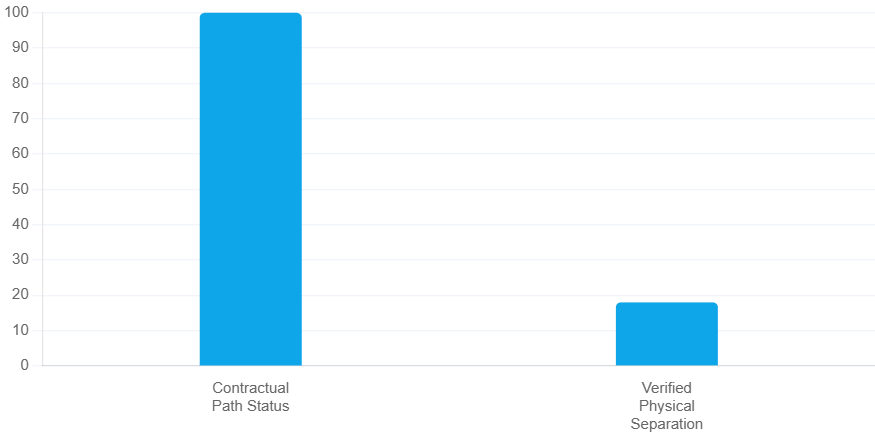
Consider a regional colocation operator that acquired a brownfield campus with two carrier contracts and a Tier III design intent.
The diligence file contained carrier route maps. It contained no trace.
An acoustic survey commissioned after a tenant escalation found both circuits inside one duct bank for the final six hundred meters.
Remediation required a second lead-in vault and a municipal permit cycle.
Neither sat in the capital plan, and the tenant renewal that triggered the survey moved to a competing campus while the permit was pending.
This persists because of information asymmetry.
Carriers rarely release granular route files, citing commercial sensitivity and physical security, and the maps they do provide are stylized schematics without conduit-level resolution.
Then mergers, emergency repairs, and municipal relocations move the physical plant while the documentation stays still.
A cable cut repaired on a weekend gets spliced along whatever path is available, and nobody updates the buyer.
You inherit a diagram. You do not inherit a path.
The same gap runs through capital allocation. In the EuroHPC gigafactory tender, an operator with five AI factories across Europe found that half its named locations could not host one, with the eligibility test measuring jurisdiction and secured power rather than operating skill. The credential was real. It was measured against the wrong thing.
The Assumption That Stopped Holding
The industry has long assumed that carrier diversity is physical diversity.
That assumption held when carriers owned the conduit they sold, end to end, and a second carrier name meant a second build.
It does not hold now because most metro and middle-mile capacity is leased, resold, and consolidated, so two competing names routinely deliver from the same trench.
The diversity premium survived that change. The diversity did not.
The AI buildout raises the cost of that error.
Training workloads synchronize parameters continuously across distributed compute.
When the interconnect partitions, the run does not slow down.
It stops, and it restarts from the last clean checkpoint, which can erase days of consumed power and reserved capacity.
The abrupt load drop then stresses power and cooling systems built for steady draw.
A failure mode that used to produce a service credit now produces a write-off.
Time, Not Cost
The friction is time, and time is the part nobody budgets.
Field verification is a labor-constrained service.
Engineers who can walk a route, open a manhole, and read an optical trace against a second circuit are scarce, and they are scarcest in exactly the secondary markets where the assets are cheapest.
Acoustic route mapping is faster and requires cooperation from the fiber owner, which carriers grant slowly.
A second building entrance is worse.
Street opening permits, easements, and utility coordination run in quarters, and municipal review does not accelerate because a tenant signed a lease.
Add a carrier build interval on top of the civil work and the remediation clock can outlast the lease negotiation that exposed the problem.
The cost of separation is manageable. The schedule is what breaks the model.
How Each Investor Carries It
Independent operators carry this as a specification problem.
Diversity has to be written into the request at the duct level, with named conduit banks and separate meet-me room delivery, and it has to be qualified before the circuit is accepted.
Qualify the vendor and skip the path, and you have bought two invoices and one trench.
Private equity and infrastructure investors carry it as a schedule and structure problem.
Remediation capital lands after close, when the second vault is priced at retail and the permit clock is already running. Service credits compress net operating income in the same window.
And a fault-tolerance claim that fails a physical audit is a representation issue, which moves the exposure out of the engineering file and into the purchase agreement, where it stops being a capex line and becomes an indemnity negotiation.
Public equity investors carry it as a dispersion problem.
Facilities with verified dual entry and separated meet-me rooms qualify for synchronous AI training tenancy, which is where the rent premium sits.
Facilities without it get relegated toward inference, storage, and enterprise colocation at lower rates.
Two assets with identical power and identical build cost trade apart on a variable most public disclosure never mentions, which means the divergence shows up in leasing announcements long before it shows up in a filing.
What Disciplined Capital Does
Six disciplines follow, and each is a decision rule.
Move physical trace verification into confirmatory diligence and treat it as a condition to close, not a post-close finding.
Treat every carrier route map as unverified until an independent trace matches it, and price the gap when it does not.
Underwrite the second entrance as committed capital at acquisition wherever separation is absent, because the permit cycle sets the timeline and the timeline sets the exposure.
Rewrite the master service agreement to carry an explicit zero-shared-segment representation, liquidated damages for undisclosed convergence, advance notice on any physical reroute, and standing audit rights.
Push the verified field data into the routing control plane, so that automated failover cannot move live traffic onto a path that shares a conduit with the one that just failed.
Then re-verify on a fixed cycle, because the physical plant moves and the last audit ages the moment a civil crew opens the street.
Diversity that has been walked, traced, and documented is an asset other bidders cannot underwrite from the data room. That is where the advantage sits.
I've read the verbage about data centres without understanding, it's a new language. It fails to explain what it's all about, but if Trump is anywhere near then it's all about money.
Data banks have a bad name, not helped by Government approvals for yet more banks in the worst, for us, places.
This might be a worldwide reconfiguration post-, please, Trump, or simply a way for those with spare cash to utilise the old phrase "Money makes money".
Away from flippant this needs explaining simply and clearly to avoid confrontation.
Little we are but many, many together we don't being treated as idiots.
J.D.Hamilton-Warwick
South Coast UK
Nothing is more physical than a trench: who dug it, who filled it, and who remembers what's in it when something needs repairing. What's the age demographic of those physical "knowledge workers"?