

Welcome to Global Data Center Hub. Join investors, operators, and innovators reading to stay ahead of the latest trends in the data center sector in developed and emerging markets globally.
The fastest new power plant on the largest U.S. grid may be one that is already built.
That is the lesson in the agreement Google and Constellation Energy announced on October 6.
The deal adds 890 MW of new nuclear capacity to PJM by upgrading existing reactors. It also gives 2,700 MW of existing nuclear supply a 15-year home. Together, the two contracts cover 3,590 MW.
So the deal does two jobs. It adds firm power on a timeline measured in years. It also keeps a large block of existing clean power on the grid as demand climbs.
What Google Actually Signed
The package has three parts, according to Constellation’s announcement and Google’s own post.
First, a 20-year power purchase agreement backs 890 MW of added output at 11 reactors in Illinois, Pennsylvania and New Jersey. Constellation says it will invest more than $4.3 billion in the work. The first uprate is expected by 2028. All 890 MW is due before the end of 2032.
Second, a separate 15-year supply agreement covers 2,700 MW from Constellation’s existing PJM fleet. Constellation says this keeps those plants on the grid.
Third, an expanded five-year technology alliance brings Google Cloud and Gemini Enterprise into Constellation’s operations, from uprate planning to plant output.
The deal also includes load shaping and demand response. Google can cut non-critical power use during high-stress grid events. The two companies also set up a framework to look at new generation, storage and demand response, with PJM first.
When you count new capacity, use 890 MW. That is about 25% of the 3,590 MW total. The other 2,700 MW is power that already flows, now under a long contract.
Headline figures often blur that line, which is why we wrote a guide to reading hyperscaler pledges number by number.
How Existing Reactors Add Power Faster
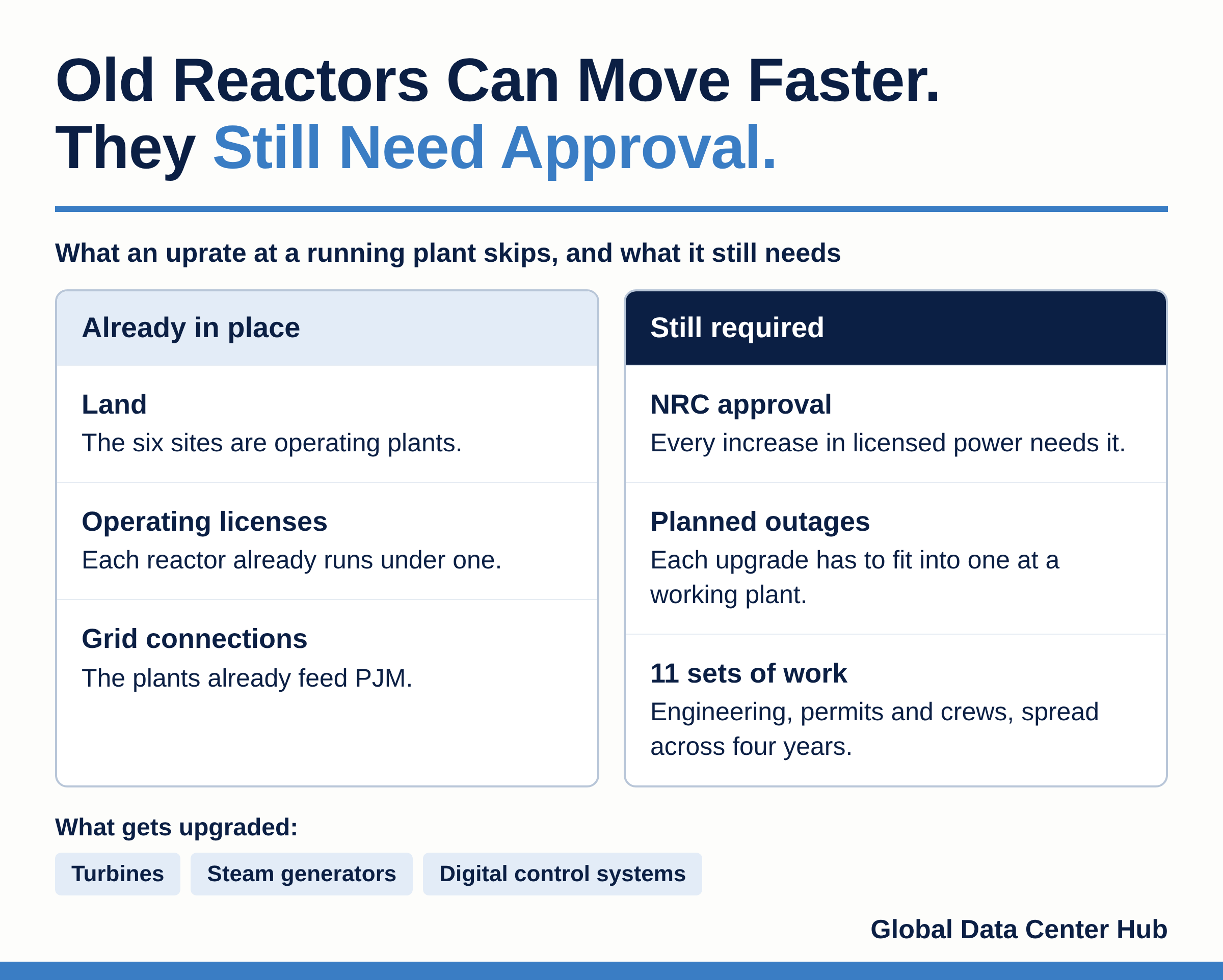
An uprate is an increase in the maximum licensed power of a reactor that is already operating. The Nuclear Regulatory Commission approves every increase. Utilities have used uprates since the 1970s.
Here, the upgrades cover turbines, steam generators and digital control systems, according to the American Nuclear Society. The plants already have land, operating licenses and grid connections. That saves much of the work that slows a new power plant.
Some steps remain. Each unit needs NRC approval. Each upgrade fits into planned outages at a working plant. And 11 units means 11 sets of engineering, permits and work crews, spread across four years.
Think of it like adding a floor to a house you already own. You still need a permit and a builder. But you skip buying land and running a new driveway.
Why PJM Needs the Megawatts
PJM needs this power. Its independent market monitor reports that the 2028/2029 capacity auction cleared 6,831.3 MW short of the reliability target. The shortfall was 208.7 MW in the two auctions before that.
The same monitor names data center load growth as “the primary reason” for those conditions. It estimates that adding existing and forecast data center load raised capacity market revenues by $29.37 billion across four auctions.
The monitor also cautions that data center forecasts carry real uncertainty. So grid planners face a hard task. They must add supply for demand whose timing is still moving.
Deals like this one help with that task. A buyer with a long contract funds new supply, and the new supply serves the whole grid.
The Rule That Decides Whether 890 MW Counts
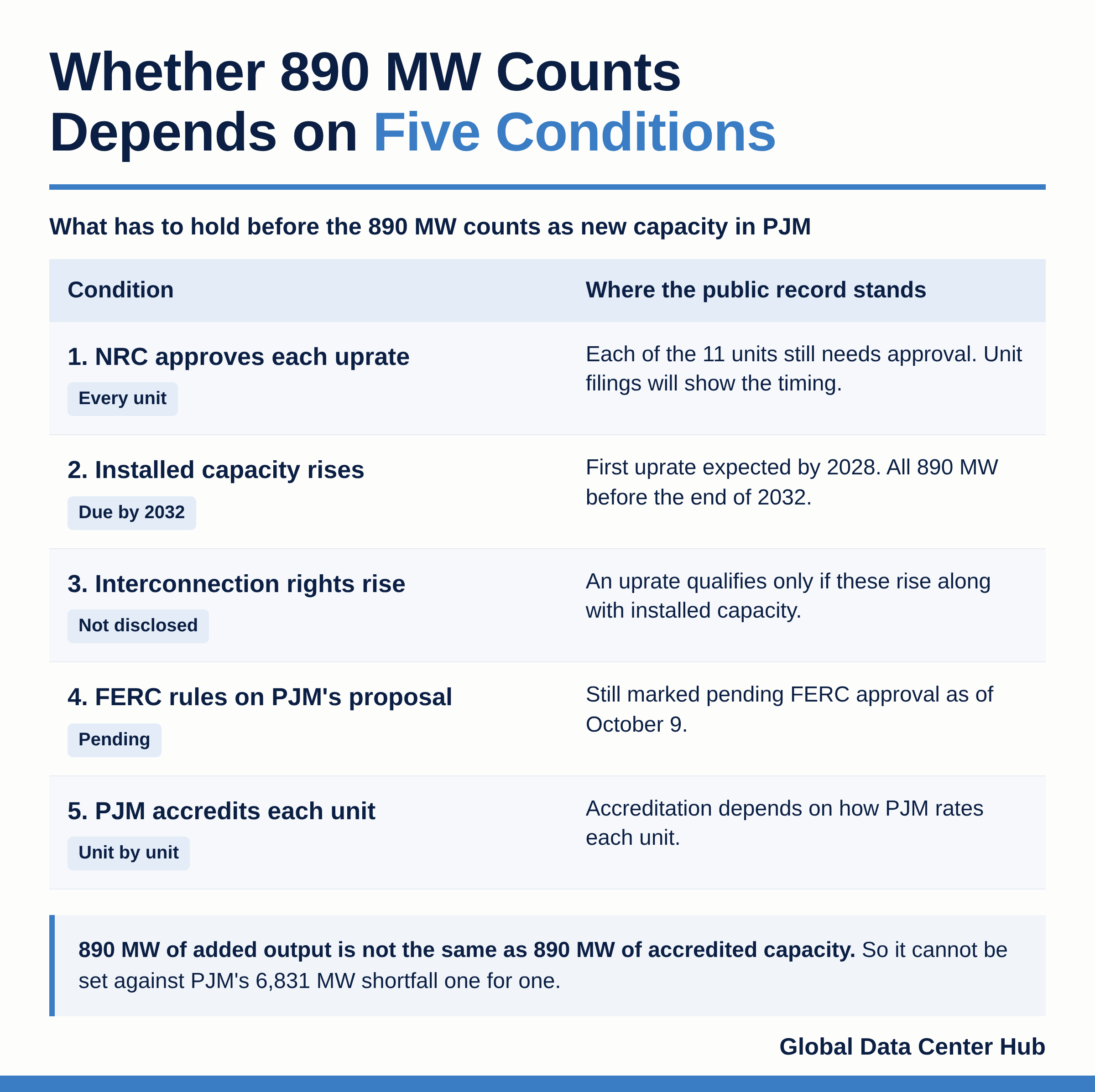
PJM has proposed new rules for large loads, filed with FERC as Docket ER26-3515-000. Under the proposal, a large load that brings its own new capacity can avoid an interim service that may curtail uncovered loads during grid emergencies. PJM calls this Bring Your Own New Capacity.
As of October 9, PJM’s large load page marked the registry and the interim service as pending FERC approval.
The Google and Constellation deal aligns with that proposal's direction.
According to POWER magazine’s review of the filing, an uprate qualifies when it raises both installed capacity and capacity interconnection rights. Capacity that has already cleared a PJM auction generally does not qualify, which shapes how the 2,700 MW agreement fits.
The registration path for the 890 MW will become clear as the rules and the unit filings move forward.
Accreditation is the second step to watch. PJM rates each unit to decide how much accredited capacity it provides. That rating lines up against the 6,831 MW shortfall.
Texas is wrestling with the same question, and one regulatory filing there matters more than the headline pause.
The Terms That Will Shape the Economics
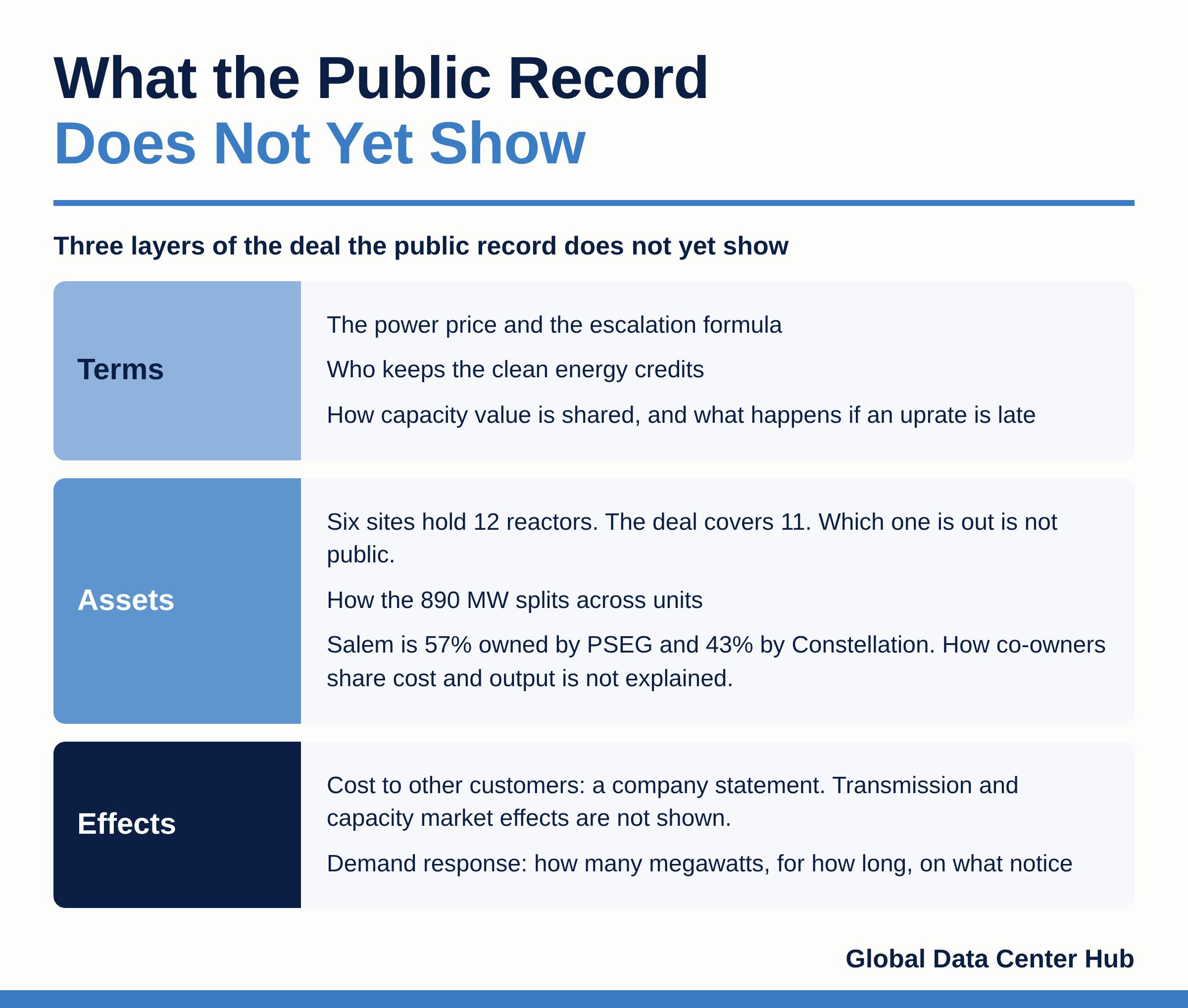
The commercial terms are private. The parties set the power price, the escalation formula, the treatment of clean energy credits, how capacity value is shared, and the timing provisions.
Those terms will decide the return on Constellation’s $4.3 billion and Google’s delivered cost of power. The 20-year term already tells you something useful. It aligns the revenue period with a long-lived capital program, making the work easier to finance.
The asset list will fill in over time. A Constellation spokesperson named six sites to the American Nuclear Society: Braidwood, Byron, LaSalle, and Quad Cities in Illinois; Limerick in Pennsylvania; and Salem in New Jersey. Those sites hold 12 reactors, and the deal covers 11. The unit list and the split of the 890 MW across units are the next disclosures to look for.
Salem has shared ownership. PSEG owns 57%, and Constellation owns 43%. How the co-owners share costs and added output is another detail to watch.
On cost to other customers, Google says the deal comes at no cost to other ratepayers. Constellation ties it to the federal Ratepayer Protection Pledge. Transmission work and capacity market results will show how that plays out across the system.
The demand response terms matter too. The number of megawatts Google can cut, for how long and on what notice, will show how much flexibility the deal adds in a grid emergency.
Uprate Deals Are Becoming A Pattern
I would read this deal as part of a series. One week earlier, on September 30, Amazon and Constellation signed a 20-year agreement at Calvert Cliffs in Maryland. It covers 690 MW, including a 190 MW uprate, backed by more than $3 billion of investment.
POWER also lists a 176 MW Walmart agreement at Dresden that includes 30 MW of uprates, and a proposed Google arrangement with Georgia Power for about 96 MW of uprates at Vogtle and Hatch, subject to state approval.
Google says its uprate and restart deals have enabled more than 1.5 GW of new nuclear capacity in the U.S. That sits beside a planned restart of the Duane Arnold plant in Iowa with NextEra and an advanced reactor program with Kairos Power. Each runs on its own timeline, and uprates come first.
The shape is clear. Large buyers sign long contracts, and plant owners use that revenue to add output at reactors already on the grid.
The Lesson Travels Further Than the Reactors
The Bankability Gap is the distance between capacity that is announced and capacity that can secure power, financing, permits, equipment and customers. This deal closes much of that gap in a specific way. The 20-year contract answers the financing question. The existing sites answer most of the land and grid questions. Licensing and the PJM rule remain.
That is why the model travels in two forms.
In markets with nuclear fleets, like Canada, South Korea, Japan and parts of Europe, the asset itself may repeat. There may be output to add inside plants that already run, paid for by a long contract with a large buyer.
In most of the Gulf, Africa, Latin America and Southeast Asia, the contract is the part that travels. A creditworthy buyer signs a long offtake. That offtake pays for new supply on the shared grid. The buyer also agrees to cut load when the grid is under stress.
That second form matters most for emerging markets. The International Energy Agency reports that emerging and developing economies outside China hold about half the world’s internet users but less than 10% of global data center capacity. Reliable power is the condition it names first.
What to Watch Next
Watch FERC. Its ruling on PJM’s large load rules will decide how bilateral deals like this one count as new capacity.
Watch the NRC docket. Unit-level applications will show which reactors, how much added power each one gets, and when.
Watch 2028. The first uprate is the first real test of the schedule.
And when you read “new capacity” in the next power deal, check two things before you count it. Is the output added, or already flowing? And how will the grid operator accredit it?
Good piece, and the 890 versus 2,700 split is the right place to start.
One update since you wrote it. FERC ruled on ER26-3515 on Friday 9 October. It rejected the interim service and the bring-your-own-new-capacity rules and kept only the 50 MW definition and the registry, both effective today. Its reason was jurisdiction: the tariff put obligations on retail customers and chose who gets curtailed, which FERC says belongs to the states. PJM has 30 days to file the stripped-down version. So the two-part uprate test you cite was PJM’s proposal, and for now it’s gone. The contracts signed under it stand.
The market’s answer to your question is already in. I ran the price test on every hyperscaler contract with an existing nuclear plant since Three Mile Island: what did the seller’s stock do on the day? The deals that fund new megawatts moved it: Constellation 22% on Crane and 12% on Google’s upgrades; Vistra 10% on Meta’s. The deals for existing output alone didn’t move it: Clinton flat, Comanche Peak down 4.5%, Dresden down 1.9%. The market paid for the 890, not the 2,700. Your “added or already flowing” test is the one investors have been applying.
The detail I’d add to your watch list is Salem. PSEG owns 57%. How the co-owners split the $4.3 billion and the new output decide what Constellation’s share of that reactor is worth.
What's interesting here is that the story isn't really about finding more uranium or building a new reactor. It's about unlocking additional capacity from infrastructure that's already operating. The next chapter will be regulatory: whether the NRC approves the uprates and how FERC and PJM ultimately treat that capacity. If those decisions go favorably, this could become a template for meeting large-load growth faster than building entirely new generation.