

Welcome to Global Data Center Hub. Join investors, operators, and innovators reading to stay ahead of the latest trends in the data center sector in developed and emerging markets globally.
TL;DR
Governor Greg Abbott directed the Public Utility Commission of Texas and the Electric Reliability Council of Texas on August 3, 2026, to audit every data center in the ERCOT interconnection queue before any additional project advances. ERCOT is processing more than 1,800 large-load requests totaling approximately 474 gigawatts, roughly 90 percent of it data centers. The audit covers 250 to 300 Batch Zero projects and reports on December 10, 2026.
PUCT Docket No. 59220, decided July 24, 2026, imposed a cumulative 525.5-megawatt emergency curtailment obligation on two co-located data centers sitting behind a single 265.5-megawatt wind facility. The commission held that curtailment on a co-located load is not capped by the paired generator’s capacity. The conditions are uncompensated and attach to the physical asset.
The Batch Zero financial security schedule, not the audit, is what clears the 474-gigawatt queue. Developers post a default 50,000 dollars per megawatt and forfeit 80 percent of it on withdrawal or a six-month milestone miss. ERCOT will not meet the April 9, 2027, study deadline and has proposed no replacement date.
Part One: The Record
Governor Greg Abbott directed the Public Utility Commission of Texas and the Electric Reliability Council of Texas to audit every data center advancing through the ERCOT interconnection process on August 3, 2026.
The instruction came by letter to PUCT Chairman Thomas Gleeson and ERCOT Chief Executive Pablo Vegas, and it stated that any project failing the review must be denied connection to the Texas grid.
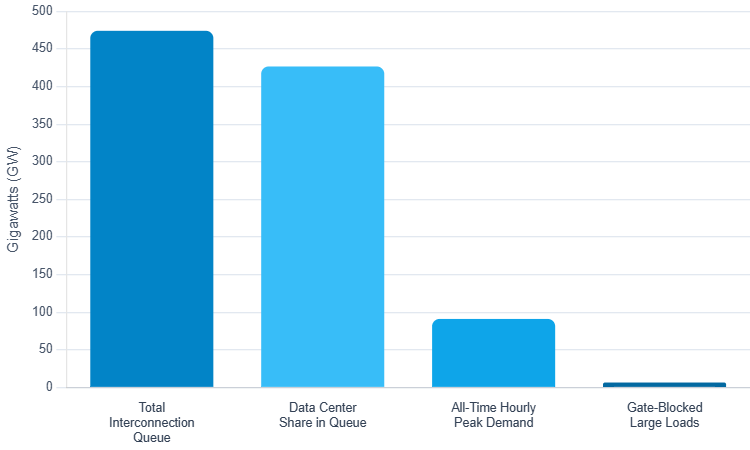
ERCOT is processing more than 1,800 large-load interconnection requests totaling approximately 474 gigawatts, and roughly 90 percent of that volume is data centers.
ERCOT suspended its Batch Zero classification process the same day and filed for regulatory relief seven days later.
Queue Volume And Disclosure Requirements
The 474 gigawatts is more than five times the all-time hourly peak of 91,089 megawatts that ERCOT recorded on July 22, 2026.
ERCOT delivered the 90 percent data center share in testimony to the Texas Senate on July 29.
Abbott also cited the failure of some data centers to comply with the PUCT survey measuring water and power usage under the General Appropriations Act.
The directive requires every project to disclose five categories of information.
These cover public financial assistance, projected annual and peak electricity use, on-site generation, water use and cooling technology, community impact mitigation, and ownership and control.
Batch Zero Suspension And Good Cause Exceptions
ERCOT’s August 3, 2026, Market Notice confirmed it would not deliver Batch Zero large-load classification notices to transmission and distribution providers by the August 7 deadline.
Batch Zero is the system-wide interconnection study the PUCT approved on June 18, 2026, for loads of 75 megawatts and above.
ERCOT filed for three good cause exceptions on August 10, 2026, under PUCT Project No. 59142.
It sought relief from the August 7 classification deadline, permission to include unclassified base-load candidates in the August and November Quarterly Stability Assessments, and a 24-day window to cure dynamic-data deficiencies.
The PUCT granted all three on August 20, 2026, and approved conditional classification by August 31.
ERCOT also told the PUCT it has paused approvals to energize large computational loads, the category covering data centers and cryptocurrency mining facilities.
Seventeen large loads representing approximately 6.6 gigawatts of peak demand ramping over five years have cleared every ERCOT gate except the approval to energize.
Audit Scope And Reporting Timeline
The audit covers approximately 250 to 300 projects in the Batch Zero cohort rather than the full queue.
Most are data centers. ERCOT General Counsel Chad Seely described the effect of the letter as moving verification to the front of the line, ahead of the interconnection study.
ERCOT issues requests for information through interconnecting utilities in August and September 2026, with information gathering and cure periods running through October and November.
ERCOT files the Batch Zero Eligibility Verification Report and the Community Impact Review Report on December 10, 2026, and presents both at the PUCT open meeting on December 17.
ERCOT stated it will not meet the April 9, 2027, deadline to deliver Batch Zero study results and has not proposed a replacement date.
Part Two: The Read
The Binding Term Was Set Ten Days Before The Freeze
The number that governs Texas data center underwriting is 525.5 megawatts, and the PUCT fixed it on July 24, 2026, ten days before Abbott wrote his letter.
In Docket No. 59220 the commission imposed a cumulative 525.5-megawatt emergency curtailment obligation on two co-located data centers sitting behind a single 265.5-megawatt wind facility.
Coverage of the August 3 pause has treated behind-the-meter co-location as the route around the interconnection queue, and Docket 59220 was decided, published, and analyzed without that implication being drawn.
A developer who reads the pause as a timing problem and co-location as the answer is acquiring an asset whose shutdown obligation is sized by the grid rather than by the generator it paired with.
Curtailment Is Sized Against The Grid, Not The Generator
FGE Goodnight I and Crusoe Energy Systems applied on January 9, 2026, to net meter Goodnight Wind, an existing 265.5-megawatt facility in Armstrong County, with Crusoe Load Two, a 260-megawatt AI data center developed with Google.
Crusoe transferred the load to Ensign Infrastructure, a special purpose vehicle, in March.
Docket No. 58881 had already placed a 265.5 megawatt 30-minute curtailment obligation on the adjacent Crusoe Load One, and ERCOT recommended stacking a second full obligation on Crusoe Load Two.
Ensign, Crusoe, and Goodnight Wind called this double counting. The PUCT disagreed.
Both loads net behind the same point of interconnection, so curtailing one and not the other lets the other absorb the wind output and keeps the generator off the grid.
The obligation is uncompensated. Co-located loads are barred from paid demand response, ancillary services, Emergency Response Service, and utility load management programs.
The conditions attach to the physical assets and bind successors in interest. A joint review falls due between 36 and 60 months.
The commission dismissed Crusoe’s argument that repeated 30-minute shutdowns damage server hardware, calling it a commercial trade-off accepted for faster interconnection.
Over the next four to eight quarters co-location stops being a queue workaround and becomes a curtailment liability that travels with the title.
Full islanding remains outside the ERCOT interconnection process entirely.
The 933 megawatts of off-grid gas turbines already under construction at that same Armstrong County site is the structure the market moves toward.
Posted Security Turns A Queue Slot Into A Priced Position
The second mechanism sits inside Batch Zero.
Where upgrade costs cannot be determined, developers post financial security at a default 50,000 dollars per megawatt.
All direct interconnection costs are paid in cash through contribution in aid of construction, with no offset, and the interconnecting utility cannot recover them through PUCT-regulated rates.
A developer who withdraws, or who misses a phased energization milestone by six months, forfeits 80 percent of posted security to the utility’s rate base.
The remaining 20 percent returns on energization and after five years of operation.
A materially false eligibility attestation makes a project ineligible outright.
That regime, not the audit, clears the 474 gigawatts. An audit of 250 to 300 projects tests disclosure.
The security schedule tests conviction, and it prices a queue slot that used to be free.
When the December 10 report lands, the number worth watching is not how many projects passed.
It is the gap between requested megawatts and posted megawatts, the first honest measure of how much of the Texas pipeline was ever real.
December 10 Is Reversible. April 2027 Is Already Gone.
Read the calendar and the audit is the reversible part.
Seely told the commission the verification work was already scheduled under Batch Zero and the letter moved it to the front of the line.
Gleeson framed the goal as more confidence in the process. The PUCT granted every exception ERCOT requested.
What has actually slipped is the study. ERCOT will not deliver Batch Zero study results by April 9, 2027, and has proposed no replacement date.
That pushes the Long-Term Load Forecast and the Reliability Assessment, and it puts the December 2026 Capacity, Demand and Reserves Report at risk.
BloombergNEF put the delay cost at just over 8 billion dollars by the first quarter of 2027 at a 60 percent AI-compute mix, and near 15 billion at a full AI mix.
Those are revenue estimates on slipped capacity, not write-downs.
Megawatt allocations, not audit clearance, set build dates. A project can pass in December and still not know what it was allocated.

What Each Segment Prices Before December 17
Private Capital should reprice every co-located Texas position against an uncapped curtailment obligation rather than a proportional one and treat the conditions as attached to the asset in any change of control.
Diligence the 36-to-60-month review clock.
Firms underwriting co-location on the pre-59220 assumption are paying an islanded-asset price for a curtailable one.
Public Markets holders own the disclosure gap. Seventeen large loads representing 6.6 gigawatts sit at the final gate, and no operator has said which of them are theirs.
Ask on the next call whether guided 2027 energization dates assume an April 2027 study result ERCOT has already withdrawn.
Waiting for December 17 means repricing after everyone else hears the same date.
Operators face the most expensive choice. Post the security, answer the request for information inside the cure window, and price a fully islanded configuration in parallel rather than sequentially.
Developers who treat the pause as a reason to slow down concede allocation priority to those who use the same four months to lock generation and cure their filing.
The Doctrine Outlives The Audit
The audit ends. The curtailment doctrine does not.
December 10 closes a disclosure exercise Texas regulators designed to close, and the market will read that report as the end of the pause.
The durable change came July 24, when the PUCT ruled that emergency curtailment is measured against grid needs, not paired generation, and applied the condition for the asset’s economic life.
Every behind-the-meter structure in Texas now carries a shutdown obligation its financial model was probably not built to hold.
The question for the next two quarters is whether the first co-located project to trade does so at a discount to its islanded neighbor, because that is the moment the doctrine gets priced rather than discussed.
"That pushes the Long-Term Load Forecast and the Reliability Assessment, and it puts the December 2026 Capacity, Demand and Reserves Report at risk."
And this will affect the timing of the 765 kV build. And time is absolutely not on the side of those projects. It just gives more time for the public backlash to grow.
One important clarification: The security deposit forfeit is only 20%. They proposed 80% initially, but this got flipped in April-May of this year. All the details are in PUC Case 58481.