
Welcome to Global Data Center Hub. Join investors, operators, and innovators reading to stay ahead of the latest trends in the data center sector in developed and emerging markets globally.
Every answer from an AI chatbot comes from a data center that has to stay on every second of every day.
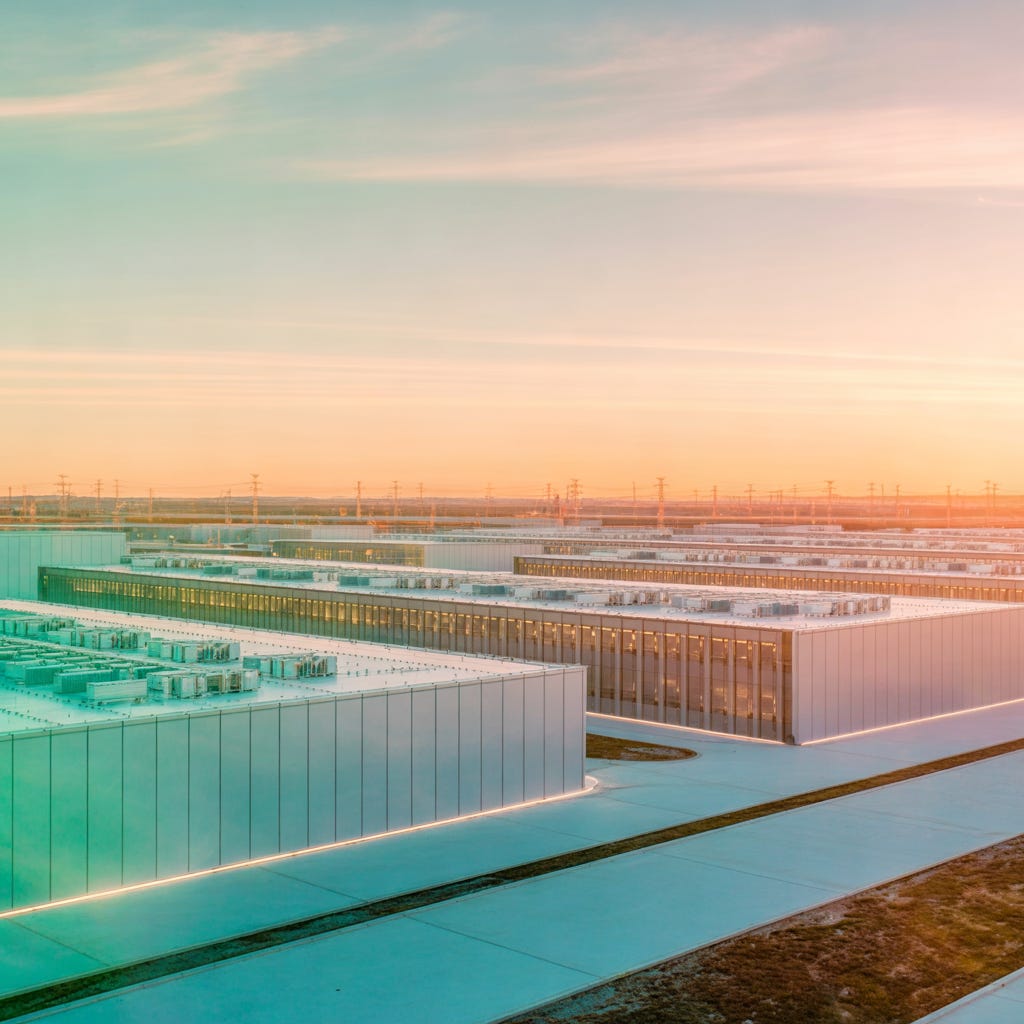
A bitcoin mine looks almost the same from the road: a big metal building, a thick power line, rows of humming computers. It is built around the opposite habit. A bitcoin mine is built to switch off.
Core Scientific found that gap in Denton, Texas, north of Dallas.
The company, which described itself in June 2024 as one of North America's largest bitcoin mining operators, partly built a mining site in Denton in 2021.
It stopped construction there in December 2022, it told the Denton Record-Chronicle, during a bankruptcy it left in January 2024.
On June 3, 2024, Core Scientific signed 12-year agreements to host about 200 megawatts of computing for CoreWeave, a company that rents out AI computing power built on NVIDIA chips. The plan was to turn mining sites into AI data centers.
In September 2024, Core Scientific moved the last mining machines out of two sites marked for the switch.
Then its crews began tearing out the cabling, power units, and racks the miners had used, the company said on October 7, 2024. In February 2025, CoreWeave expanded the Denton deal to just over 260 megawatts.
On May 7, 2025, Core Scientific said the first 8 megawatts at Denton would be ready by the end of that month. It said it was on track to deliver 250 megawatts across its sites to CoreWeave by the end of 2025.
The schedule slipped. On November 10, 2025, CoreWeave cut its 2025 sales forecast to $5.05 billion to $5.15 billion, blaming one outside developer that was behind schedule.
In December 2025, The Wall Street Journal reported, citing people familiar with the project, that the site was Denton, where rain and wind had stopped concrete work for about 60 days that summer.
By March 2, 2026, Core Scientific reported more than 185 megawatts billing across its sites, short of the 250 it had expected by the end of 2025.
That month it also restated earlier results, because it had kept counting mining equipment marked for demolition as an asset. By July 28, 2026, Denton was billing about 260 megawatts, about two years after the first CoreWeave deal.
Denton fits a repeating pattern. Bitcoin miners hold large power connections, and AI companies want power fast.
The connection carries over, while much of what was built around it was made for a different job.
A Bitcoin Mine Is Built to Switch Off
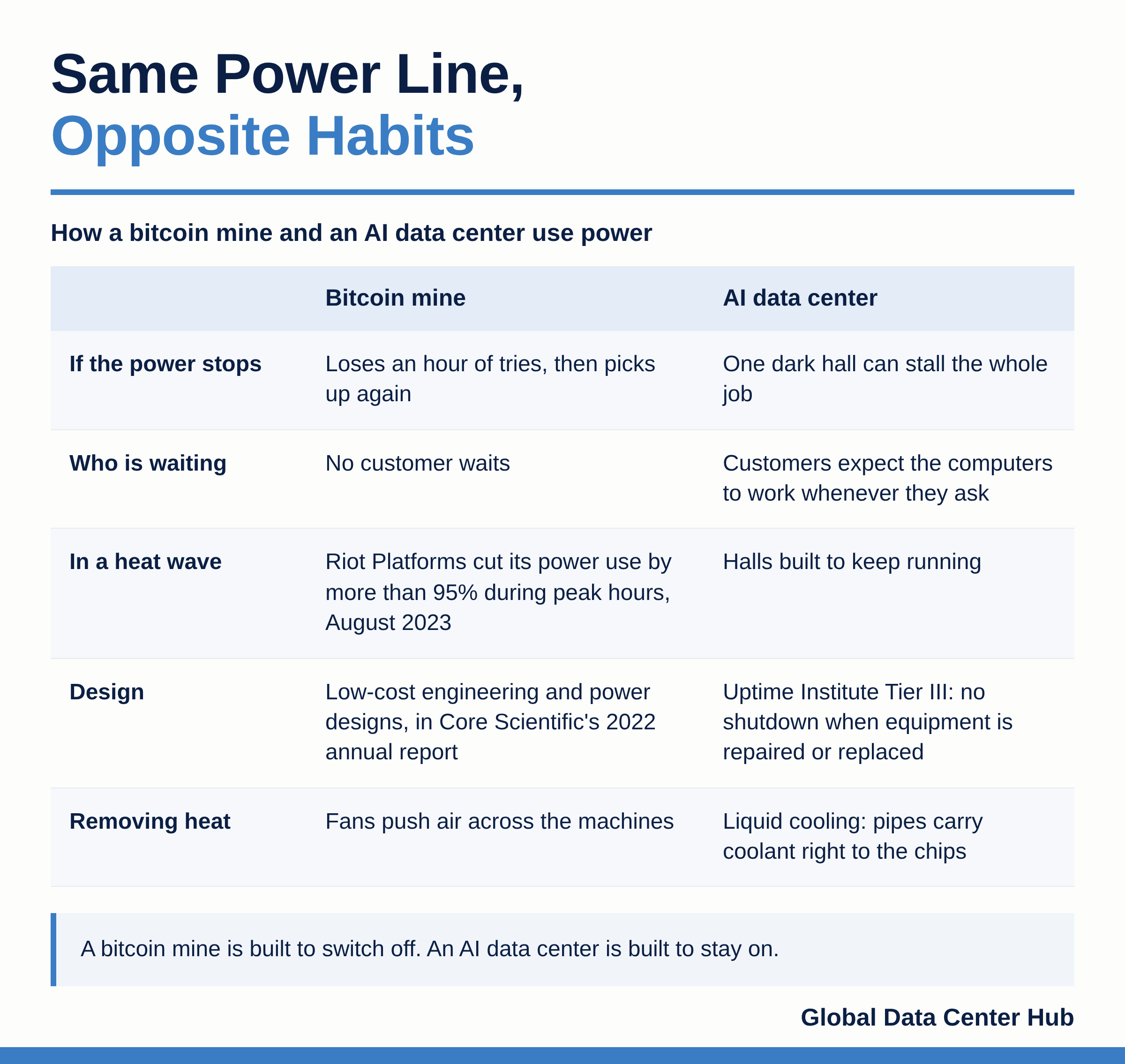
A bitcoin mine and an AI data center use power in opposite ways. A mining machine is a box of chips that does one task: it races other machines to solve a math puzzle, and the winner earns new bitcoin. If it stops for an hour, it loses an hour of tries and then picks up again. Nothing breaks, and no customer waits.
That makes switching off useful. During a Texas heat wave in August 2023, Riot Platforms, another large bitcoin miner, cut its power use by more than 95% during the hours of peak demand.
It returned the power to ERCOT, the operator of most of the Texas grid.
Riot reported an estimated $31.7 million in credits for that month, according to its September 6, 2023, release.
Core Scientific built its mines for the same purpose. Its 2022 annual report described its sites as purpose-built for bitcoin mining machines, with low-cost engineering and power designs.
Its filings describe handling heat through airflow, meaning fans push air across the machines.
An AI data center runs the other way. CoreWeave rents its computers to customers who expect them to work whenever they ask. Training an AI model links huge numbers of chips together, so one dark hall can stall the whole job.
Uptime Institute, which runs a widely used data center rating system, describes Tier III as a building that needs no shutdown when equipment is repaired or replaced. A Tier I building must shut down completely for repairs.
Reaching the higher level takes a spare at every step: extra electrical paths, backup batteries, and backup generators. GDCH has covered how those backup generators add up.
Heat adds a second rebuild. In its October 2024 update, Core Scientific said it would deliver power equipped with advanced liquid cooling built for AI chips.
Liquid cooling means pipes that carry coolant right to the chips, because the newest AI chips run too hot for fans alone. I have explained why AI chips need that plumbing.
The Power Line Carries Over, the Halls Come Down
A newcomer could fairly assume that a bitcoin mine is most of an AI data center already. It has the big power connection, the building, and rooms full of computers.
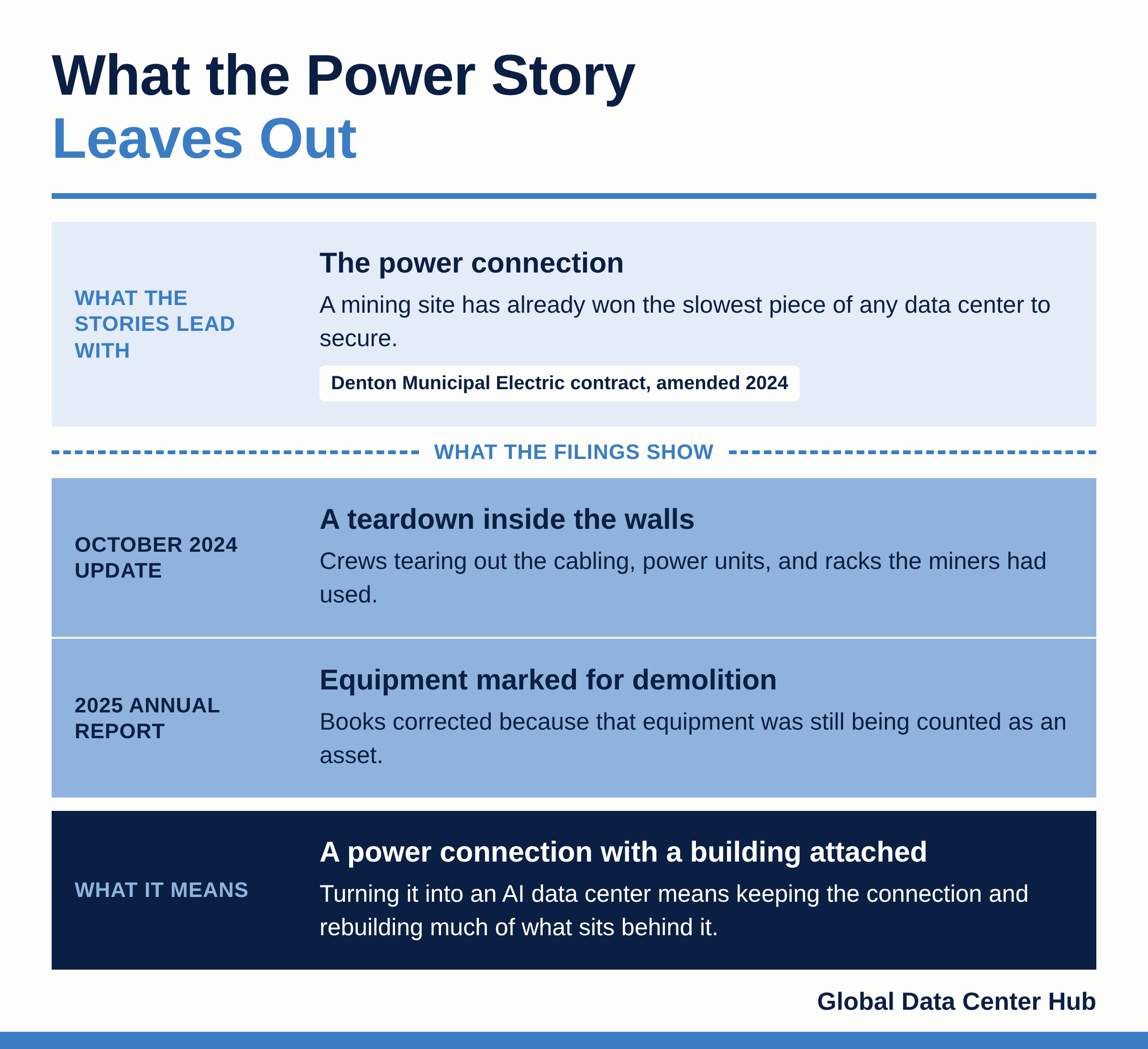
That belief rests on something real. Power is the slowest piece of any data center to secure, and a mining site has already won it.
Denton’s site ran on a contract with Denton Municipal Electric, the city-owned utility, and the Denton City Council amended that contract in 2024 so the power could serve AI computing.
Stories about miners moving into AI usually lead with that power.
Core Scientific’s own filings show what the power stories leave out. Its October 2024 update described crews tearing out the cabling, power units, and racks.
Its 2025 annual report corrected its books because it had counted equipment marked for demolition as an asset. Those two documents describe a teardown inside the walls.
A bitcoin mine is a power connection with a building attached. Turning it into an AI data center means keeping the connection and rebuilding much of what sits behind it.
About Two Years to Remake One Texas Campus
The rebuild takes years because each step must finish before the next starts. The old machines come out first. Then the racks, cables, and power units that fed them come out too.
New foundations go in, and in Denton the weather alone cost about 60 days of concrete work in the summer of 2025, The Wall Street Journal reported.
Then come the spare electrical paths, the backup equipment, the liquid cooling, and weeks of testing before a customer moves in.
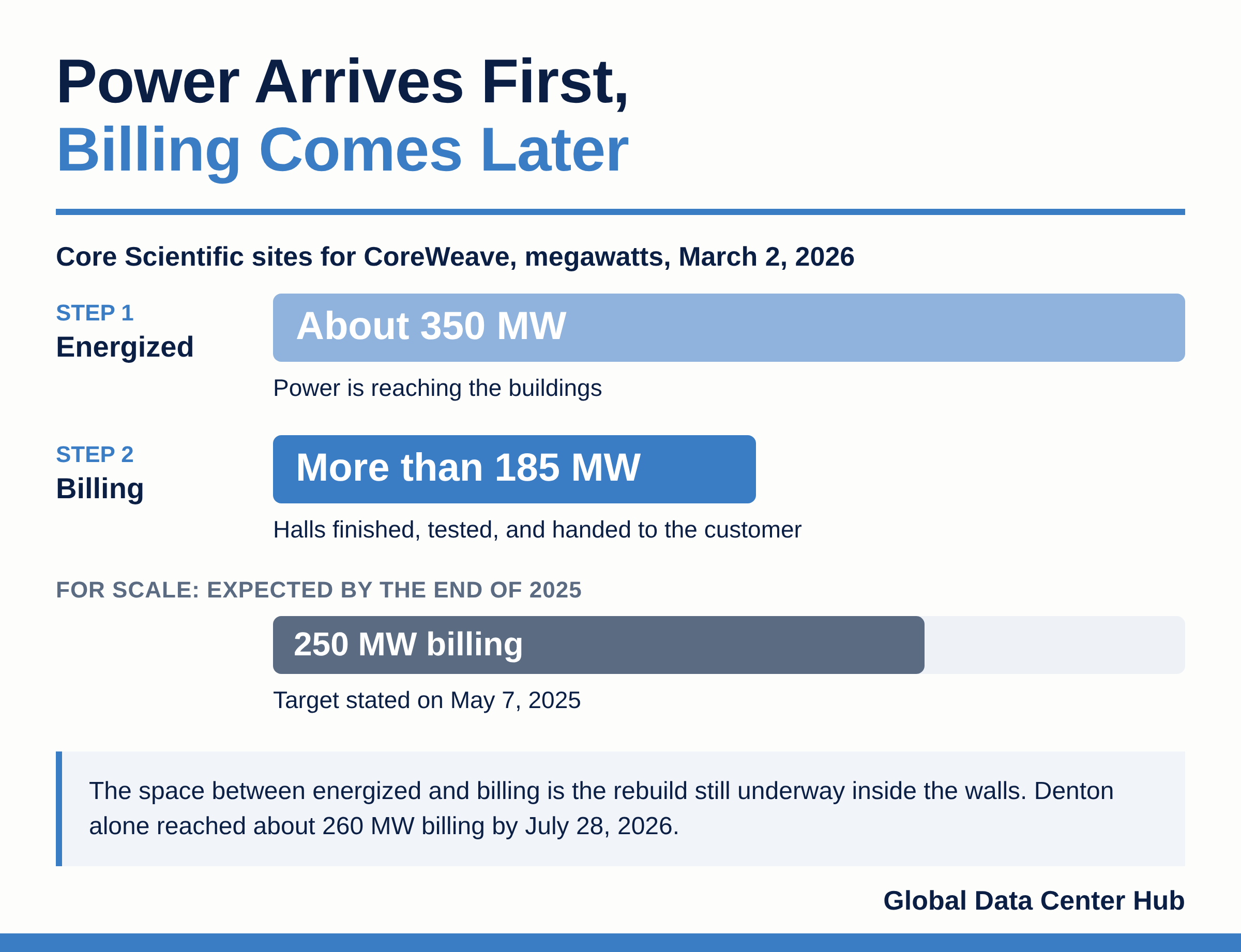
Core Scientific’s own numbers show where the time goes. On March 2, 2026, it reported about 350 megawatts energized across its sites, with more than 185 megawatts billing.
Energized means power is reaching the buildings. Billing means a hall is finished, tested, and handed to the customer. The space between those two numbers is the rebuild still underway inside the walls.
The next conversion runs on the same kind of clock. On its March 2, 2026, call, Core Scientific said it was moving forward with converting its mining site in Pecos, Texas.
Its July 28, 2026, slides said the first delivery there for chipmaker AMD was expected in early 2027.
From Denton City Hall to the AI You Use
If you live near a mining site, the switch to AI comes through a public vote. In November 2024, Denton’s public utilities board and City Council took up new terms for Core Scientific’s power contract and land lease.
City officials said the company asked for no tax breaks or other incentives, the Dallas Morning News reported.
The same power line that once fed machines built to step back during a heat wave now feeds halls built to keep running.
If you follow AI, the rebuild explains why new computing power arrives later than the deals suggest. CoreWeave signed for the capacity in 2024.
One delayed building was enough to push its November 2025 sales forecast back, and the AI tools that run on that capacity waited for the concrete with everyone else. If you work in construction or electrical trades, these conversions are building jobs.
Crews in Denton lost roughly two months to rain and wind before they could raise the halls.
Four Clues a Data Center Is Changing Jobs
Start with the word “conversion” in a company announcement. When a miner says it is removing racks, cabling, and power units, as Core Scientific did in October 2024, it's rebuilding the building from the inside.
These details show up in monthly updates and quarterly releases.
Next, watch the city agenda. When a utility board or council amends a power contract to serve AI computing, as Denton did in 2024, the site is changing jobs.
City councils post these agendas publicly, often a week or more before the vote.
Then compare energized megawatts with billing megawatts. A large gap, like Core Scientific’s 350 against 185 in March 2026, means the power has arrived while the rebuild is still underway.
Both numbers appear in quarterly investor slides.
Finally, read the customer’s forecast. When an AI company blames an outside developer for a delay, as CoreWeave did in November 2025, a building somewhere is behind.
That shows up first in earnings calls, and reporters often name the site later.
Every Data Center Is Drawn for One Job
The chatbot answer feels like it came out of nowhere.
It comes from a building drawn around one habit, staying on, and Denton shows how long it takes to teach a building that habit. AI chips keep changing too.
When the next kind of computing arrives, how many of the halls finished in 2026 will need to rebuild themselves?