
Welcome to Global Data Center Hub. Join investors, operators, and innovators reading to stay ahead of the latest trends in the data center sector in developed and emerging markets globally.
In late 2022, Meta wrote off $1.3 billion of data center work to redesign for AI heat.
The newest AI racks are cooled with liquid, while most data centers run far cooler machines.
Every ChatGPT answer ends the same way. It becomes heat.
The chips that write the answer run on electricity, and almost all of that electricity leaves the building as warmth. For decades, data centers moved that warmth out with fans and cold air.
The newest AI chips run hot enough that the buildings around them need pipes.
Meta, the company behind Facebook and Instagram, learned this in the middle of a building spree.
Data Center Frontier, a trade publication, reported in April 2023 that Meta had dozens of data centers under construction. Many had been planned around ordinary computer chips.
In December 2022, Meta paused construction in Huntsville, Alabama; Temple, Texas; and Kuna, Idaho. It also dropped two of the three data centers it had planned near Odense, Denmark. On February 1, 2023, Meta told shareholders it had shifted to “a next-generation data center design” that could support AI.
Its results for the last three months of 2022 included $1.3 billion in charges for abandoned data center assets. In April 2023, Reuters reported that the new buildings would need liquid cooling to handle the heat of AI chips.
The redesign cost time and money. Temple and Kuna restarted about ten months after the pause, DatacenterDynamics reported on October 19, 2023.
The problem has kept growing since. A data center is planned around the chips of its day and built to run for decades, but AI chips change much faster.
The International Energy Agency reported in 2026 that AI server power density rose 11 times between 2020 and 2025.
A Shelf of AI Chips Gives Off 30 Boilers of Heat
The heat starts in the rack. A rack is a tall shelf, about the size of a refrigerator, that holds dozens of servers. A server is a desktop computer with the screen removed, flattened into a tray.
For most of the internet’s history, racks were cooled the way a person cools off in front of a fan.
Cold air blows across the front of the servers, picks up their heat, and leaves out the back. Machines outside the building then push that heat into the open air.
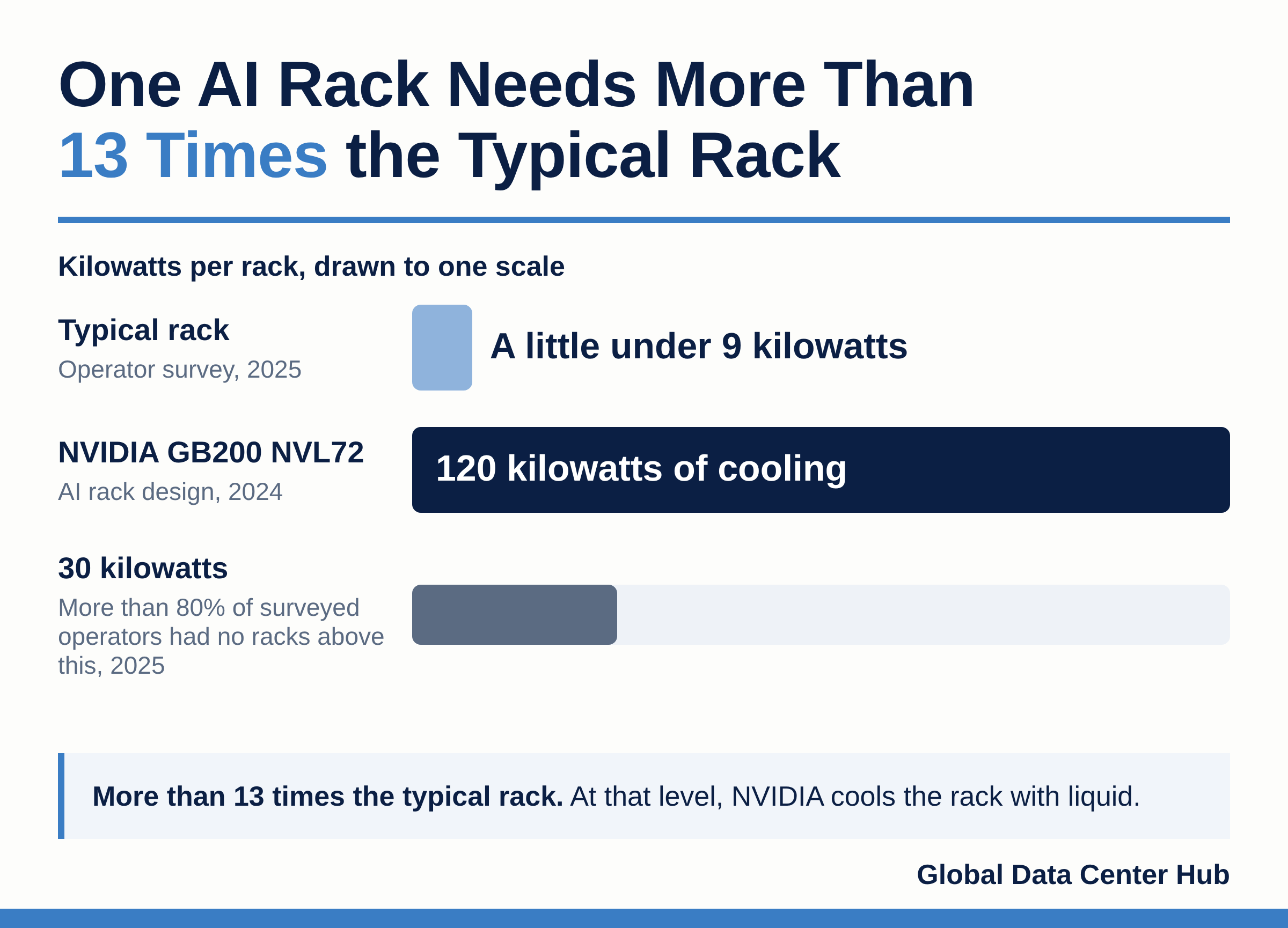
That works as long as the heat stays modest. Uptime Institute, a group that surveys data center operators every year, found in July 2025 that the typical rack in its survey drew a little under 9 kilowatts.
AI racks sit on another scale. NVIDIA, the company whose chips power the AI boom, designed its GB200 NVL72 rack to need 120 kilowatts of cooling, according to a design note it published on October 15, 2024.
That is more than 13 times the typical rack in Uptime’s survey.
The IEA put the same scale in plainer terms in its 2026 report: AI data centers must remove the heat of about 30 natural gas boilers from each rack.
At that level, NVIDIA cools the rack with liquid, much as a car radiator cools an engine.
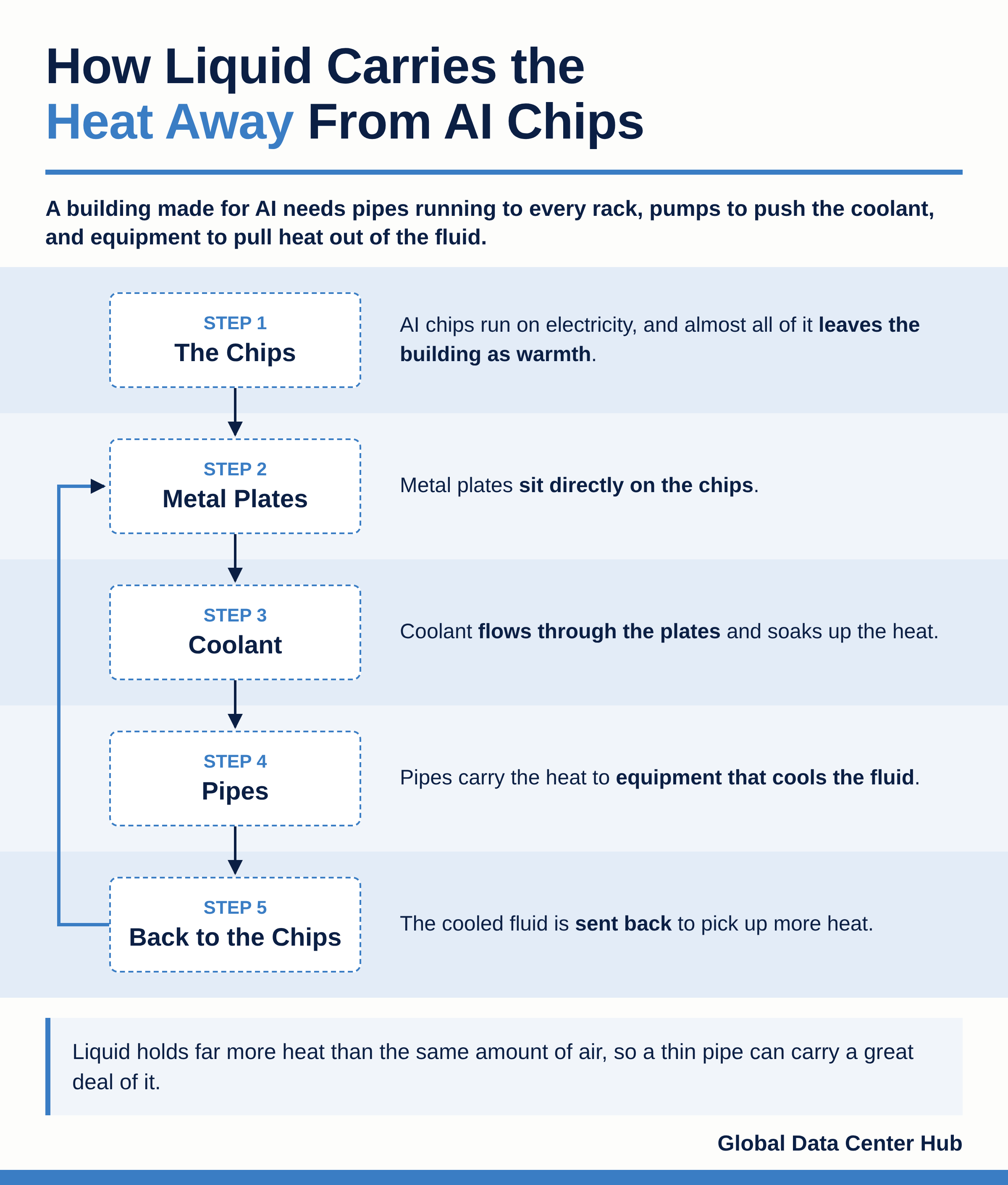
Metal plates sit directly on the chips. Coolant flows through the plates, soaks up the heat, and carries it through pipes to equipment that cools the fluid and sends it back.
Liquid holds far more heat than the same amount of air, so a thin pipe can carry much more of it.
So, a building made for AI needs pipes running to every rack, pumps to push the coolant, and equipment to pull heat out of the fluid. A building made for air has fans, open floors, and none of that plumbing.
Most Operators Still Run Racks Under 30 Kilowatts
A newcomer could fairly assume that a data center is a data center: a secure building full of computers, ready for whatever chips come next.
The assumption has history behind it. For years, upgrading a data center mostly meant sliding newer servers onto the same shelves, cooled by the same air.
News coverage also measures data centers in megawatts, a number that shows how much electricity a building can draw and leaves out how it removes the heat.
Two buildings with the same megawatts can look identical in a headline.
Uptime’s 2025 survey shows how far most buildings sit from the AI frontier. More than 80% of respondents said their facility had no racks above 30 kilowatts.
Next to NVIDIA’s 120-kilowatt rack, most of the buildings in that survey were set up for a different kind of machine.
The clearer picture of the data center world has two parts. A large group of buildings runs ordinary computing on air. A newer group is being built around liquid for AI.
Meta’s 2022 pause shows what happens when a company finds its plans sitting in the first group while its future needs the second.
Old Buildings Stay in Service for Decades
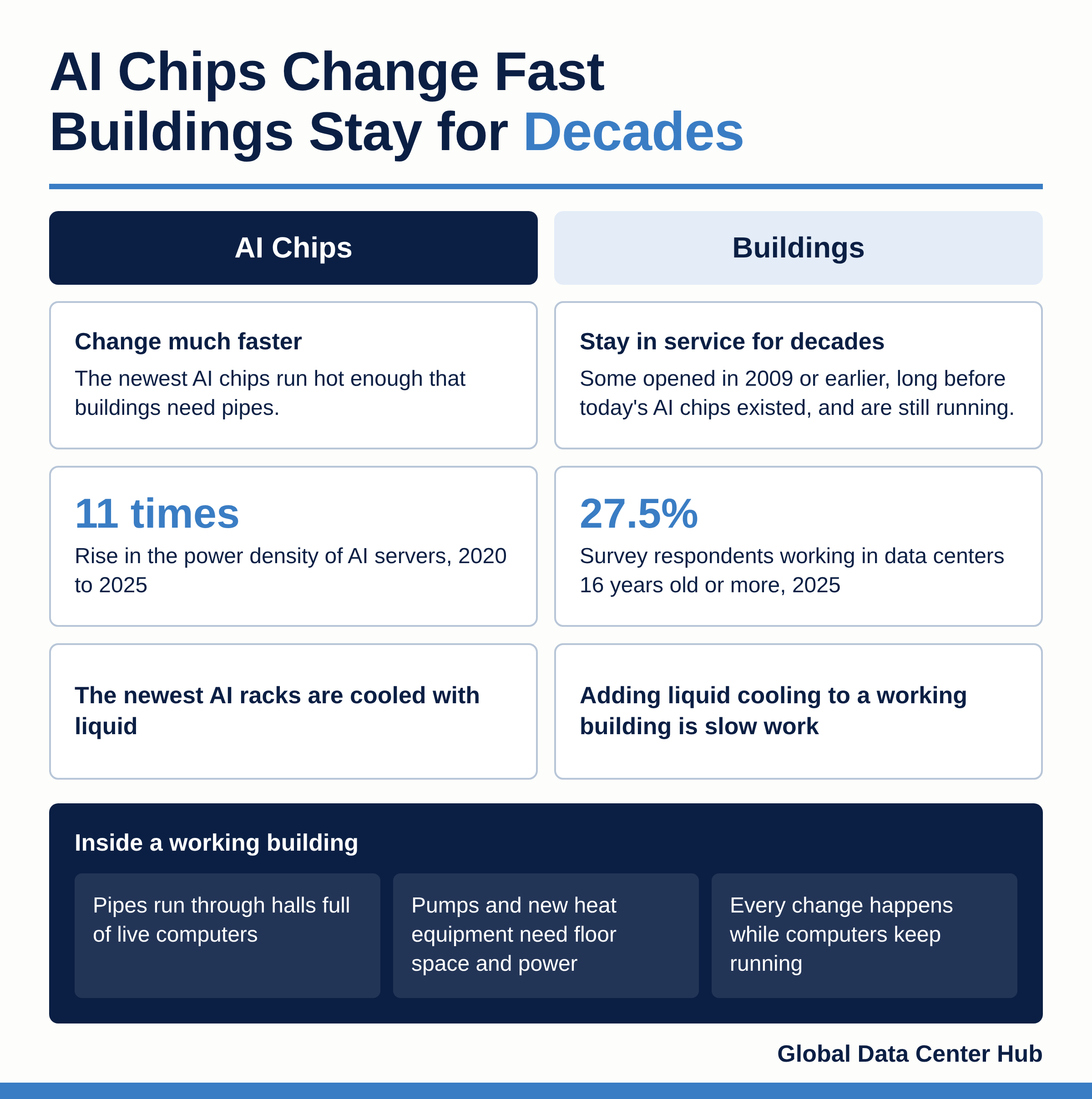
The fix takes years because buildings last much longer than chips. In Uptime’s 2025 survey, 27.5% of respondents worked in data centers 16 years old or older.
Those buildings opened in 2009 or earlier, long before today’s AI chips existed, and they are still running.
Adding liquid cooling to a working building is slow work. Pipes have to run through halls full of live computers.
Pumps and new heat equipment need floor space and power of their own. Every change has to happen while customers’ computers keep running inside.
Even new campuses lose time adjusting. Meta’s redesign delayed Temple and Kuna by about ten months.
Microsoft, the company behind Windows and a major AI cloud, paused early work on the second phase of its Mount Pleasant, Wisconsin, campus in January 2025.
It told The Register on January 3, 2025, that it was evaluating “scope and recent changes in technology” and how they “might impact the design of our facilities.”
On the same Wisconsin campus, Microsoft said in September 2025 that Fairwater would cool over 90% of the facility using a closed-loop liquid system. On June 23, 2026, it announced that its first Mount Pleasant data center was fully operational.
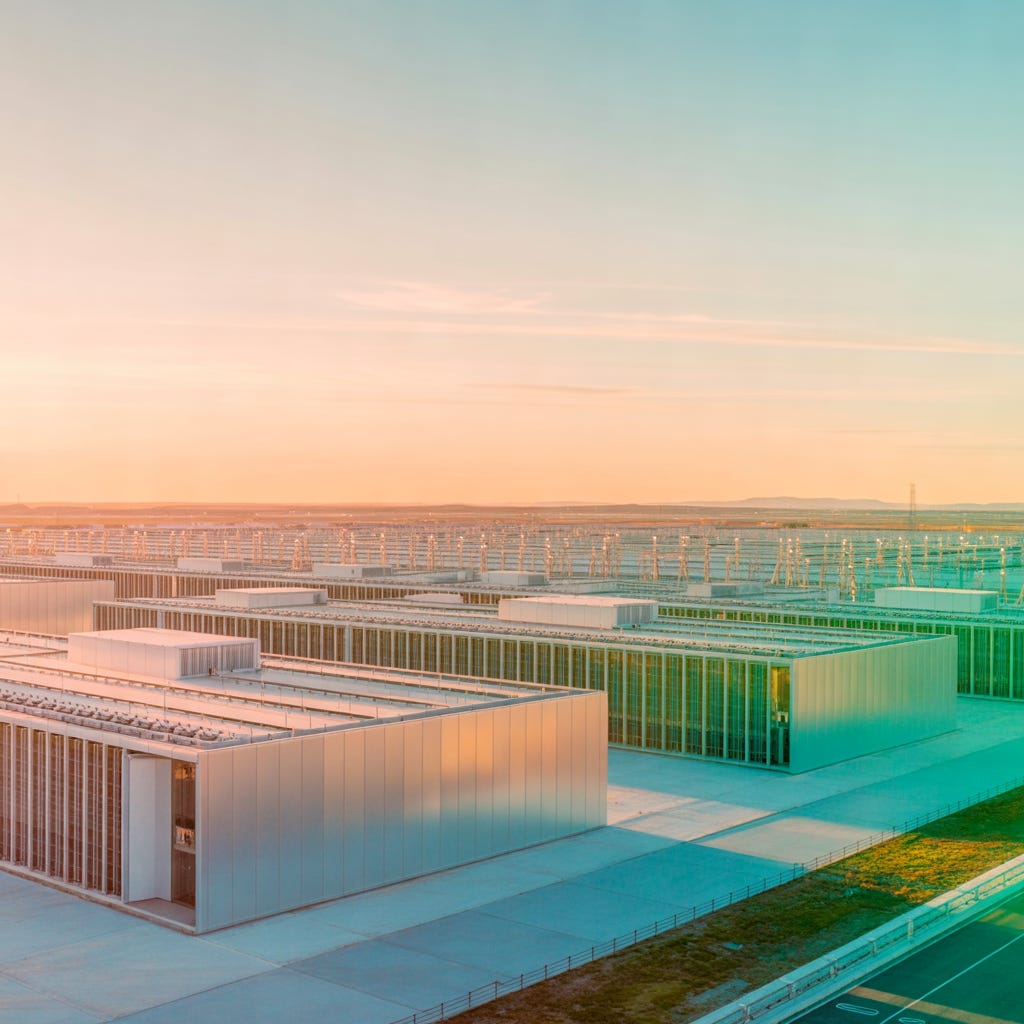
Why the Heat Problem Reaches the AI on Your Phone
If you follow AI news, the heat problem explains why a new chip takes time to reach you. A faster chip helps only once a building can cool it.
ChatGPT launched on November 30, 2022, and a few weeks later Meta stopped building to redraw its data centers for AI.
The next AI tools will run in buildings that can carry away their heat.
If you live near a planned data center, cooling shapes how much water it uses. Some cooling systems shed heat by evaporating water, like sweat cooling skin.
Closed loops keep the same fluid moving around a sealed circuit.
Microsoft said in September 2025 that Fairwater’s loop is filled once during construction and then reused, and that the building would use roughly the water a typical restaurant uses in a year. That figure is Microsoft’s own.
Many operators publish far less: Uptime found in 2025 that only 47% of operators collected water data at all. At a public hearing for a new data center, it's fair to ask about the cooling design.
Four Clues That Show a Data Center’s Cooling
Start with the cooling words in an announcement. Terms like liquid-cooled, direct-to-chip, and closed-loop mean the building was designed for AI-grade heat.
Microsoft used that language for Fairwater in its September 2025 post, and company blogs and press releases are where these words show up first.
Next, watch for a pause to change the design. Meta used those words for Huntsville in December 2022, and Microsoft pointed to “recent changes in technology” in Wisconsin in January 2025.
Both statements tied a construction pause to the building's design, and in Meta’s case, the new design was built for AI. Local news and company statements carry these pauses first.
Then look for a charge for abandoned data center assets in a company’s quarterly results. Meta’s $1.3 billion line for late 2022 showed in one number how much unfinished building it was leaving behind.
These lines sit in earnings releases and in filings with the US Securities and Exchange Commission.
Finally, compare the rack number in a chip launch with what buildings run today.
NVIDIA’s 120-kilowatt rack sits far above the typical rack, which runs at a little under 9 kilowatts, in Uptime’s 2025 survey. Chipmakers publish their rack designs, and Uptime publishes its survey every year.
The AI people use every day feels weightless. Underneath it sits a shelf giving off the heat of 30 boilers, inside a building that has to carry that heat away every second.
The buildings going up in 2026 are being planned for the chips of 2026. Will they still be able to cool the chips of 2030?