
Welcome to Global Data Center Hub. Join investors, operators, and innovators reading to stay ahead of the latest trends in the data center sector in developed and emerging markets globally.
When a storm knocks out the power at home, the lights go dark and the fridge goes quiet. When the same storm hits a data center, the email still loads and the AI chatbot still answers.
That steady service rests on something most people never see rows of diesel engines parked beside the building, waiting for the grid to fail.
In 2024, Amazon bought about 350 acres near Xcel Energy’s Sherco coal plant outside Becker, Minnesota, according to MPR News.
The plan called for a large data center and 250 diesel backup generators to keep it running through any outage.
Amazon asked the Minnesota Public Utilities Commission, the state board that oversees power plants, to waive a “certificate of need.”
State law requires that ruling before anyone builds a plant of 50 megawatts or more.
Amazon said its generators would never connect to the grid and would run fewer than 15 hours a year, Data Center Knowledge reported on March 3, 2025.
The commission disagreed. On February 28, 2025, it voted 4-0 to deny the exemption.
E&E News reported on March 4, 2025, that Amazon would have to prove the need for up to 600 megawatts of diesel generators. Data Center Frontier noted on March 7, 2025, that the total came close to the 647 megawatts of Xcel’s Monticello nuclear plant.
Then the project stopped. On May 23, 2025, MPR News reported that Amazon had suspended development in Becker while keeping the land. Amazon gave its own reasons.
A spokesperson cited uncertainty and said the company would move resources to projects that could add capacity faster. Whatever the cause, a campus the town had expected sat paused, with no new date.
Becker is one example of a pattern that grows with every new campus. A data center has to stay on when the grid fails, so each building gets its own backup. Bigger buildings need more engines. Counted one at a time, each engine looks small.
Counted together, they reach the size of a power plant, and the rules written for power plants start to apply.
Thirty Seconds of Batteries, Then the Engines Take Over
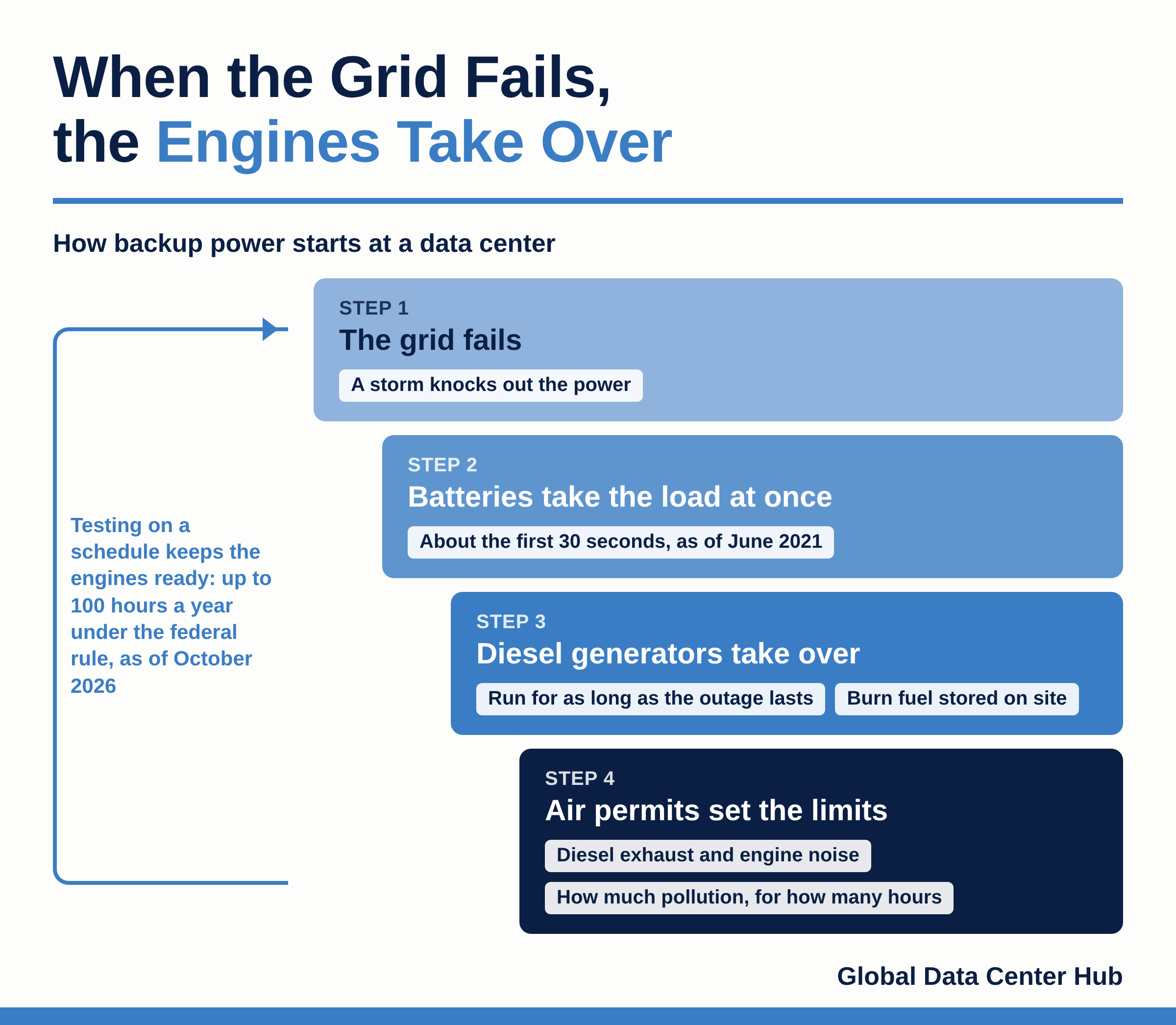
When the grid fails, the switch to backup happens in two steps. First, large banks of batteries take the load at once.
Microsoft explained in a June 1, 2021, post that these batteries cover roughly the first 30 seconds, the time a diesel generator needs to start.
Then the generators take over and run for as long as the outage lasts, burning fuel stored on site.
Most days, the engines sit idle. They still have to run on a schedule, because an engine that never starts in practice may fail on the day it is needed. So, crews start them for testing and upkeep.
The US Environmental Protection Agency’s rule for emergency engines, as published in October 2026, allows up to 100 hours a year of testing and maintenance, with no time limit during a real emergency.
Each start sends out diesel exhaust and engine noise. That is why the engines need air permits, the state approvals that set how much pollution a machine may release and for how many hours.
The counting question shows up outside the United States too. In England, a site whose engines together burn fuel at a rate of 50 megawatts or more needs an environmental permit from the Environment Agency, the national pollution regulator.
Amazon’s December 2024 permit application for its data center in Hayes, west London, covered 28 generators, according to the agency’s public consultation file.
A Backup Generator Sounds Small Until You Count Them
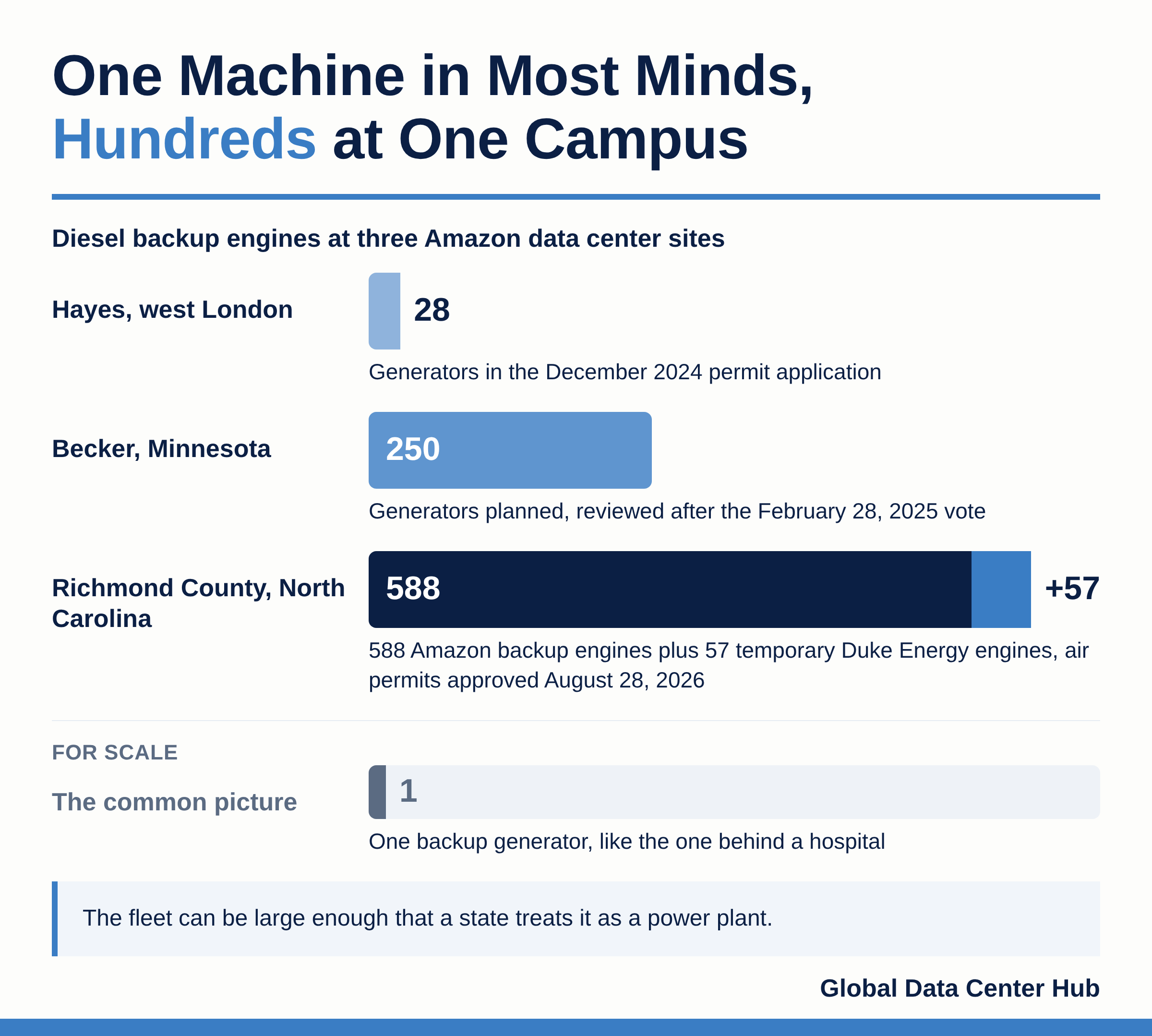
Most people picture a backup generator as one machine, like the one behind a hospital or in a neighbor’s garage. That picture is reasonable.
For most buildings, it is accurate. An office or a clinic might keep a single engine for emergencies. The word “backup” also suggests something that rarely runs, and data center engines do sit quiet most of the year.
Amazon estimated its North Carolina engines would run about 5 to 15 hours a year for testing and upkeep, WRAL reported on July 30, 2026.
The count changes the picture. Amazon’s planned campus in Richmond County, North Carolina, will have 588 emergency backup engines. Duke Energy, the local utility, will add 57 temporary engines to power the site until its grid connection is ready.
North Carolina’s Department of Environmental Quality approved both sets of air permits on August 28, 2026. That is 645 engines for one campus.
In Virginia, the state’s environmental agency listed 177 air permits for data centers as of November 12, 2024, the Virginia Mercury reported.
Backup power at a modern data center is a fleet of engines. The fleet can be large enough that a state treats it as a power plant.
A Cleaner Backup Is a Ten-Year Project
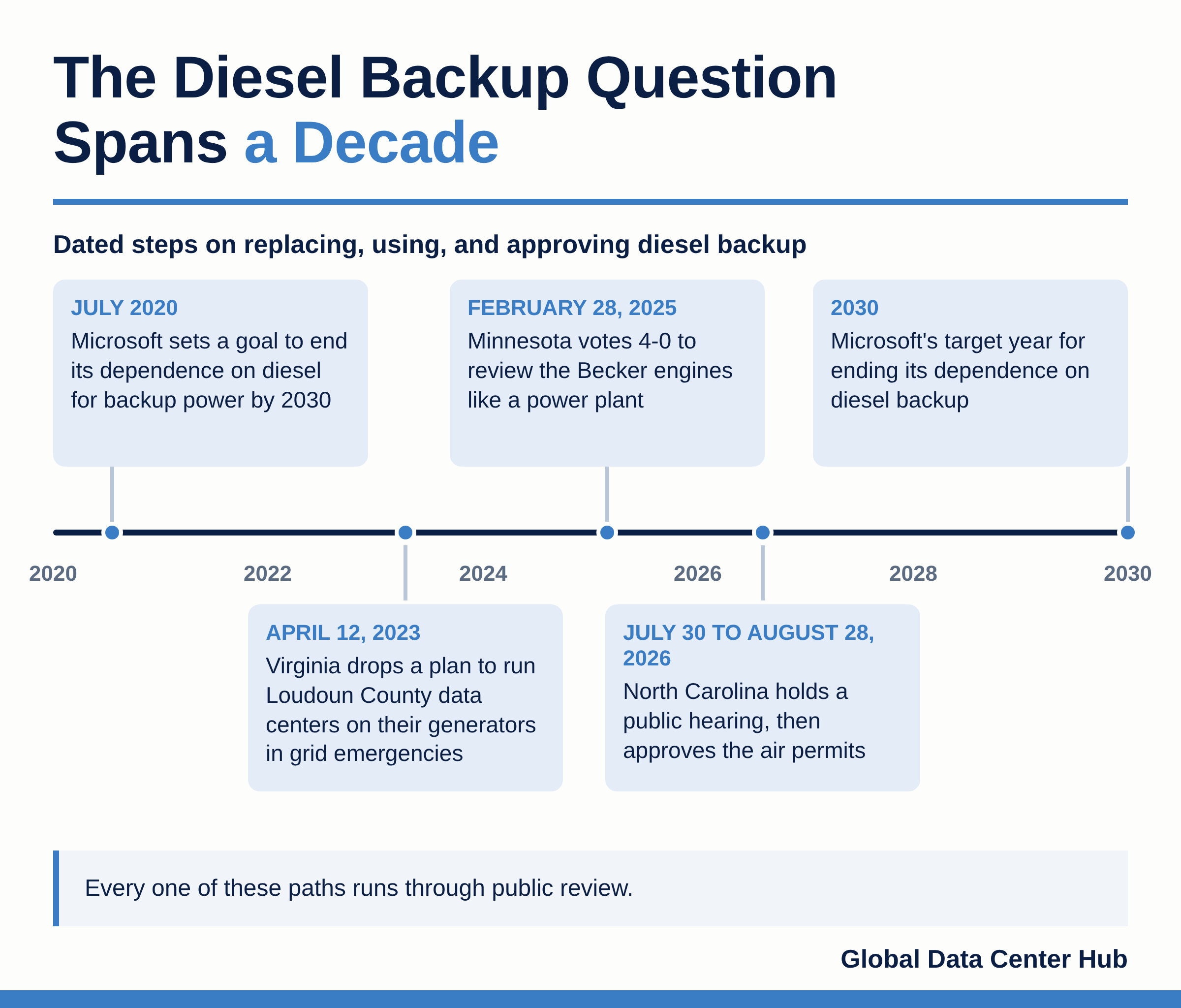
Replacing diesel takes years, and the companies that want to do it have said so. In July 2020, Microsoft, the company behind Windows and the Azure cloud, set a goal to end its dependence on diesel fuel for backup power by 2030. That is a ten-year plan.
In 2020, Microsoft ran a row of servers for 48 hours straight on hydrogen fuel cells, machines that make electricity from hydrogen without burning it. The company called that test a proof of concept.
The grid adds its own delay. Duke’s 57 temporary engines in North Carolina exist because the permanent grid connection will arrive later, and the state requires Duke to retire them within one year of starting them up.
When a new campus waits on the grid, the engines carry more of the load for longer.
GDCH has covered why new data centers wait years for power.
A strained grid can also pull the engines into a bigger role. In 2023, Virginia’s Department of Environmental Quality proposed letting data centers in Loudoun County run their generators during grid emergencies without the usual hour limits, to free up power for homes.
It dropped the plan on April 12, 2023, after public comment, saying the issues were being worked out among data centers, utilities, and PJM, the grid operator for the region, according to Data Center Frontier.
Every one of these paths runs through public review. In North Carolina, the Amazon and Duke permits went through a public hearing on July 30, 2026, before approval four weeks later.
In Minnesota, the denied exemption meant a full certificate of need case, in which Amazon would have to show the engines were needed and weigh cheaper alternatives.
The Engines Sit Next Door to Someone
If you live near a planned data center, the generators may be the part you hear about last. WRAL reported on July 30, 2026, that some Richmond County residents had expected a distribution center and learned the scale of the project late.
A local group, the Richmond County Coalition for Justice and Black Empowerment, told WRAL it wanted residents included in decisions.
If you follow the AI story, the engines explain a trade built into every outage plan.
Amazon told WRAL that each building needs backup to keep cloud services running for hospitals, first responders, utilities, and national security agencies. Reliability for users far away rests on engines in one town.
If you pay a power bill in a crowded grid region, the same engines can enter the picture during a shortage.
The 2023 Virginia proposal was written to free grid power for homes by moving data centers onto their own diesel.

Four Places the Generator Count Shows Up
Start with the air permit notice. State environmental agencies post draft permits for public comment, and those drafts list the number of engines.
North Carolina’s notice for Amazon’s Richmond County campus listed 588. A large engine count signals a large campus.
Next, read the hours in the permit. The draft North Carolina permits allowed each backup engine up to 500 hours a year, while Amazon expected about 5 to 15.
The permit sets what the engines are allowed to do during a long outage. The estimate describes a normal year. Both numbers sit in the same public file.
Then look for temporary engines. When a utility brings in “bridge” generators, as Duke Energy did in Richmond County, the site is ready before its grid connection is.
That shows up in utility filings and air permits, and it tells you the grid side of the build is running behind the building.
Finally, watch for a power plant review. When a state utility board takes up a data center’s generators, as Minnesota’s commission did in Becker, the state has decided to count the engines together.
England reaches the same result through its 50-megawatt permit rule. Those cases sit on public dockets; with filings anyone can read.
The Diesel Under the Cloud
The cloud feels weightless. It lives in buildings that can keep a power plant’s worth of engines on standby, and every AI answer that survives a storm survives it on stored fuel.
As campuses grow, the engine counts grow with them.
Who decides how many engines one town should host, and what replaces them once diesel goes?