
Welcome to Global Data Center Hub. Join investors, operators, and innovators reading to stay ahead of the latest trends in the data center sector in developed and emerging markets globally.
The most useful number in Google’s Wyoming power plan is $399 million.
That is the amount Google advanced to its local utility for long-lead equipment, before any of the new generators were built.
That advance tells you how the deal works. The campus pays for the power it needs, and it pays in writing.
The fuel cells AEP announced this week are the newest and most visible piece of that system. The contracts underneath them are the part other markets will copy.
What AEP Announced
On October 14, AEP said it plans to invest approximately $4 billion in a 702 MW fuel cell project near Cheyenne, Wyoming. Google will buy the power under a 20-year power purchase agreement.
The seller is Cheyenne Fuel Cell, LLC. AEP owns and controls about 92% of it. Funds advised by Basalt Infrastructure Partners own nearly 8%. Construction is set to start in 2026, with full operation expected by the end of 2028.
Bloom Energy supplies the fuel cells. They make electricity from natural gas through a chemical reaction rather than by burning it. AEP says the project plans to add carbon capture to make the power near-zero-emissions.
AEP chairman, president and CEO Bill Fehrman framed the project as a way to meet energy needs beyond the company’s traditional service territory. That phrase matters.
This is a utility building a contracted plant for one customer, outside the system its regulated customers pay for.
For scale, the project equals about 5% of AEP’s $78 billion capital plan for 2026 through 2030. By GDCH’s arithmetic, the announced figures work out to roughly $5.7 million per megawatt. AEP has not published a cost breakdown, so that ratio is a simple division, not guidance.
The Fuel Cells Are One Layer of a Larger Plan
The AEP release says the project follows agreements between Google and Black Hills Corp. that took effect on September 30. Those agreements describe the full power setup for the campus.
According to Black Hills’ October 6 filing, Google’s planned data center will be served by a total resource mix of 2.7 GW, including reserve margins. Up to 590 MW comes as grid-connected service from Black Hills.
Black Hills will also build 564 MW of new gas generation at its Cheyenne Prairie site.
And it will manage the output of about 2.1 GW of Wyoming-based, third-party contracted resources through a private microgrid.
Read that 2.7 GW figure carefully. It measures supply with reserves built in. The load the servers will draw has not been disclosed. When a campus is described as “2.7 GW,” the supply plan is doing the talking.
The public record also does not map each plant into the 2.1 GW microgrid portfolio. Google’s site plan application, as reported by Cowboy State Daily, describes Black Hills resources, fuel cells, and a third-party power plant feeding a substation that serves the campus.
So, the 702 MW of fuel cells sits inside a wider system. How much of the 2.1 GW it fills has not been disclosed.
Then there is timing. Black Hills expects the campus to start taking service in late 2027 and to ramp to peak load in 2030.
AEP targets full fuel cell operation by the end of 2028. The power will arrive in stages, matched to a load that grows in stages.
The Contracts Put the Cost on the Campus
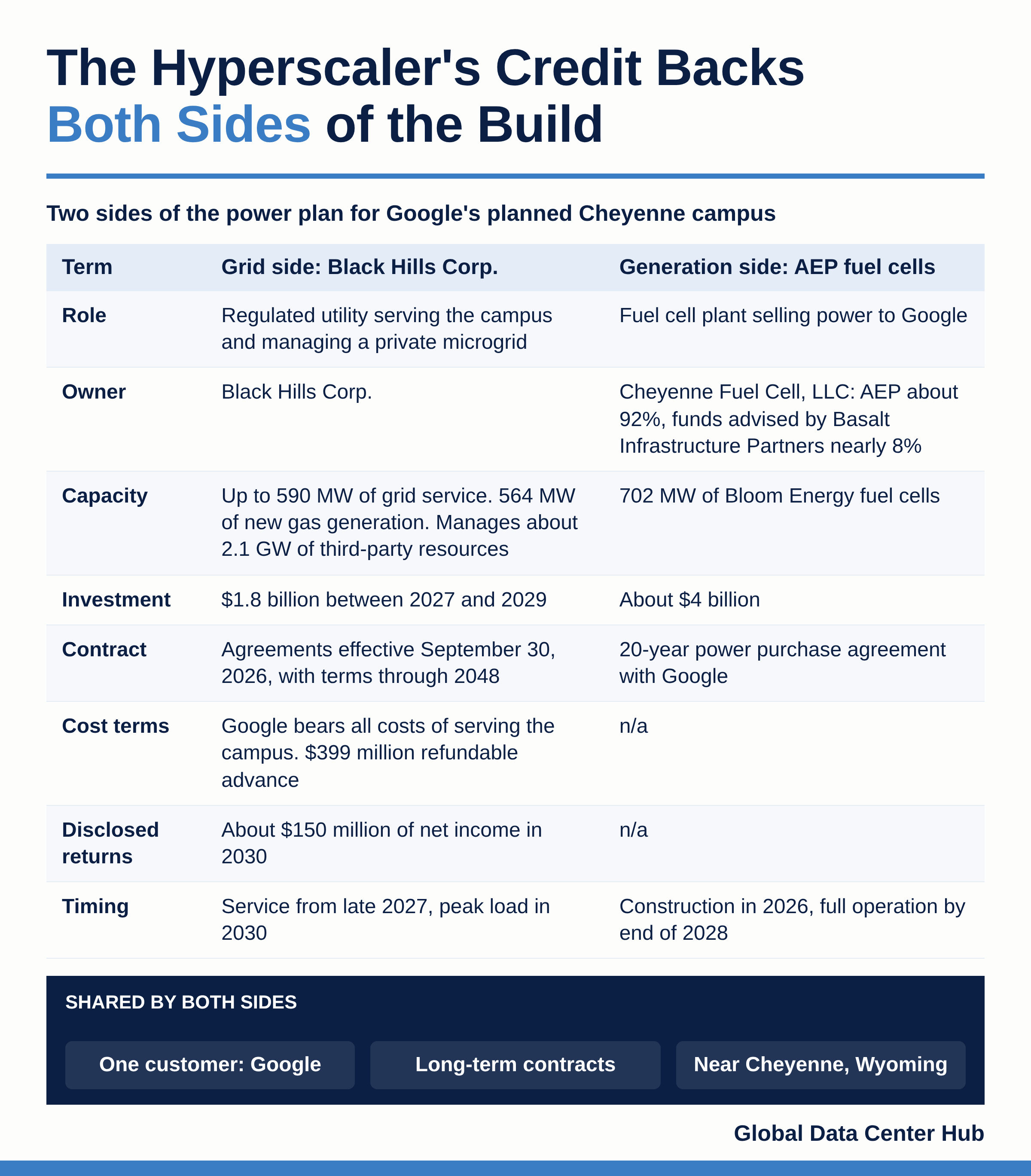
Here is the part I would study first.
Black Hills CEO Linn Evans says Google bears all costs associated with serving the planned data center throughout the life of the project. The company says the deal is structured so costs do not shift to its existing retail customers. The agreements run through 2048.
The protections are specific. Black Hills says the agreements protect returns from inflation and interest rate swings, provide full recovery of generation capital over the contract term, and guard against early termination.
Collateral and financial assurance back Google’s commitments, and a contracted minimum peak load is expected to begin in 2027. Google’s $399 million advance for long-lead equipment is refundable, with Black Hills expecting to reimburse it by June 30, 2027.
Black Hills also published its own economics. It plans to invest $1.8 billion in company-owned generation between 2027 and 2029.
It expects about $150 million of net income from the project in 2030 and about $2.4 billion of unlevered free cash flow through 2048, net of that investment.
Those figures belong to Black Hills. They say nothing about the returns on AEP’s fuel cells.
This is the structural point. On the grid side, a regulated utility is serving a gigawatt-scale customer while ring-fencing everyone else. On the generation side, an unregulated affiliate owns a plant backed by one long contract. In both, the hyperscaler’s credit is what makes the build possible.
If you invest in power, that is the asset you are really looking at. A 20-year contract with Google turns a fleet of modular fuel cells into a stream of contracted cash flow.
Without that contract, the same fleet would be a merchant bet on a single site.
The Pattern Has Precedent
AEP has used this structure before. In June 2025, Ohio regulators approved AEP Ohio’s plan to install on-site fuel cells at data centers run by Amazon Web Services and Cologix, with the two customers covering the full project costs.
AEP described it as the first project under its agreement with Bloom.
That agreement dates to November 2024, when AEP and Bloom set a framework for up to 1 GW of fuel cells.
Cheyenne is the same idea at a much larger size: the customer funds the power, and the utility builds and runs it.
What Still Has to Go Right
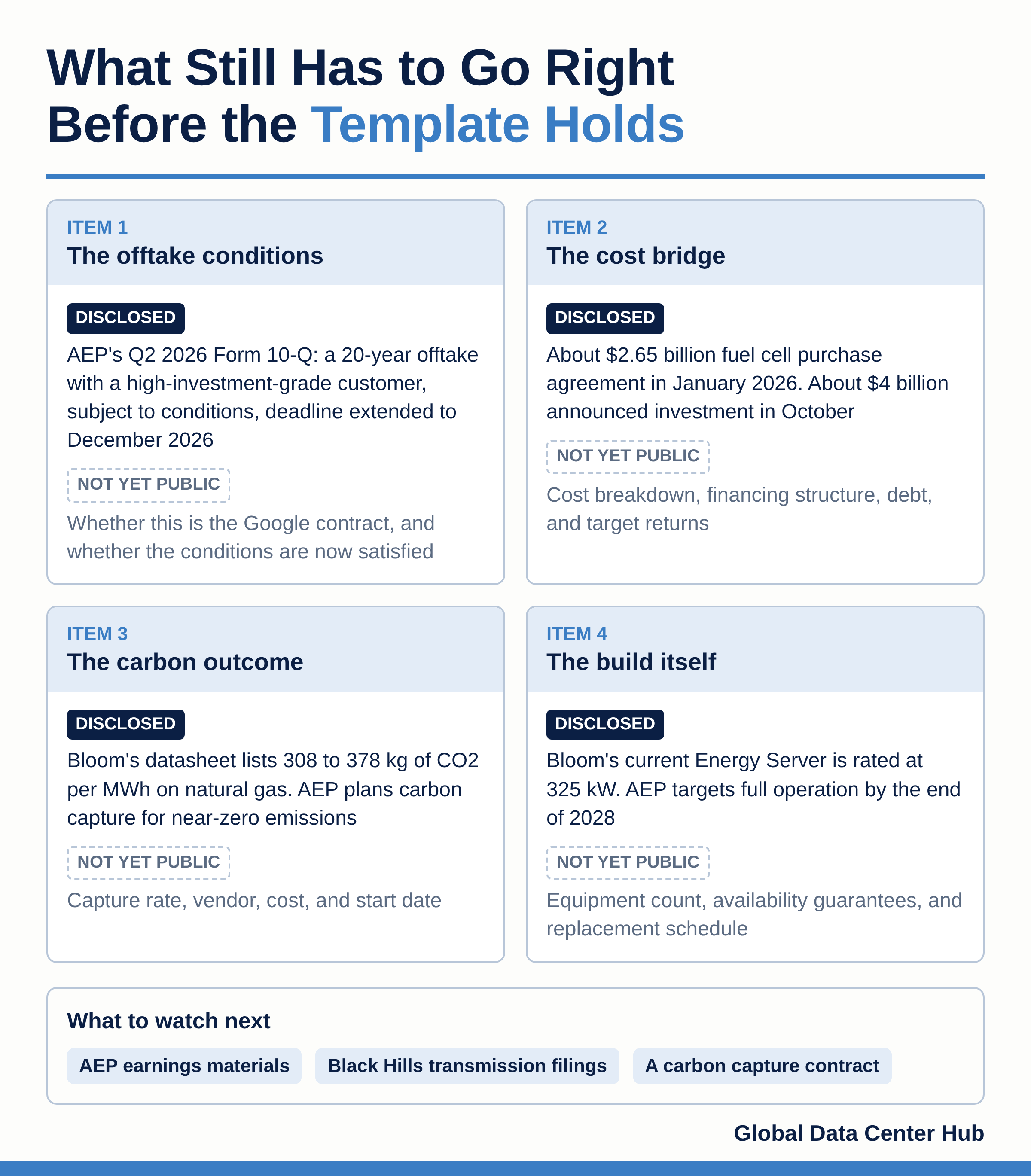
The structure is clear. Several of its terms are not yet public.
The offtake conditions. AEP’s second-quarter 2026 Form 10-Q says that in January 2026 an unregulated AEP subsidiary signed an unconditional purchase agreement for a substantial portion of its 1 GW fuel cell option, for approximately $2.65 billion.
The filing describes a 20-year offtake arrangement with a high-investment-grade third-party customer.
It states that the offtake remained subject to specified conditions, with the deadline extended by mutual agreement to December 2026, and that AEP would be entitled to additional consideration if the revised conditions are not met.
The October release names Google but does not say whether this is the same arrangement, or whether those conditions are now satisfied.
The cost bridge. If the January purchase and the Cheyenne project are the same, roughly $1.35 billion separates the equipment agreement from the $4 billion investment.
Site work, gas supply, electrical systems, and financing costs could all sit in that gap. AEP has not published the bridge, and the financing structure, debt, and target returns are also undisclosed.
The carbon outcome. Bloom’s current datasheet lists 308 to 378 kg of CO2 per MWh at stated efficiency on natural gas, with near-zero local NOx and no water use during normal operation.
AEP’s near-zero-emissions goal depends on carbon capture that has been announced as a plan. The capture rate, vendor, cost, and start date have not been published.
The build itself. Bloom’s current Energy Server is rated at 325 kW. At that rating, 702 MW works out to more than 2,000 units, by simple arithmetic.
The actual equipment count, availability guarantees, and replacement schedule are not public.
Each item is a condition the outcome depends on. Each should show up in future filings.

The Lesson Travels Beyond Wyoming
For this campus, the binding constraint is firm power on a schedule the grid alone could not meet.
In the terms of the AI Infrastructure Scarcity Stack, the eight layers that can hold up a project, Cheyenne binds at the power layer. What is clearing it is a set of contracts.
That lesson matters most where grids are slow or utilities are stretched.
The parts that travel are simple to name modular generation that can arrive in blocks, a creditworthy long-term buyer, a local utility that runs the system, and written terms that keep ordinary customers out of the cost.
The parts that do not travel easily are local. Gas supply, permitting rules, and the legal right to combine private plants with regulated service all vary by market.
A 20-year contract is only as useful as the law that lets the structure exist.
For policymakers, the label tells you little. “Bring your own power” in Cheyenne still runs through a regulated utility.
What protects the public is the cost-allocation contract, and that is the document worth asking for.
What to Watch Next
Three filings will tell you whether this template holds.
First, AEP’s next earnings materials, for any confirmation that the Google contract conditions are met, plus the project’s financing and earnings contribution.
Second, Black Hills’ transmission filings in Wyoming, which will show how the grid side scales toward the 2030 peak.
Third, any carbon capture contract for the fuel cells, with a capture rate and a date.
If you are weighing a similar campus anywhere, start where Cheyenne starts. Ask who pays, ask where it is written, and ask what the contract says if the load ramps slower than planned.