

Welcome to Global Data Center Hub. Join investors, operators, and innovators reading to stay ahead of the latest trends in the data center sector in developed and emerging markets globally.
Every data center starts as a request for electricity, and a request is free to make and free to drop. A developer can ask several utilities for power at the same time and build in one place or in none. The request still enters each utility’s planning.
The climb from a request to a commitment happens in public, one paid step at a time. In Ohio, developers first paid for an engineering study, then signed binding agreements carrying minimum payments, collateral, and exit fees. AEP Ohio reported to the Public Utilities Commission of Ohio on February 13, 2026 that more than 30,000 megawatts of stated interest had become 13,022.7 megawatts studied and 5,642 megawatts signed.
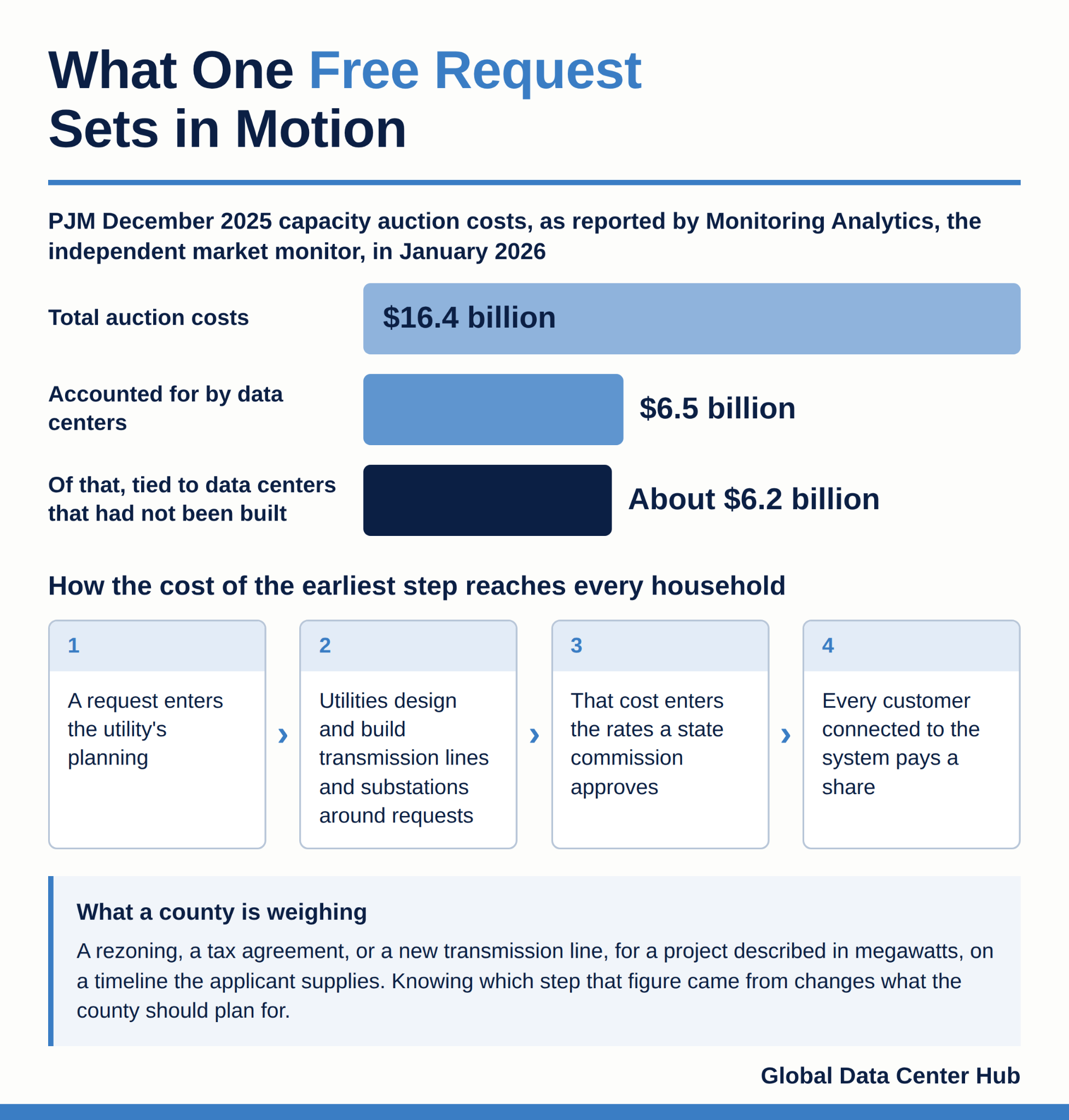
The cost of the earliest step lands on ordinary electricity customers. Utilities design and build transmission lines and substations around requests, and that cost enters rates a state commission approves, reaching every household on the system.
A data center gets announced near a town. The headline number is megawatts.
Nobody in the room can tell from that number whether the building is coming.
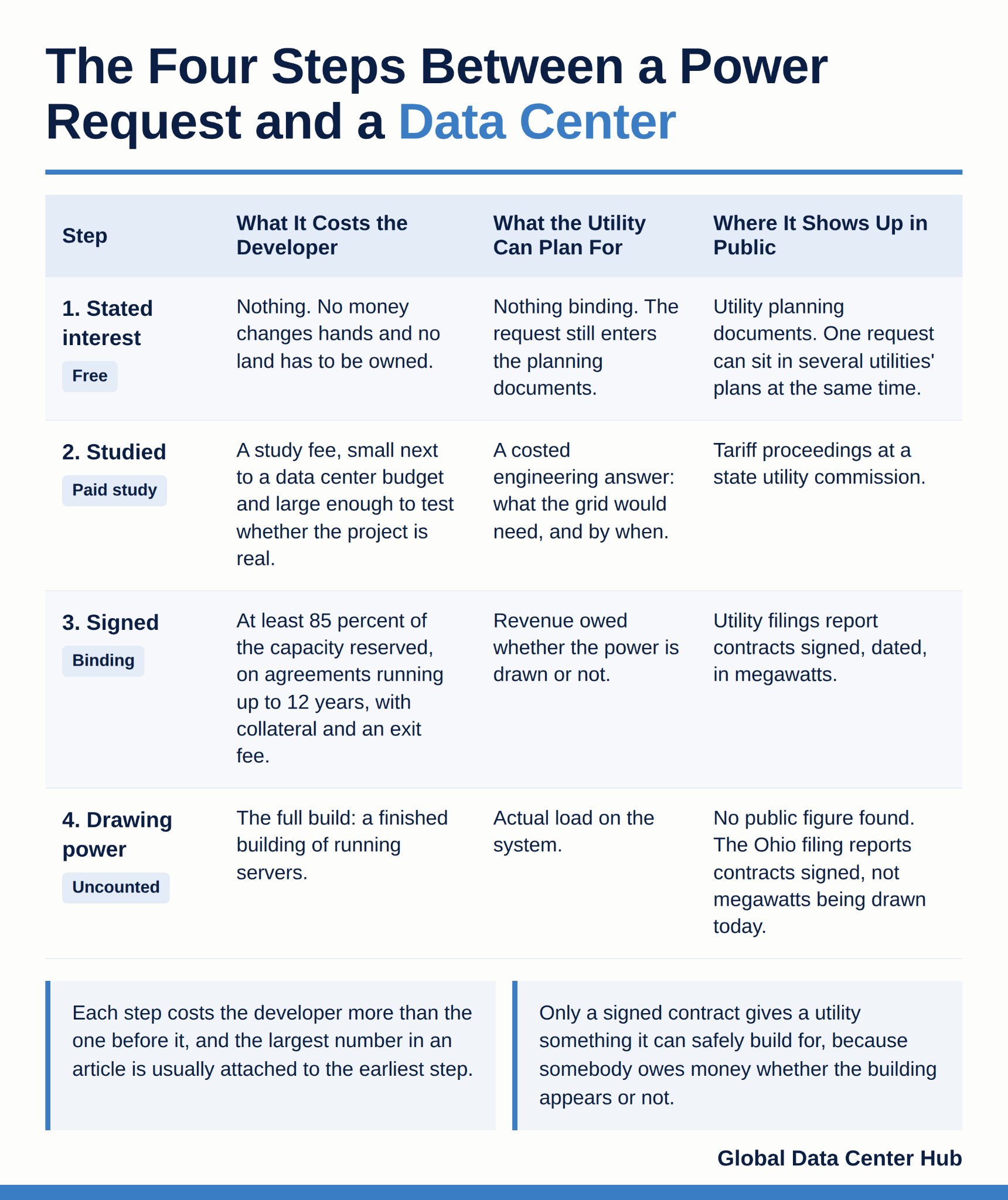
I want to give you the four steps that sit between that first number and a running data center. Each step costs the developer more than the last. Each step leaves a mark in a public record you can look up.
Ohio is the clearest place to watch all four, because the state wrote a rule that pushed developers up the steps one at a time and published what happened at each one. The steps themselves apply well beyond Ohio. They describe how any large electricity customer gets connected to the grid anywhere.
The First Step Costs a Developer Nothing
Stated interest is the cheapest part of the process.
A developer approaches a utility and says how much power a project would need. No money changes hands. No land has to be owned. The project can exist as a plan on somebody’s laptop.
The utility cannot treat that as noise. A regulated utility has an obligation to serve customers who ask for service, and the equipment that serves a large customer takes years to design, approve, and build. So the request enters the planning documents, and the planning documents drive what gets built.
This is where the biggest numbers live. Before Ohio changed its rules, data center developers had told AEP Ohio they needed more than 30,000 megawatts of electricity. The utility’s own peak demand across every customer it serves has run between about 8,000 and 10,500 megawatts.
One request can also sit in several utilities’ plans at the same time. A developer scouting four states can ask in all four, and four separate utilities can each start planning for a project that gets built once.
So when you see a very large megawatt figure attached to a place, you are almost always looking at this step, and possibly at a project somebody else is counting too.
The Second Step Arrives With a Bill
The first time money changes hands, the number falls.
Here the developer pays the utility to run a formal engineering study. Engineers work out what the grid would actually need to deliver that power to that site: a new line, a bigger substation, an upgraded connection to the high-voltage network. The study produces a cost and a timeline.
The payment is small next to a data center budget. It is large enough to make a developer decide whether the project is real.
Ohio measured exactly that. The Public Utilities Commission of Ohio approved a Data Center Tariff on July 9, 2025, and gave developers 45 days to request and pay for a study. Of the more than 30,000 megawatts of stated interest, 13,022.7 megawatts took that step.
More than half the requested power disappeared at the first sign of a bill.
This step matters to you for a second reason. It produces the first honest estimate of what serving the project would cost, which is the figure your town or state commission needs before anyone can argue about who should pay.
The Third Step Is a Signature and a Penalty
A contract is the first step a company can be sued over.
The utility presents a service plan with a date, a price, and the collateral it wants. The developer signs a binding agreement or walks away. Under the Ohio tariff, a project above 25 megawatts had to pay for at least 85 percent of the capacity it reserved, whether or not it used the power, on agreements running up to 12 years, with an exit fee for leaving early.
Developers had 60 days to sign. As of February 12, 2026, the signed total came to 5,642 megawatts.
Virginia wrote its own version of this step. The State Corporation Commission approved a new rate class for Dominion Energy on November 25, 2025, covering customers of 25 megawatts or more, with 14-year contracts and minimum demand charges taking effect January 1, 2027.
Both rules share a shape. A long term, a minimum payment, collateral, and a penalty for leaving early are how a utility turns a stated intention into something it can plan against.
The rules also arrive late for capacity already booked. AEP Ohio reported 12,219 megawatts of data center contracts signed before its tariff took effect, and those sit under the older terms.
A signed megawatt is the first one a utility can safely build for, because somebody now owes money whether the building appears or not.

The Fourth Step Nobody Has Counted
A data center actually drawing the power it signed for is where the public record thins out.
A signed contract is a promise to pay. A finished building full of running servers is a separate achievement, and the two can sit years apart. Projects get delayed, scaled back, or phased in slowly while the contract keeps running.
The Ohio filing reports contracts signed. It says nothing about how many of those megawatts are being drawn today, and no comparable number exists anywhere else.
So the last of these four steps ends on a question mark. Even the strongest number in a public filing describes an obligation, and an obligation is one step short of a finished thing.
Who Pays While These Steps Get Climbed
The grid gets built for the first step, and everyone pays the bill.
Utilities plan around requests because late planning is worse than early planning. Those plans become transmission and substation projects, and the cost enters the rates a state commission approves. Every customer connected to that system pays a share. That includes you, whether or not you will ever knowingly use a data center.
It reaches past any single utility. Monitoring Analytics, the independent market monitor that reviews the markets run by the grid operator PJM, reported in January 2026 that data centers accounted for $6.5 billion of the $16.4 billion in costs from PJM’s December 2025 capacity auction. About $6.2 billion of that was tied to data centers that had not been built.
That is the first step stated in dollars.
The same gap shows up closer to home. A county weighing a rezoning, a tax agreement, or a new transmission line is weighing a project described in megawatts, on a timeline the applicant supplies. Knowing which step that figure came from changes what your county should plan for, and it changes what you can reasonably ask at a hearing.
Placing Any Announcement on the Four Steps
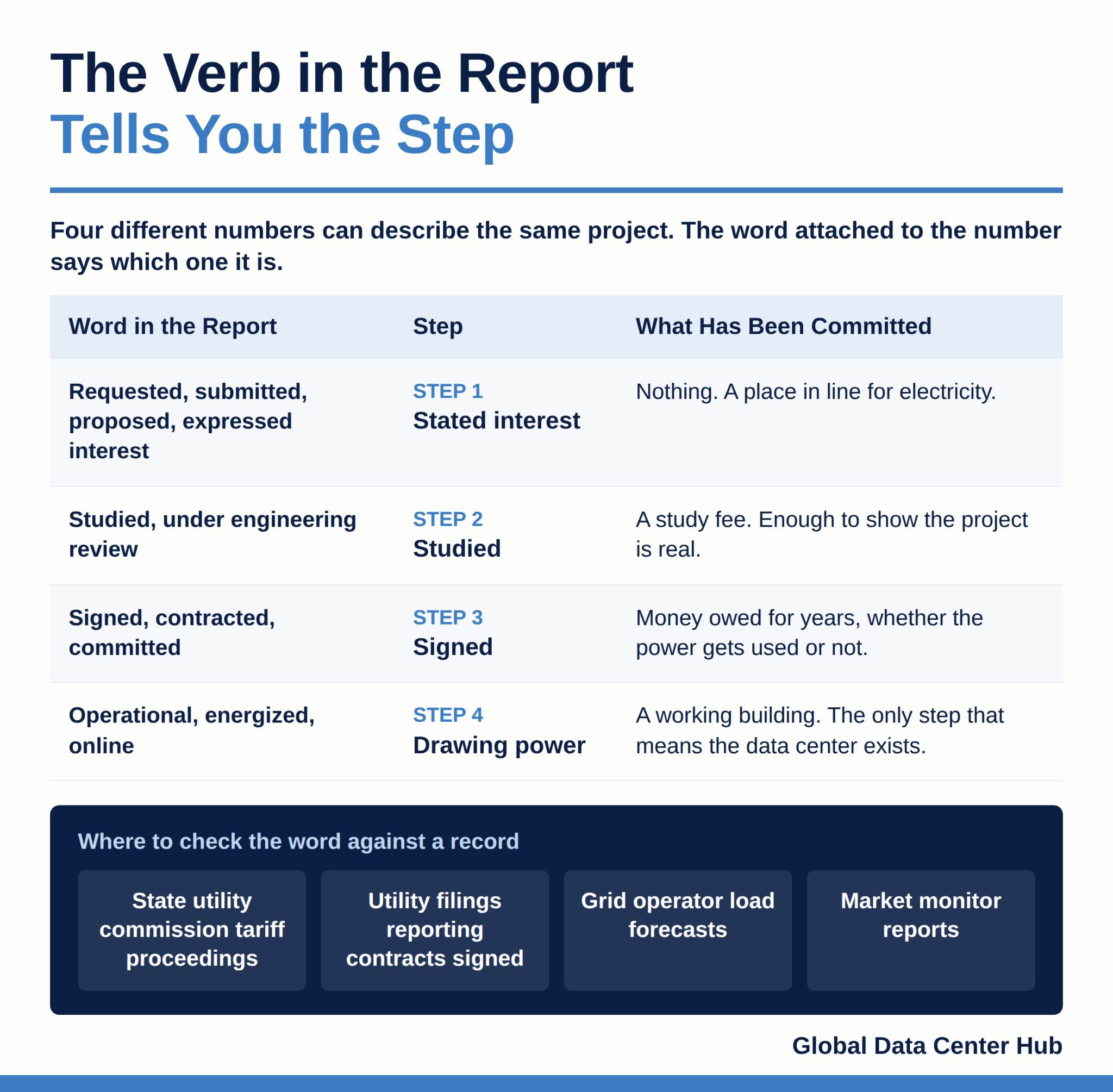
The words in a news report tell you the step, and the words stay consistent.
Requested, submitted, proposed, and expressed interest all mean step one. Studied and under engineering review mean step two. Signed, contracted, and committed mean step three. Operational, energized, and online mean step four. The largest number in an article is usually attached to the earliest step, because that is the step where numbers are free.
When I read a data center announcement, I look for the verb before the number.
The public records sit one layer below the news, and you can reach them. Tariff proceedings at a state utility commission show what happens to a forecast once a utility attaches a price to it. Grid operator and market monitor reports separate existing demand from forecast demand. Utility filings report contracts signed, dated, in megawatts.
None of this needs an engineering background. It needs you to know that four different numbers can describe the same project, and to ask which one you are holding.
These four steps also explain a pattern that otherwise looks like failure. Announced capacity keeps running ahead of built capacity, and the reason sits at the beginning. Many announced megawatts never left step one, and leaving step one costs nothing at all.
A town reading a headline, a household reading a power bill, and a reporter reading a filing are all looking at the same four steps. The only question that changes the answer is which step your number came from.
Has this improved the delay in the interconnection queue?