
Welcome to Global Data Center Hub. Join investors, operators, and innovators reading to stay ahead of the latest trends in the data center sector in developed and emerging markets globally.
For two years the AI infrastructure debate fixed on a single axis: how large the hyperscaler capex numbers could get before the market flinched.
Amazon at $200 billion, Alphabet at $180 to $190 billion, Microsoft near $190 billion.
That framing is now exhausted.
The cohort has converged on comparable spending, and backlog has answered the demand question.
What remains unresolved is quieter and more consequential: not how much these companies will spend, but how they will pay for it, and which balance sheets can absorb a multi-year build without a financing event at the wrong point in the rate cycle.
Amazon’s first quarter of 2026 makes that shift legible.
On the surface it is one of the strongest quarters the company has printed.
Underneath, it is a disclosure about capital structure: Amazon has become the only hyperscaler funding its infrastructure gap through the bond market rather than internal cash, accepting the leverage and margin consequences.
The quarter does not raise a question about demand. It raises one about financing durability.
The Signal: Free Cash Flow Went to Zero by Design
Amazon reported $181.5 billion in revenue, up 17 percent, with operating income of $23.9 billion and a record consolidated operating margin of 13.1 percent.
Diluted earnings per share of $2.78 against a $1.63 consensus is an optical beat: it carries a $16.8 billion pre-tax gain on Amazon’s Anthropic stake, a non-operating item.
Strip it out and operating income growth of 29.6 percent is the substantive result.
But the earnings headline is not where the signal lives. It lives in cash flow.
Trailing twelve-month free cash flow collapsed to $1.2 billion, a 95 percent decline from $25.9 billion a year earlier, while operating cash flow over the same period grew 30 percent to $148.5 billion.
This is not operational deterioration; the entire delta is capital expenditure.
Amazon deployed $44.2 billion in the quarter alone, up 77 percent, against trailing property and equipment purchases of $147.3 billion.
A company generating $148 billion in operating cash converted almost none of it to free cash flow because it is routing the whole of that generation, and more, into physical capacity.
That is a capital allocation decision surfaced as a cash flow statement.
Infrastructure Strategy: Vertical Silicon as Margin Control
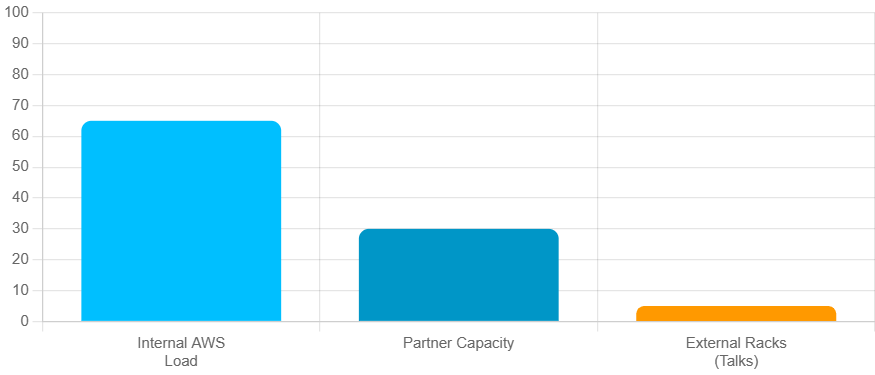
The differentiation sits at the silicon layer. Amazon’s Graviton, Trainium, and Nitro families reached a $20 billion annualized run rate, growing at triple-digit rates.
The Trainium3 UltraServer also began shipping at rack-scale density comparable to merchant Blackwell hardware.
The logic is margin capture: every workload on proprietary silicon rather than merchant GPUs retains economics that would otherwise flow to Nvidia.
That logic is visible in the compute Amazon has locked.
Anthropic secured up to five gigawatts of Trainium capacity, while OpenAI committed to roughly two gigawatts beginning in 2027 under broader arrangements that include a reported $50 billion Amazon investment and a $100 billion contract expansion.
That investment figure appears in the quarter’s materials and should be confirmed against independent disclosure before it is treated as settled.
The two-gigawatt commitment, however, anchors the competitive read regardless.
Capital Allocation: The Balance Sheet Does the Work
Here the cohort separates. Alphabet paused buybacks entirely, dropping repurchases to zero from $15.1 billion a year earlier, to self-fund from internal cash.
Microsoft finances its program out of a 47 percent operating margin.
Amazon alone is bridging the gap with debt: it issued $54 billion in corporate paper in March 2026 and a $25 billion investment-grade offering in July, driving long-term debt to $119.1 billion from $65.6 billion at year-end 2025.
The posture is defensible on the assets being financed, since data center shells carry roughly thirty-year lives and server assets are tied to contracted backlog, and Amazon holds $143.1 billion in cash and short-term investments.
But the choice is directional: Amazon has traded buyback flexibility and free cash flow optionality for build velocity, carrying the cost as leverage rather than forgone capital returns.
That is the deciding variable the cohort now competes on, and Amazon has taken the most aggressive position within it.
Competitive Positioning: Reacceleration Against a Compressing Margin
AWS delivered $37.6 billion in revenue, up 28 percent, its fastest growth in fifteen quarters, on a run rate near $150 billion.
Remaining performance obligations reached $364 billion, up 93 percent.
That backlog is the demand answer, but it carries a concentration signal that belongs in the same sentence: the incremental is driven heavily by a small number of frontier-lab counterparties, so forward visibility and counterparty concentration are rising together.
A backlog that nearly doubles in a year is strength; a backlog whose growth depends on two or three names is strength with a specific fragility.
The margin tells the more instructive story. AWS operating margin declined to 37.7 percent from 39.2 percent a year earlier.
This is not weakness; it is the depreciation of accelerated infrastructure hitting the operating expense line before the compute is monetized. Racks deploy, the depreciation charge lands immediately, and the revenue arrives over the contract life that follows.
For investors, that is the tension to underwrite: reacceleration and margin compression are the same event viewed from two lines of the income statement.
The System Pattern: Power First, Financing Second, Everything Else After
Across the cohort a single sequencing logic has hardened.
Combined 2026 hyperscaler capex approaches $700 billion, concentrated in a tight constraint stack of advanced packaging, accelerators, liquid cooling, transformers, and grid power.
Power is the binding constraint, and it governs the order of execution: power first, then land and interconnects, then silicon allocation, then networking and cooling.
Amazon added roughly four gigawatts in 2025 with plans to double by 2027.
The geographic consequence matters for emerging markets. Buildouts cluster where grids are reliable and regulatory continuity is long-term.
Amazon’s model adds another filter: a build financed partly through investment-grade debt depends on stable rate environments and deep bond markets, conditions absent across most regions competing for this capacity.
The cycle is not broadening globally. It is concentrating, and the financing structure reinforces the concentration.
What Resolves Next
Three signals will define the next several quarters.
The first is the third-party Trainium decision. Reports suggest Amazon is in early talks to sell Trainium racks directly to external data centers, ending AWS-exclusive distribution.
While not yet a disclosed transaction, it is a key forward signal. If it proceeds, Amazon moves into direct competition with Nvidia.
The second is free cash flow recovery against the debt trajectory. Free cash flow should recover as AI workloads monetize and the build cycle normalizes.
Whether that happens in 2026 or 2027 will determine how long Amazon carries elevated leverage.
If capex stays near $200 billion and debt issuance resumes, the market will view the balance sheetnot demand as the constraint.
The third is time-to-energize. Power-secured land is the appreciating asset, while Amazon's debt-backed build concentrates AI's expansion in one credit profile and one grid pathway.
Amazon did not report a strong quarter with a cash flow problem.
It reported a decision: to finance infrastructure on the balance sheet, separating itself from peers funding the same future out of pocket.
The demand story is settled by a $364 billion backlog.
What remains is whether capital structure compresses returns faster than AI workloads monetize.