
Welcome to Global Data Center Hub. Join investors, operators, and innovators reading to stay ahead of the latest trends in the data center sector in developed and emerging markets globally.
The Contract Is The Signal, Not The Capacity
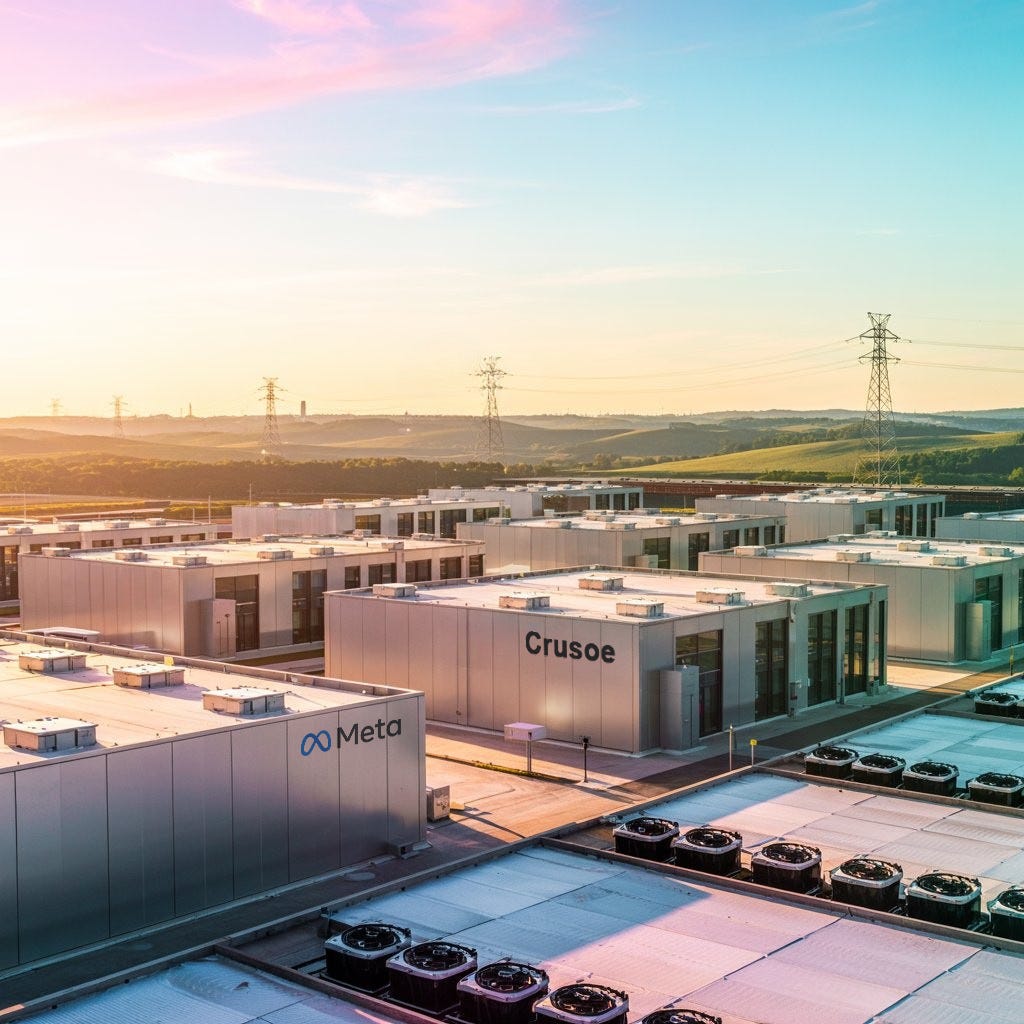
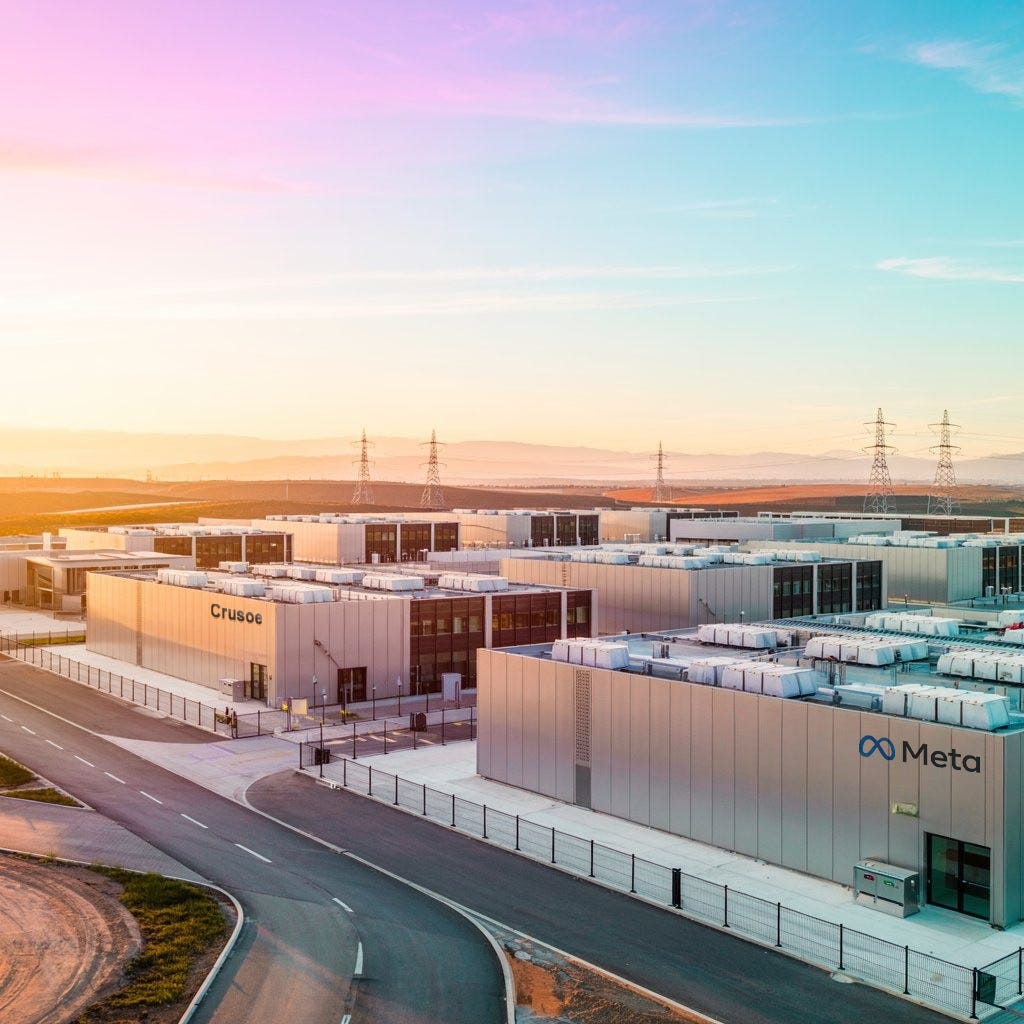
Meta contracted 1.6 gigawatts of compute from a developer it does not own rather than building the capacity itself.
The mainstream coverage fixed on the gigawatt number and the missing price.
The number that should move you is the one nobody disclosed, because the absence of a price tells you what the contract is doing.
This is a frontier hyperscaler routing its scarcest input through a third-party balance sheet.
The build-versus-buy line in AI infrastructure has moved, and the operators who do not reprice against it will underwrite the wrong risk for the next two years.
Offtake Is Becoming The Collateral That Underwrites Developer Debt
Crusoe does not fund gigawatt campuses on its own credit.
It funds them on contracted demand.
The Abilene flagship sits inside a $15 billion joint venture with Blue Owl Capital and Primary Digital Infrastructure, structured as a forward takeout against an Oracle build and an OpenAI lease.
The Meta contract extends the same logic.
A named hyperscaler commitment converts a development site into a financeable asset, and the lender underwrites the tenant, not the developer.
Expect this pattern to harden over the next 12 to 24 months.
The developers who control energized sites and can attach an investment-grade offtake will raise capital at terms unavailable to operators carrying merchant capacity risk.
Power plus a signed tenant is now the financing unit, and capital will price that bundle at a premium.
Counterparty Concentration Has Moved From The Tenant To The Developer
Crusoe holds 4.9 gigawatts under contract against a pipeline exceeding 40 gigawatts.
The contracted book now spans Oracle, OpenAI, Microsoft, Google, and Meta.
One developer sits at the center of several of the largest US AI infrastructure projects.
That concentration is a strength for Crusoe and a risk for everyone underwriting it.
The dependency runs both directions.
Crusoe’s lenders carry exposure to a handful of anchor tenants, and any hyperscaler that slips a delivery date or renegotiates an offtake transmits stress straight into the developer’s capital stack.
Crusoe already exited a Wyoming project this month after a counterparty path collapsed.
Diligence on any Crusoe-adjacent exposure now requires mapping the full tenant book, not the single contract in front of you.
Power-First Siting Has Replaced Hub Proximity As The Underwriting Variable
The sites reported in this deal sit in Childress, Texas, and Warrenton, Missouri, not in Northern Virginia or Santa Clara.
Crusoe’s model locates compute where power already exists rather than fighting interconnection queues in saturated hubs.
The 1.2 gigawatt Abilene campus pairs with a dedicated power strategy spanning gas, renewables, and 12 gigawatt-hours of iron-air battery storage. The siting choice is the underwriting choice.
For the next cycle, the question is not whether a market has tenants or land.
The question is whether it has deliverable, energized megawatts before the build begins.
Markets that solve power first will capture the AI capacity that saturated hubs can no longer physically accommodate.
Investor Action
Infrastructure and private equity funds should re-underwrite digital infrastructure equity around offtake quality, not asset location.
The asset that holds value is the energized site with a contracted investment-grade tenant. Diligence the tenant book and the power strategy before the building.
Funds that continue to price on land and proximity will overpay for assets carrying merchant power risk the market has already learned to discount.
Public equity and credit investors holding hyperscaler names should read this as a capital-efficiency signal.
Meta is securing capacity without carrying the full asset on its balance sheet, which preserves capital against its commitment reaching up to $600 billion through 2028.
Credit investors evaluating developer-adjacent paper should price the tenant concentration directly.
Treat a Crusoe-style contracted book as a single-name exposure cluster, not a diversified pipeline, and benchmark spreads against that read.
Developers and operators should sequence power procurement and offtake before capital raises. The financing follows the signed tenant, not the other way around.
Operators carrying speculative capacity without a named anchor will find the bank syndicate and the private placement market both tightening against them. Negotiate the offtake first.
The operators who control energized sites hold the leverage in every conversation that follows.
The Verdict
This contract marks the point where compute capacity became a procured input rather than an owned asset for the largest buyers in the market.
The inflection is structural.
Hyperscalers are converting their balance sheet advantage into contracted demand, and developers are converting that demand into financeable capacity.
Over the next 24 months, the firms that win will be the ones controlling energized sites with investment-grade offtake attached, because that bundle is what capital now prices at a premium.
The open question is the concentration it creates.
When five hyperscalers anchor one developer’s 40 gigawatt pipeline, who holds the risk when the first anchor moves, and has anyone underwriting that pipeline actually priced it?