

Welcome to Global Data Center Hub. Join investors, operators, and innovators reading to stay ahead of the latest trends in the data center sector in developed and emerging markets globally.
Vantage Data Centers closed a $2 billion revolving credit facility.
Evercore and Wells Fargo Securities, LLC served as lead arrangers, and a dozen insurance and other institutional investors provided the capital.
The facility funds early-stage development across the company’s North American data center platform.
Vantage announced the transaction on September 14, 2026.
Vantage Facility Structure And Collateral
The facility is structured as a five-year revolving credit platform with extension options. The initial collateral pool holds three development assets.
Vantage can contribute additional assets to the pool over time.
The company did not identify the three assets.
It also did not disclose pricing, advance rates, covenants, or the recourse structure.
Scott Beasley, Global Chief Financial Officer of Vantage, called the facility “a strategic addition to Vantage’s capital platform, providing committed development-stage financing backed by a broader and more diverse investor base.”
The Investors Behind The $2 Billion
Vantage did not name individual lenders.
The announcement describes the group as a dozen insurance and other institutional investors.
The Financial Times reported on September 10, four days before the announcement, that Vantage was seeking the $2 billion from PIMCO and PGIM.
Neither name appears in the company’s announcement.
The Financial Times also reported that Vantage was tapping new investors for AI infrastructure as Wall Street banks limit their exposure.
That framing is the newspaper’s, not the companies.
Data Center Capital Raised Across 2026
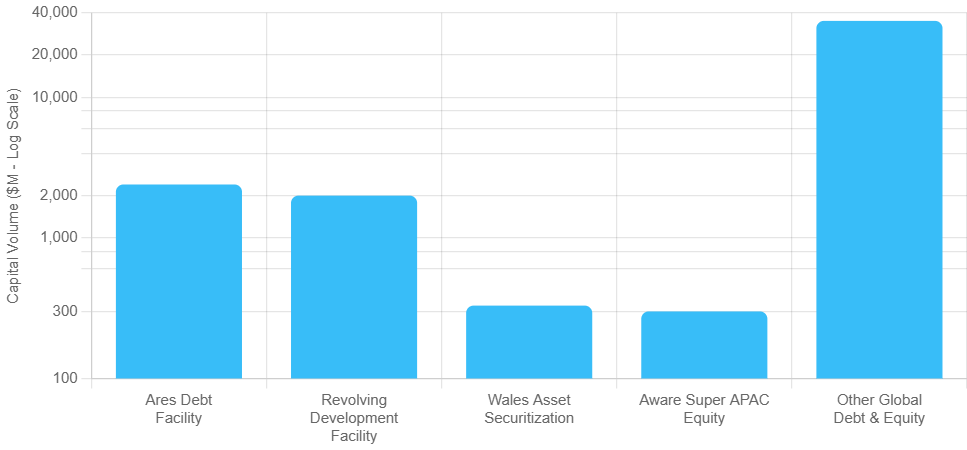
Vantage reports closing over $40 billions of capital during 2026 across global debt and equity markets.
The announcement presents the figure as an aggregate and does not break it down by transaction.
Data Center Dynamics reported that the company’s 2026 financings include a $2.4 billion debt facility from Ares Management for North American development, a £254 million securitization backed by facilities in Wales, and a $300 million minority investment from Aware Super in the company’s Asia Pacific business.
Vantage operates data center campuses across North America, EMEA, and Asia Pacific, serving AI and cloud customers.
Rich Cosgray, Senior Vice President of Global Capital Markets at Vantage, said the facility gives the company “greater capacity to move quickly, provide certainty for our customers and deliver the infrastructure needed.”
The disclosed next step is growth of the collateral pool, as additional development assets are contributed over time.
The Backing Arrives Before The Buildings Do
Three development assets, none of them operating data centers, now secure five years of committed institutional capital.
Coverage has treated the facility as a one-time loan, when the disclosed structure is a revolving pool that can be repaid, redrawn, and refilled with new assets.
Read it as a single financing and you will misjudge both the capacity it creates and the risk its lenders have accepted.
A Facility Designed To Be Repaid And Drawn Again
The mechanism matters more than the amount.
Vantage draws against the facility to fund early-stage work.
When an asset matures and moves to its own financing, the drawn capital is repaid.
The repaid capacity becomes available again. The pool then accepts new assets.
Nothing in the disclosed structure limits the facility to its first three assets, and the extension options push its life beyond five years.
That changes what the facility is.
It is not a loan against a project. It is standing infrastructure for the development phase itself.
Vantage no longer needs to arrange a bespoke facility each time a site reaches the expensive part of early development.
Over the next 12 to 24 months, the test is throughput. Watch how many assets enter the pool and how quickly they leave it for their own financing.
A pool that turns over compounds the platform’s speed. A pool that does not turn over concentrate’s development risk in one place.
Insurance Capital Has Moved To The Front Of The Project
The lender list is the second signal.
Insurance capital has historically entered data centers at the stable end, through leased buildings, contracted cash flows, and securitized notes.
This facility puts a dozen insurance and other institutional investors at the opposite end, where the assets are still in development and the buildings have not been delivered.
The Financial Times reported that Vantage sought the capital from PIMCO and PGIM and framed the deal as the company tapping new investors while Wall Street banks limit exposure.
Vantage confirmed neither name. Even on the confirmed record alone, the composition is the point.
Development-stage data center credit now clears with investors who need duration and yield, not with relationship banks alone.
Expect that migration to continue through 2027.
The capital that must deploy at AI infrastructure scale sits with insurers and institutional managers, and this facility shows the structure that lets them reach the development stage.
The Capital Stack Now Has A Dedicated Development Layer
The third signal sits in the 2026 sequence.
On the reported record, Vantage has put separate pools of capital against separate parts of the platform.
This facility covers early-stage North American development.
The Ares Management facility covers North American development credit at similar scale.
A securitization funds facilities in Wales. An Aware Super minority investment backs the Asia Pacific business.
The over $40 billion the company reports closing in 2026 is an aggregate, and it reads as a menu of stage-matched products rather than a single raise. The structural consequence follows.
Development risk is being carved out as its own credit product, with its own lender base and its own collateral logic. Once a risk is carved out and priced, it scales.
Over the next two years, the question is not whether other scaled platforms copy the structure. It is which lenders fund the copies, and at what price.

Ask What Qualifies An Asset For The Pool
For Private Capital, this structure will reach your desk in one of two forms, as an invitation into a comparable facility or as competition for development assets you wanted to fund directly. Three checks come before either decision.
First, ask what qualifies an asset for the collateral pool and what removes it. The answer lies in the facility’s eligibility criteria and borrowing base mechanics, and the check belongs in term sheet review before commitment. Vantage disclosed that assets can be added over time. It did not disclose the tests those assets must pass, and the tests are where the risk lives.
Second, ask what the capital costs, drawn and undrawn. Pricing, advance rates, and fees were not disclosed here. When a comparable facility reaches you, test the spread against development risk, not against the operating-asset spreads insurance portfolios already know. That check belongs in the allocation decision itself.
Third, ask how assets leave the pool. A revolving facility only works if projects graduate to their own financing. The visible channels in Vantage’s record are large private credit facilities and securitization. Trace the takeout path before you underwrite the entry and revisit it in every monitoring cycle.
Skip these checks and you are pricing development risk off an announcement that discloses no price. A dozen investors have already accepted terms the market cannot see. The next pool will be priced against this one.
The Second Facility Will Be The Real Signal
This deal will matter more for what follows it than for what it funds.
A committed revolving pool for development-stage data center assets is now a closed transaction with a dozen institutional backers and two major arrangers behind it.
That existence proof is the inflection. The development phase, the part of the cycle that previously ran on sponsor equity and bespoke loans, now has its own institutional product. Watch the next 12 to 24 months for two things.
The first comparable facility from another scaled platform confirms the template. The first disclosed pricing tells you what development risk actually clears at. Until then, the open question is the one the announcement leaves.
What enters the pool next, and what are the lenders being paid to hold it?