
Welcome to Global Data Center Hub. Join investors, operators, and innovators reading to stay ahead of the latest trends in the data center sector in developed and emerging markets globally.
TL;DR
Banks led by Morgan Stanley are pricing $15 billion of debt against Google’s balance sheet, with Anthropic’s credit serving only as the trigger. Google capped its guarantee at the minimum level lenders required, which reveals the deal does not clear on the tenant’s credit alone. Guarantee scope, and the guarantor behind it, now sets the price of AI data center debt.
Google converts a contingent guarantee into roughly 20 percent ownership of the data center and power project. The backstop is a paid product, and the payment is equity in the physical infrastructure layer. Hyperscaler guarantors are becoming owners of the assets their tenants occupy.
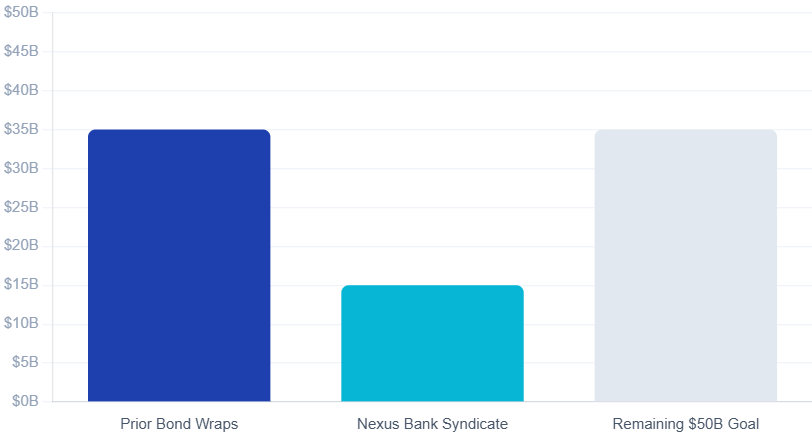
The Google backstop template is migrating from private bond markets into syndicated bank debt. Roughly $35 billion of prior Anthropic-linked debt across five Fluidstack-developed facilities used the structure, with TeraWulf, Cipher Digital, Hut 8, and a Next Frontier joint venture raising over $15 billion in bonds. A Morgan Stanley-led bridge loan now extends the template to commercial banks.
The Syndicate’s Real Counterparty Is Google
Google’s guarantee is the credit in this deal.
The bank group led by Morgan Stanley is preparing to lend roughly $15 billion against Alphabet’s balance sheet, and Anthropic’s own credit functions mainly as the trigger that would activate it.
Most coverage has fixated on the headline number, the campus, and the gas plant.
Investors who keep underwriting the tenant will misprice every deal this template touches over the next two years.
Lenders Price The Guarantee, Not The Borrower
The most revealing line in the reporting is the smallest one.
Google’s backing is limited to the minimum level lenders required to complete the financing. That single condition tells you three things.
The banks would not fund this project on Anthropic’s obligations alone.
Google knew precisely where the credit floor sat and negotiated down to it.
And the binding variable in the deal was never the loan size, it was the guarantee scope.
The guarantees attach to four specific leases and the power purchase agreements tied to the on-site plant, so the wrap is surgical, covering the cash flows that service the debt and nothing beyond them.
Over the next 12 to 24 months, expect term sheets in this market to negotiate guarantee perimeter the way real estate lenders negotiate loan-to-value.
The projects that price well will be the ones where a hyperscaler’s credit sits behind the tenant’s signature.
The projects that struggle will be the ones asking lenders to hold naked AI-startup lease risk.
The Backstop Now Costs 20 Percent
Google is not extending its balance sheet for free.
In exchange for the guarantee, it takes an equity stake of about 20 percent in the combined data center and power project.
That is a repricing event for the whole market.
In the earlier Fluidstack structures, Google’s backstop supported bond placements.
Here the guarantee is compensated with hard-asset ownership, and the ownership spans both the buildings and the 1.6-gigawatt generation plant.
The guarantor becomes a part-owner of the physical layer its model partner runs on.
Watch what this does to negotiating leverage.
A hyperscaler that can convert a contingent promise into a fifth of a multi-billion-dollar infrastructure project has found a way to buy AI infrastructure with its credit rating.
Over the coming cycle, expect guarantee-for-equity to become a standard exchange, and expect the equity share to become the visible market price of tenant credit risk.
The Template Moved From Bonds To Bank Syndicates
This structure did not appear this week.
Roughly $35 billion in Anthropic-linked data center debt across five US facilities already carries Google backstops, with support activating once the facilities are operational.
TeraWulf, Cipher Digital, Hut 8, and a Next Frontier-Fluidstack joint venture have raised over $15 billion in bonds on that template across New York, Texas, Louisiana, and Indiana.
The Hubbard deal moves the same architecture into a Morgan Stanley-led syndicated bridge loan.
That migration matters because bank syndicates and the refinancing markets behind them hold far more capacity than private bond placements.
A bridge loan exists to be taken out, and the takeout market will inherit the guarantee structure.
The template is now compatible with the deepest pools of debt capital in the system, which is what Anthropic’s $50 billion US buildout requires.
The Guarantee Perimeter Is The Diligence Item
Private Capital should shift diligence from the tenant to the wrap.
Before pricing any AI data center credit or equity, examine the guarantee’s scope, activation terms, and compensation, as the Fluidstack structures show support begins only once facilities are operational, leaving construction risk uncovered.
Funds that keep running tenant-credit models will lose deals to lenders pricing off Google and will overpay for the deals they win.
Public Markets should track two exposures moving in opposite directions.
Alphabet is accumulating contingent lease and power obligations while collecting project equity, and developers including TeraWulf, Cipher Digital, and Hut 8 rely on Google’s backing to access debt markets.
Pricing either side as standalone credit misreads both. Operators face a widening cost-of-capital gap.
A campus whose anchor tenant carries a hyperscaler wrap now borrows against an investment-grade balance sheet, and a campus without one competes against that pricing.
The move is to secure an anchor tenant whose obligations a guarantor will carry, and to control power the guarantee can attach to, as the Hubbard PPAs show.
Operators who wait will watch guaranteed campuses take the capacity, the turbines, and the lenders first.
Guarantee Capacity Becomes The Binding Constraint
Whether this financing signs this week or next, the template is set, and it will outlive the deal.
The market has spent two years treating power as the binding constraint on AI infrastructure.
The next constraint is guarantee capacity, because only a handful of balance sheets can do what Google is doing here, and each new wrap adds to a contingent liability stack that already spans roughly $35 billions of linked debt plus this facility.
The inflection to watch over the next 12 to 24 months is the moment a guarantor starts pricing its wraps like a lender, tightening perimeter, raising the equity toll, or declining a deal outright.
The open question is what happens to every unguaranteed developer, and every lender holding template-priced paper, on the day the co-signers stop signing.
Unlike the monoline bond insurers pre-GFC, Google is fully aware of what its guarantee is worth. Pricing in upside equity participation to its credit guarantee is just smart risk management.