
Welcome to Global Data Center Hub. Join investors, operators, and innovators reading to stay ahead of the latest trends in the data center sector in developed and emerging markets globally.
SpaceX wants to build a $24 billion AI campus that makes its own electricity.
The plan puts a gas-fired power plant and a supercompute facility on about 444 acres near the Port of Brownsville.
If it works, the campus does not wait for a utility to bring power to the fence. It generates its own.
That design changes where the project can get stuck. A grid-connected campus waits on wires and interconnection studies.
This one waits on an air permit, a fuel supply and turbines that run when the servers need them. The constraint moves to a new place.
What Has Been Filed, and What Is Still Proposed
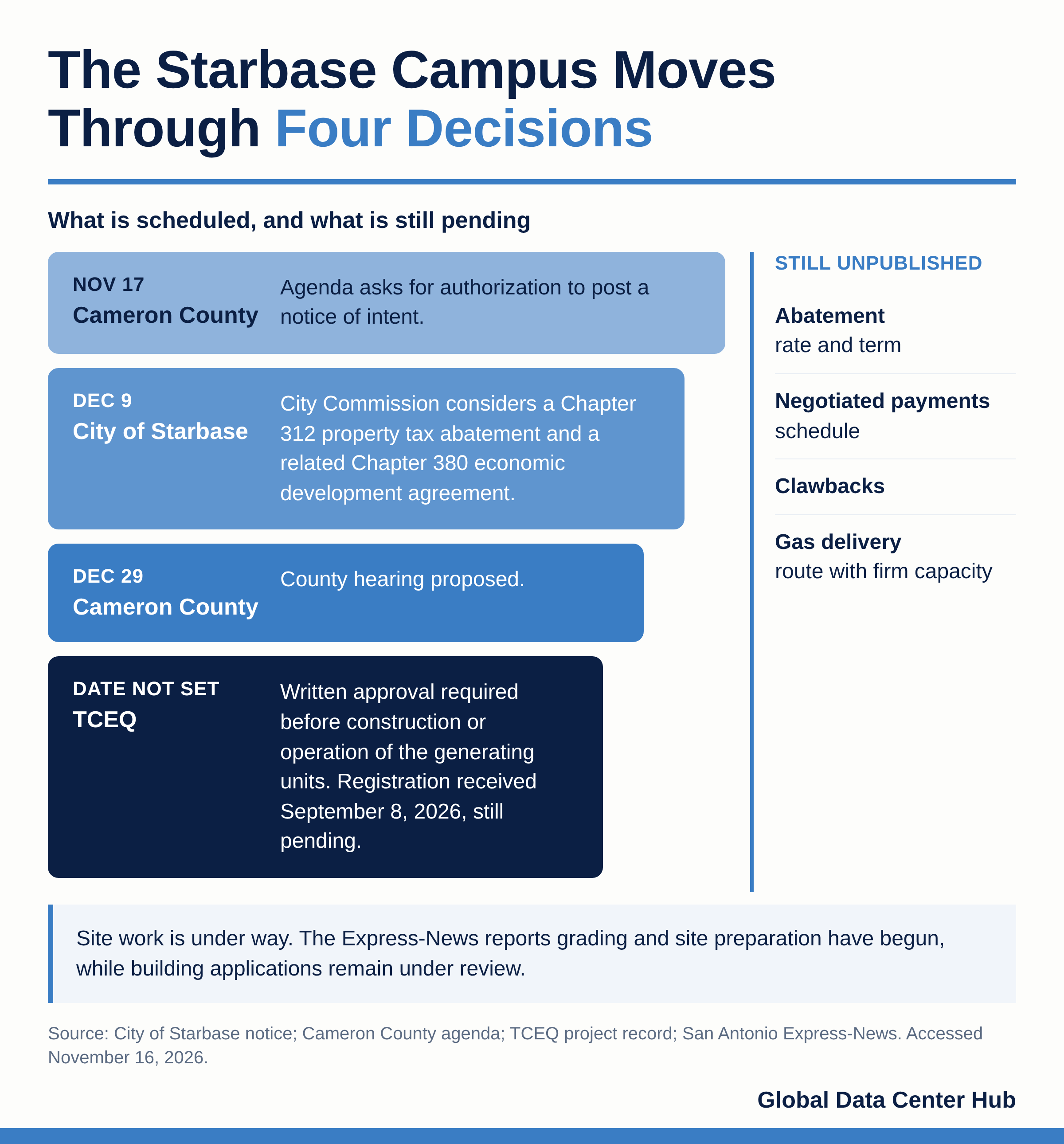
The news came from a city notice. The City of Starbase notice says the City Commission will consider a Chapter 312 property tax abatement and a related Chapter 380 economic development agreement on December 9.
It names Space Exploration Technologies Corp. as owner and applicant. It says SpaceX proposes to construct, own and operate a gas-fired power plant and super-compute facility.
It estimates about $24 billion of investment for the initial phases, with more phases and future expansion possible.
The notice gives no generation rating, IT load, building area, chip count, construction schedule or financing package. It gives no abatement rate or term either.
A few days later, SpaceX described the project. It says the campus will train frontier intelligence systems and help test technologies for space-based computing. It says the facility will generate its own electricity without drawing power from the public grid.
SpaceX announced its acquisition of xAI on February 2, 2026, so the AI use fits the group. The statement does not name a customer, a workload contract or a GPU order.
Work on the ground has started. The San Antonio Express-News reports that grading and site preparation have begun, while building applications remain under review.
So the right status is proposed. The site is owned and being graded. The tax agreements, the air permit and the commercial terms are still open.
Three Investment Figures for One Project
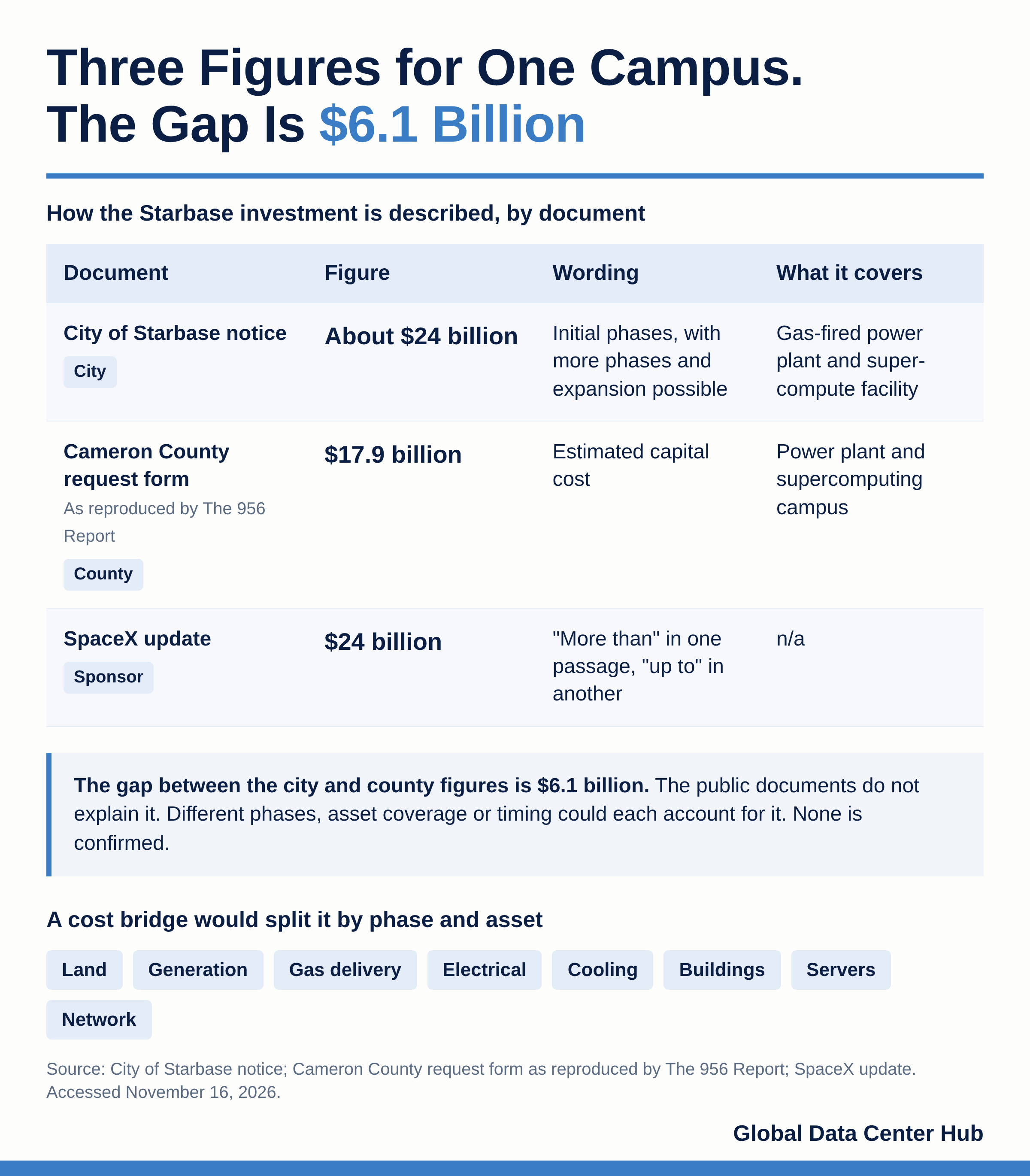
The $24 billion headline carries a reconciliation question.
The city notice says about $24 billion for the initial phases. A Cameron County request form, reproduced by The 956 Report, puts the estimated capital cost of the power plant and supercomputing campus at $17.9 billion.
SpaceX’s own update says “more than $24 billion” in one passage and “up to $24 billion” in another.
The gap between the city and county figures is $6.1 billion. The public documents do not explain it.
Different phases, different asset coverage or timing could each account for it. None is confirmed.
So do not divide any of these numbers by a megawatt figure. Without a cost bridge by phase and asset (land, generation, gas delivery, electrical, cooling, buildings, servers and network), there is no defensible cost per megawatt.
The servers will also wear out far faster than the turbines and buildings. One capex figure blends assets with very different lives.
Own Power Moves the Binding Point
The AI Infrastructure Scarcity Stack is the eight-layer map I use for what can hold up an AI project: power, transmission, land and permitting, water and cooling, fiber, equipment, capital, and operating and political capacity.
A campus that builds its own plant steps around the transmission layer. It puts more weight on the power layer itself.
Texas shows why that trade appeals. Governor Greg Abbott directed grid operators to pause new data center connection requests while those facilities are audited, the Texas Tribune reports. A campus that never draws from the grid is designed to sit outside that line.
The power plan is in the air filing. TCEQ’s registry lists the “Boca Chica Facility,” owned and operated by SpaceX, with power generation as its primary business and its air registration pending. The project record shows a standard permit registration received September 8, 2026, still pending.
The application introduction, reproduced by The 956 Report, describes 35 natural gas simple-cycle turbines in a temporary first setup. Eight permanent units replace them later.
The 956 Report puts the first setup at about 748 MW and the permanent one at about 708 MW. The Express-News reports roughly 750 MW. The full rating schedules are not public, so treat these as reported figures.
Two points matter for anyone sizing this campus. Those are generation figures, and server load is smaller. Usable IT power is what is left after cooling, plant auxiliaries, electrical losses, maintenance and reserve.
And the two setups do not stack. The permanent units replace the temporary ones.
SpaceX and the county also describe the grid link in different words. SpaceX says no draw from the public grid.
County project language, reproduced by The 956 Report, describes behind-the-meter generation meant to “limit the burden” of new load on ERCOT.
Both can be true. A single-line diagram would show whether there is any standby, startup or export connection.
The Air Permit Sets How Hard the Turbines Can Run
The emissions table in the reproduced application proposes a yearly NOx limit of 248.86 tons. The federal PSD major-source threshold is 250 tons. The margin is 1.14 tons.
The limit is labeled “Routine and MSS.” It covers planned operations, including maintenance, startup and shutdown. The table also marks several pollutants as not below Title V thresholds, which points to a separate operating permit path.
This is where the power layer binds. The limit is a yearly total. Full-output hours, starts and stops all have to fit inside it.
A training campus wants steady power around the clock. The dependable figure for the servers is what the permit allows across a year.
TCEQ’s standard permit requires written approval before construction or operation of the generating units begins. That approval is pending.
Gas and Water Come Next
No gas supply route for the campus has been disclosed. Reuters reports a separate SpaceX affiliate pipeline proposal, Starpipe, to feed a planned liquefaction plant for Starship’s methane propellant.
That reporting does not tie the pipeline to this campus. Lenders and partners will want the supplier, firm transport rights, curtailment terms and backup plan.
Water has more on the record. Brownsville’s announcement describes an agreement worth up to $220 million: $40 million into escrow first, then six quarterly payments of $30 million.
The money is restricted to water and wastewater projects and released as milestones are met. SpaceX says it has already provided $40 million to the Brownsville Public Utilities Board.
The capacity figures differ. Brownsville’s September statement describes about 18 million gallons a day of potential new regional capacity.
SpaceX’s update says about 20 million, with 8 million from potable reuse and 12 million from brackish groundwater treatment. No engineering document reconciling the two is public.
County language describes closed-loop cooling for the computing facility. It gives no water demand for the campus or the plant. The contribution is clear. The campus water budget is not yet public.
The land history is public too. Brownsville approved removing about 444.45 acres from its city limits and extraterritorial jurisdiction on August 29.
Its data center moratorium, covering the city and that jurisdiction, has since taken effect, the Tribune reports.
The tract now sits inside Starbase. The Tribune describes the water funding as offered in exchange for the land action. Brownsville says the agreements are independent.
The Tax Logic of a Fast-Depreciating Campus
SpaceX makes a tax argument that applies well beyond this site. Computing equipment depreciates quickly.
So, a supercompute campus can cause a large jump in taxable property value, then a steep decline as the equipment ages.
SpaceX proposes pairing a tax abatement with negotiated payments to local governments, to give them steadier revenue.
That argument fits the asset. The value to Starbase and Cameron County depends on terms not yet published: the abatement rate and term, the payment schedule and any clawbacks.
Cameron County’s November 17 agenda asks only for authorization to post a notice of intent. A county hearing has been proposed for December 29.
Ireland Wrote a Rule for This
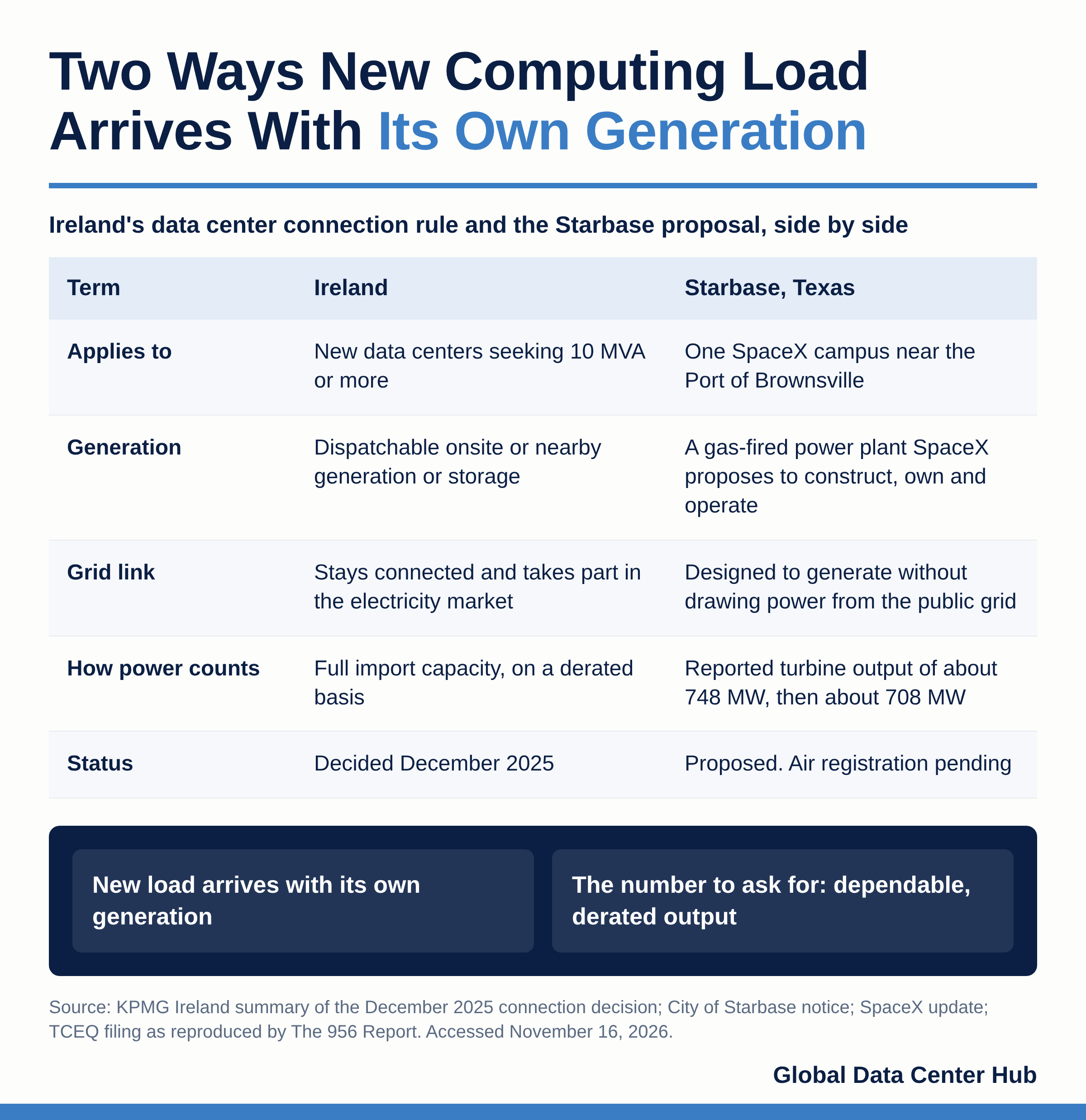
Ireland reached a related answer through regulation. In December 2025, its utility regulator decided that new data centers seeking 10 MVA or more must bring dispatchable onsite or nearby generation or storage covering their full import capacity on a derated basis, according to KPMG Ireland.
That generation stays connected and takes part in the electricity market.
In both places, new computing load arrives with its own generation. The difference is useful. Ireland counts derated capacity and keeps the plant tied to the system.
SpaceX proposes a campus that does not draw from its grid. The Irish rule names the number you should ask for here: dependable, derated output.
The Investment Lesson
For investors, track this as a proposed campus. Keep the $24 billion as a government and sponsor estimate. Leave IT megawatts and delivery dates blank until documents fill them.
For operators, the model is a trade. Your own generation can cut the wait for a utility. It adds fuel contracts, turbine maintenance, emissions limits and reliability planning to your job.
For policymakers, the useful question is the net deal: abatement, negotiated payments, water funding and service obligations, read together with their conditions.
Three documents will settle most of it. The TCEQ decision on the air registration.
The executed Starbase and county agreements after the December hearings. A gas delivery route with firm capacity.
Until then, ask one question of every update: how many dependable megawatts reach the servers?
The 35 turbines are the real story. Starbase swaps a grid queue for an air permit queue, and the NOx limit sits 1.14 tons under the threshold, so the permit caps megawatts before the gas does. China's western hubs face the same swap in reverse: there the grid connection is the queue that sets the schedule. Which one clears faster here?