
Welcome to Global Data Center Hub. Join investors, operators, and innovators reading to stay ahead of the latest trends in the data center sector in developed and emerging markets globally.
SpaceX completed its initial public offering on June 12, 2026, listing on Nasdaq under the ticker SPCX in the largest IPO on record.
Most coverage of the listing has centered on valuation, float, and the Starlink connectivity business.
I set that aside in this article.
My focus here is the company’s data center infrastructure:
The physical assets, the silicon, the power architecture, and the contracted compute capacity that sit inside its AI segment.
That segment houses xAI and the Grok model family alongside the physical compute and power assets.
It is the company’s primary growth-investment area and its largest loss center.
In the most recent quarter it ran a segment loss of about $2.5 billion, reflecting the scale of infrastructure and compute spending.
The overview below describes the footprint, the silicon, the power architecture, and the contracted capacity that segment comprises.
The Colossus Cluster
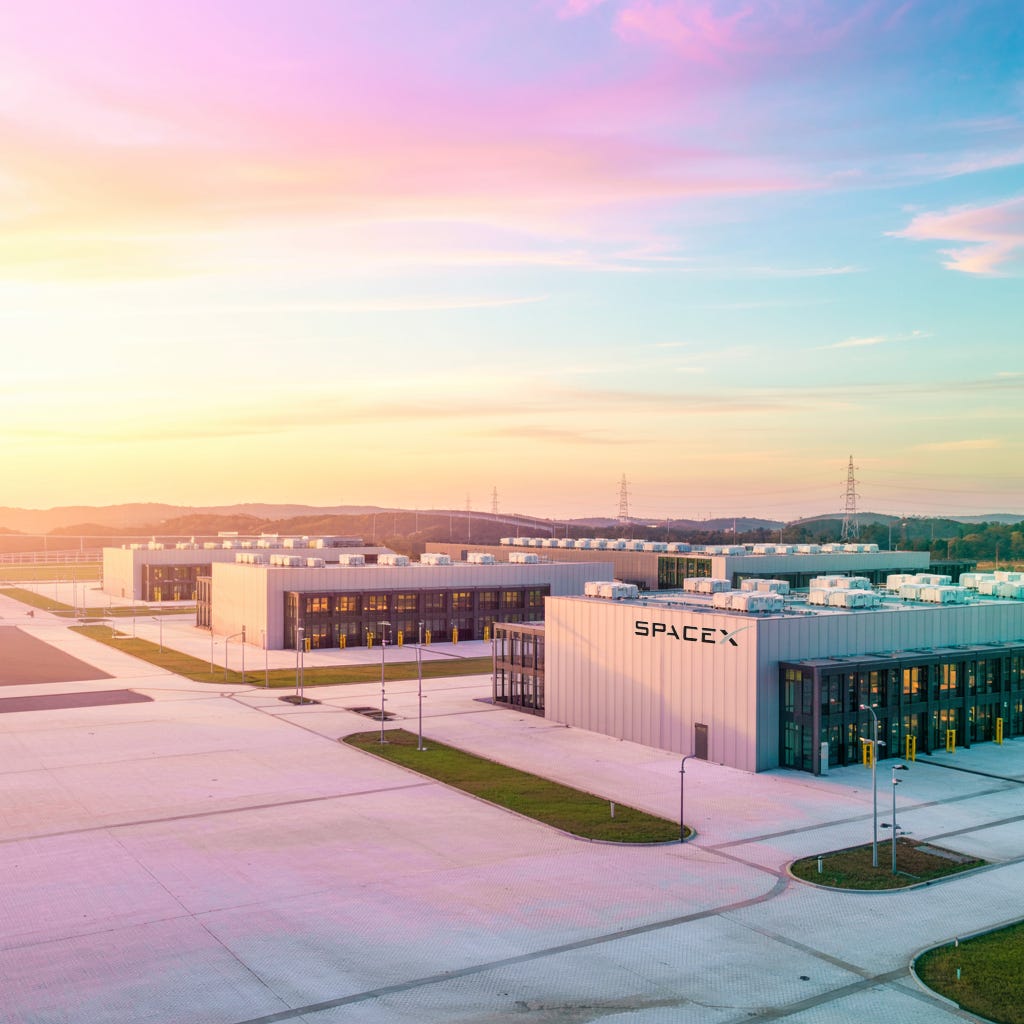
The infrastructure is anchored by two terrestrial data center assets in the mid-South US.
Colossus is the flagship facility, located on Paul R. Lowry Road in Memphis, Tennessee.
Colossus II is a multi-site cluster spanning data centers in Memphis, Tennessee and Southaven, Mississippi, roughly fifteen miles south across the state line.
Together the two assets provide approximately 1.0 gigawatt of compute power.
The clusters were built in distinct phases on different silicon generations.
Colossus operates roughly 100,000 NVIDIA H100 processors at approximately 130 megawatts.
The first Colossus II cluster operates roughly 110,000 GB200 processors at approximately 210 megawatts.
The second Colossus II cluster operates roughly 110,000 GB300 processors at approximately 220 megawatts. The processor mix spans three NVIDIA generations across a single contiguous compute platform.
Buildout Speed And Construction Method
The defining operational characteristic of the infrastructure is the speed at which it was built.
Colossus came online in 122 days by repurposing the shell of an existing factory rather than constructing a facility from raw ground.
Colossus II came online in 91 days from groundbreak.
The industry benchmark for a 100-megawatt greenfield data center is near two years.
The construction method, brownfield retrofit of existing industrial structures combined with self-generated power, is what compressed the timeline.
The Behind-The-Meter Power Stack
The power architecture is the second defining capability.
Rather than drawing primary load from the regional grid, Colossus II is built to operate on a self-built behind-the-meter natural gas power plant at gigawatt scale.
This bypasses the grid interconnection queue that constrains conventional data center development.
The power stack is assembled from several components.
In April 2025, a SpaceX subsidiary formed Stateline Power, LLC together with a subsidiary of Solaris Energy Infrastructure to provide off-grid power to the data center campus.
The company subsequently agreed to acquire mobile gas turbines and related packages for approximately $2.0 billion.
Tesla Megapack battery storage provides grid stability across the campus. The combined system allows the clusters to power up on self-generated electricity independent of utility interconnection timelines.
Contracted Compute Capacity
The infrastructure now serves external tenants under two major compute agreements, alongside SpaceX’s own model training.
In May 2026, SpaceX entered into Cloud Services Agreements with Anthropic PBC covering approximately 325,000 NVIDIA GPUs across Colossus and Colossus II.
Under those agreements, Anthropic pays $1.25 billion per month through May 2029, with capacity ramping at a reduced fee in May and June 2026.
Either party may terminate after an initial three-month period on 90 days’ notice.
On June 5, 2026, SpaceX entered into a second agreement, a Cloud Service Agreement with Google LLC, disclosed in an amendment to its registration statement ahead of the IPO.
The agreement provides Google access to approximately 110,000 NVIDIA GPUs, along with CPUs, memory, and related components.
Google pays $920 million per month from October 2026 through June 2029, roughly $32 billion across the life of the agreement, with capacity ramping at a reduced fee through September 2026.
Either party may terminate on 90 days’ notice after December 31, 2026.
If SpaceX does not deliver the committed GPU capacity by September 30, 2026, Google may terminate the agreement or accept a reduced GPU count at a proportionally lower fee following a one-month grace period.
Google has described the arrangement as bridge capacity for demand on its Gemini Enterprise platform.
In April 2026, SpaceX entered a separate compute and option agreement with Anysphere, Inc., the maker of Cursor. Alongside this external demand, SpaceX uses the same infrastructure to train its own Grok models.
Capital Investment And Expansion
The infrastructure has been built through a steep capital investment ramp.
AI segment capital expenditure was $463 million in 2023, $5.633 billion in 2024, and $12.727 billion in 2025, with $7.723 billion in the first quarter of 2026 alone.
The 2025 and early-2026 increases were driven primarily by terrestrial data center expansion, and AI segment capex in 2025 exceeded the Space and Connectivity segments combined.
The next phase is already specified.
Colossus II is expected to add at least 220,000 GB300 processors and more than 400 megawatts of additional compute power. That expansion is intended to train Grok 5.