
Welcome to Global Data Center Hub. Join investors, operators, and innovators reading to stay ahead of the latest trends in the data center sector in developed and emerging markets globally.
Anthropic and OpenAI are exploring data center deals of 20 to 30 MW each, CNBC reported on September 18, 2026, citing people familiar with the talks.
No counterparty has been named, and no party has confirmed the terms.
The talks cover deployments in the United Kingdom, the Nordics and the United States, according to CNBC.
CNBC reported no price, capital figure, delivery date or signed contract.
Anthropic and OpenAI Small Site Talks
Four people told CNBC that Anthropic had explored deals of that size in the UK and the Nordics.
Two said OpenAI had looked at similar sites in the Nordics. One described talk in the US involving both labs.
CNBC did not say whether 20 to 30 MW means total facility power or the power available to computing equipment.
OpenAI told CNBC that it is building a diversified compute portfolio. It said it assesses sites on requirements, performance, reliability, timing and cost. It declined to discuss specific talks.
Jabez Tan, head of research at Structure Research, told CNBC that a few megawatts at a site with power already connected can be more practical than waiting for a larger block in one place.
Anthropic and the Akamai Contract
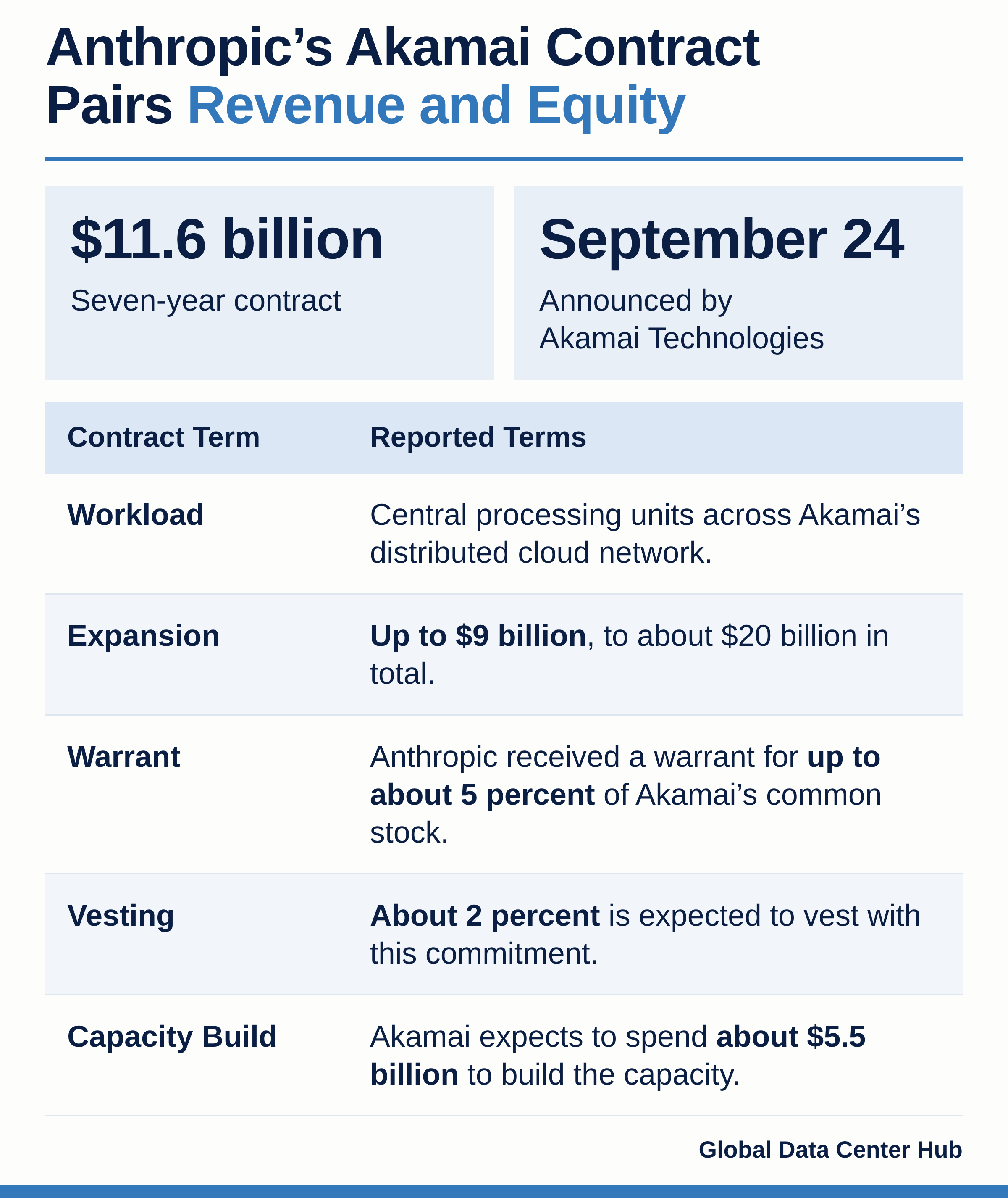
On September 24, Akamai Technologies announced an $11.6 billion, seven-year contract with Anthropic.
The contract covers work on central processing units, the general-purpose chips that also support AI services, across Akamai’s distributed cloud network.
It can expand by up to $9 billion, to about $20 billion in total.
Akamai issued Anthropic a warrant for up to about 5 percent of its common stock.
About 2 percent is expected to vest with this commitment. Akamai expects to spend about $5.5 billion to build the capacity, TechCrunch reported.
The Large Sites OpenAI and Anthropic Already Hold
In April 2026, Anthropic committed more than $100 billion over ten years to Amazon Web Services, for up to 5 GW of capacity.
In August, Anthropic signed a cloud contract with Nscale valued at about $45 billion, covering about 460 MW at a West Virginia campus, Blockspace reported.
Anthropic also signed a 20-year lease with TeraWulf for about 401 MW of computing load in Kentucky, according to Blockspace.
OpenAI passed the original 10 GW target for its Stargate program in April and has since added 3 GW in Georgia and 8 GW in Ohio, Quartz reported.
The Ohio leases cover about 8 GW of computing load, which would need about 10 GW of total power, according to Blockspace.
The first systems under the Nscale contract are scheduled for late 2027, Blockspace reported.
U.S. Hubs Have No 5 MW Block Left This Year
CBRE says no contiguous block of 5 MW, or more will be available in North America’s primary data center markets during 2026, and the labs are reportedly shopping for 20 to 30 MW.
The September coverage of the CNBC report described small sites as the faster route to capacity.
None of it set that route against CBRE’s count.
Read the talks as a speed move, and you miss where the small blocks have to come from.
Small Sites Will Come From Outside the Big Hubs
The big U.S. hubs are full. Vacancy in North America’s primary markets fell to a record low of 1.4 percent in the first half of 2026, according to CBRE.
The next large contiguous projects in those markets are not expected until late 2027 at the earliest.
So, a US deal at 20 to 30 MW this year has two places to land. It can sit in space a tenant already holds and gives up. Or it can sit outside the primary markets.
CBRE already points to the second. It expects demand in emerging markets to shift toward 25 to 75 MW sites serving inference and enterprise AI.
Inference is the work of answering user requests once a model is trained. NVIDIA is building toward the same size band.
With EPRI, Prologis and InfraPartners, it plans about 25 small data centers of 5 to 20 MW next to utility substations, across five US utilities, with pilot construction by the end of 2026.
Over the next 12 to 24 months, the first signed site will show which path the labs take.
If it lands in a secondary US market, the small-site map moves away from the hubs for good.
Britain’s Queue Grew Where Sites Are Largest
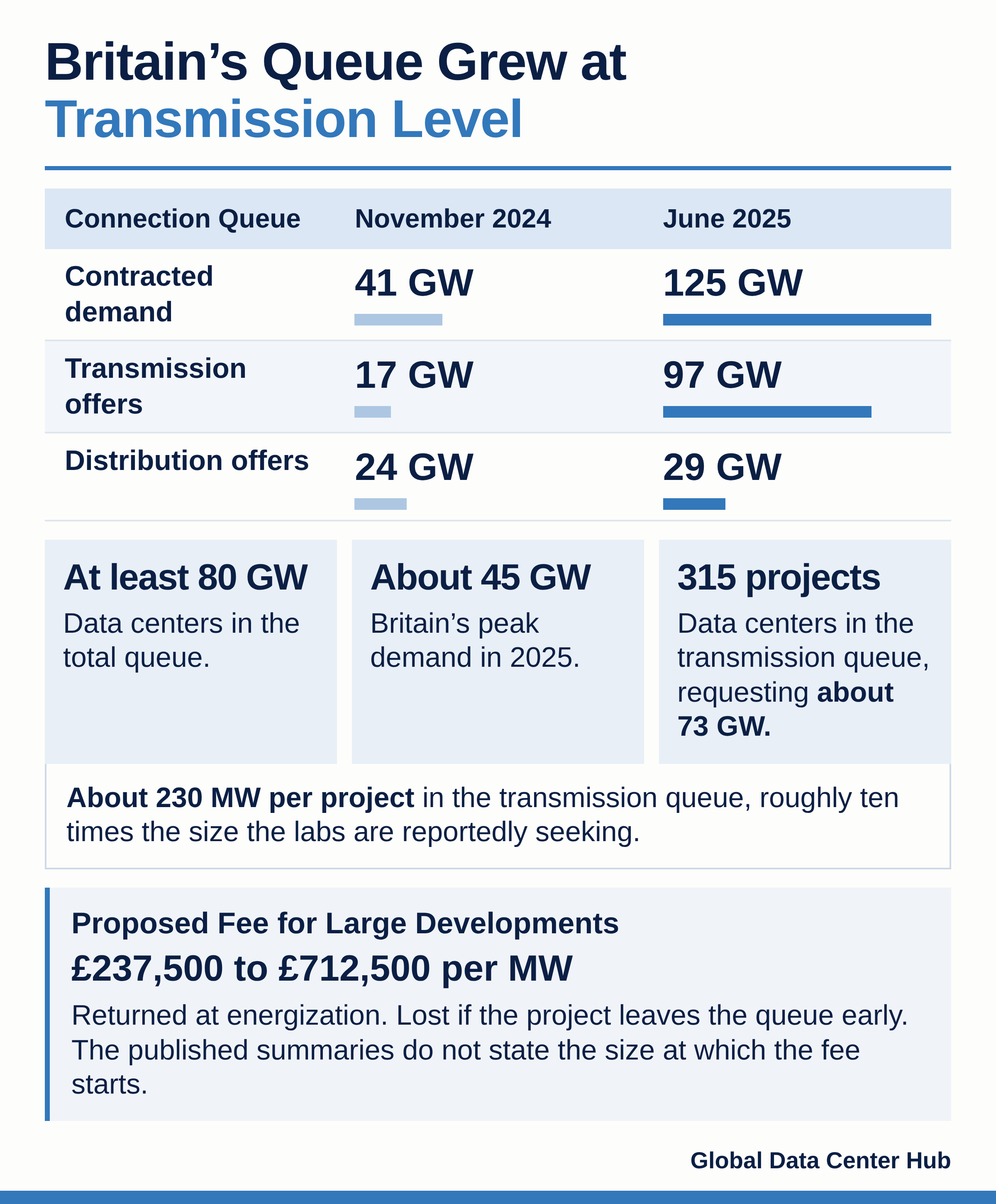
In the UK, the jam sits in the big connections. Contracted demand in Britain’s connection queue rose from 41 GW to 125 GW between November 2024 and June 2025, Ofgem reported.
Transmission offers, the high-voltage connections large sites need, grew from 17 GW to 97 GW. Distribution offers grew from 24 GW to 29 GW.
Data centers account for at least 80 GW of the total, according to Ofgem.
The transmission queue holds 315 data center projects asking for about 73 GW.
That is about 230 MW per project, roughly ten times the size the labs are reportedly seeking. Britain’s peak demand in 2025 was about 45 GW.
Ofgem proposed a fee on July 29 for large data center developments, set between £237,500 and £712,500 per MW.
The developer gets it back at energization and loses it if the project leaves the queue early. The published summaries do not state the size at which the fee starts.
That threshold decides the UK economics of a 20 to 30 MW site. Watch the final rule over the next year.
It will show whether small sites in Britain pay the same entry price as the 230 MW average.
Large Projects Break Before They Energize
The large sites break in the years between signing and switching on.
Local opposition blocked or delayed 45 US data center projects worth about $68 billion between April and June 2026, according to Data Center Watch. It counts 843 opposition groups across 49 states.
Equipment adds its own clock. Power transformers averaged 128 weeks for delivery in the US, according to a Wood Mackenzie survey from the second quarter of 2025.
JLL puts the average wait for a grid connection in primary markets at more than four years.
Anthropic’s Nscale capacity shows the same clock inside the labs’ own book. It was signed in August and delivers its first systems in late 2027.
No report ties the small site talks to a delay at any of the labs’ own campuses. The public record shows the gap. It does not show the cause.
Operators With Live Power Get the First Call
This read is for Operators: developers, owners of sites with power already connected, and landowners holding a grid position. The labs are asking for a size you may already have.
First, state what your megawatts measure. OpenAI’s Ohio leases show the gap: about 8 GW of computing load needs about 10 GW of total power. The evidence is your connection agreement and electrical design.
Settle it before you market the site, because the buyer will size the deal on the smaller number.
Second, prove the power is live. The evidence is an energization record or a signed connection offer. In Britain, add your queue position and any exposure to Ofgem’s proposed fee. This belongs in the first buyer screening.
Third, price what the buyer asks for beyond rent. Akamai gave Anthropic a warrant for up to about 5 percent of its stock alongside an $11.6 billion contract.
The filing is the first public record of that trade in this market. Take it into term sheet talks and decide your answer before the question comes.
Skip these, and the cost is concrete in Britain. Under Ofgem’s proposal, a large project that leaves the queue early loses £237,500 to £712,500 for every megawatt it holds.
The Small-Site Window Runs to Late 2027
The big US blocks return in late 2027, on CBRE’s timeline.
The Nscale capacity arrives in late 2027. Until then, sites with live power set the terms.
Rents already rose across every deployment size CBRE tracks in the first half of 2026, with 3 to 10 MW deployments up 8.3 percent.
That makes the next 15 months the window for anyone holding power. After late 2027, the large blocks come back and compete again.
The open question is what the labs are buying. Nobody has said whether 20 to 30 MW means total power or computing load, or whether any of these talks will sign.
The first signed deal will answer both, and it will set the price for every powered site behind it.