

Welcome to Global Data Center Hub. Join investors, operators, and innovators reading to stay ahead of the latest trends in the data center sector in developed and emerging markets globally.
The AI buildout has a financing problem that sits below the chip order.
A GPU earns nothing until a building, a power connection and a tenant with access to capital exist around it.
For three years, NVIDIA could leave that problem to its customers. Q3 fiscal 2027 shows that it no longer does.
The headline numbers were strong. Revenue of $115.8 billion beat NVIDIA’s own $108.0 billion guidance midpoint by 7.3% and LSEG consensus of $109.10 billion. Q4 is guided to $130.0 billion.
The more important disclosures sit in the CFO commentary, not the income statement. NVIDIA’s maximum guarantee exposure is now $118.0 billion. That is more than the company sold in the quarter.
NVIDIA’s own outlook now names the constraint.
Management said the fiscal 2028 view “considers data center readiness, the strength and durability of end customer demand and our customers’ access to capital.”
Power and buildings set the pace. Capital decides who gets built.
The Fastest Growth Is Where NVIDIA Now Lends Support
Data Center revenue was $107.6 billion, up 110% year over year. Hyperscale contributed $60.1 billion, up 71%. AI Clouds, Industrial & Enterprise contributed $47.5 billion, up 195%.
That split is the first signal. The fastest-growing segment is the one that includes AI clouds, the same kind of customer NVIDIA increasingly supports with leases, commitments and guarantees.
The Q4 guide needs one adjustment. It covers 14 weeks. On a simple 13-week basis, which is our calculation and not NVIDIA’s, $130.0 billion becomes about $120.7 billion, roughly 4.2% above Q3. Growth is still there, but the headline 12.2% overstates it.
Margins move the other way. Gross margin was 74.8% in Q3 and is guided to 71% to 72% in Q4. Management blamed supply costs, chiefly memory, which it absorbed to honor existing purchase orders. It called Q4 “the bottom” and expects 72% to 73% in fiscal 2028.
That cost is visible on the balance sheet. Supply and capacity commitments rose to $390 billion from $279 billion, mainly multiyear memory, with $203 billion falling in fiscal 2028. Raw materials inventory reached $15.8 billion, against $3.8 billion in January.
NVIDIA is buying supply years ahead to protect volume, and the cost of that supply is showing up in margin.
NVIDIA Now Sits Inside the Buildout’s Capital Stack
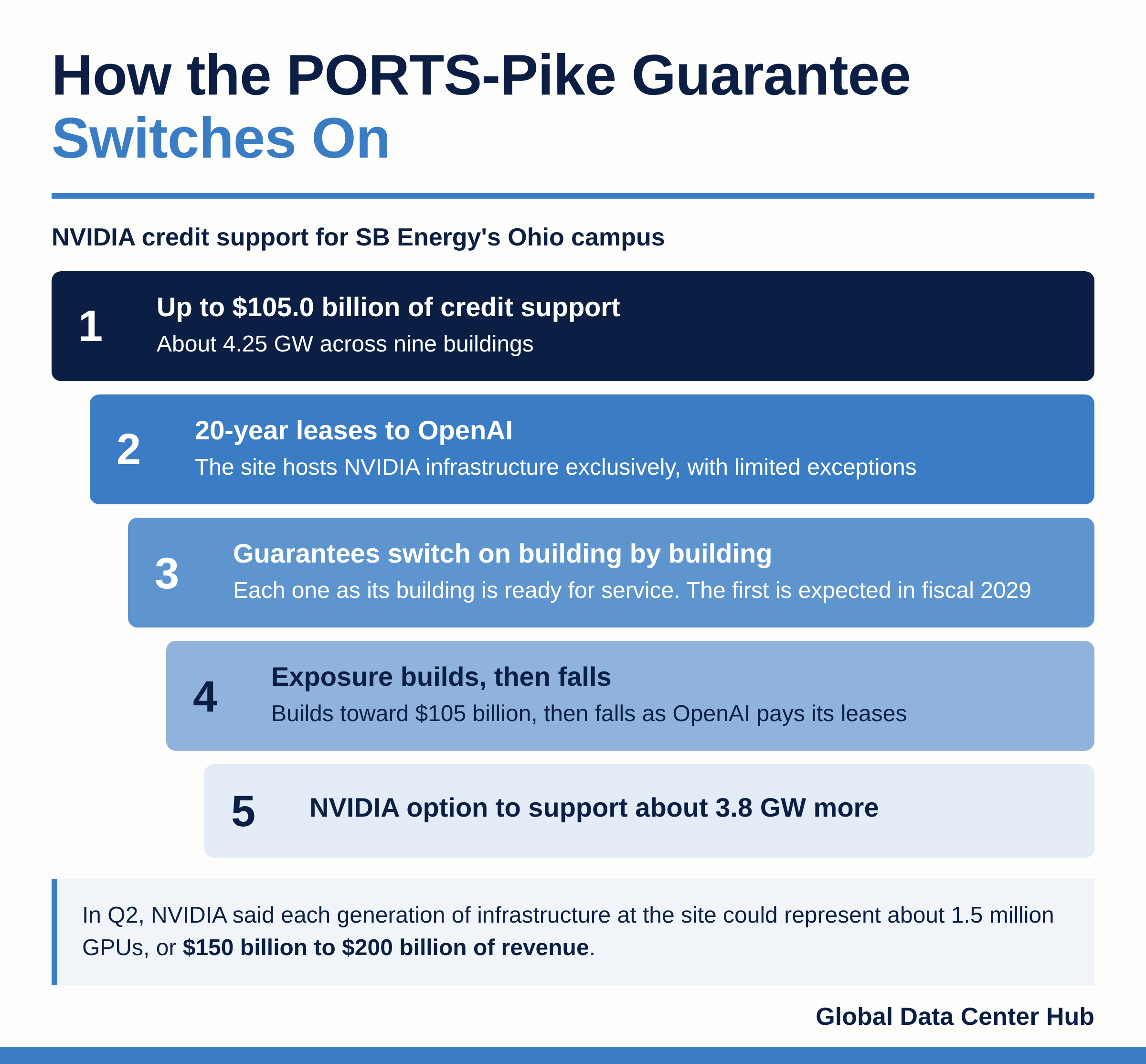
PORTS-Pike is the clearest case. NVIDIA provides credit support of up to $105.0 billion for about 4.25 GW across nine buildings on SB Energy’s Ohio campus. The site will host NVIDIA infrastructure exclusively under 20-year leases to OpenAI, with limited exceptions.
The guarantees switch on building by building, as each is ready for service. The first is expected in fiscal 2029. Exposure builds toward $105 billion and then falls as OpenAI pays its leases. NVIDIA holds an option to support about 3.8 GW more.
The logic is plain. In Q2, NVIDIA said each generation of infrastructure at the site could represent about 1.5 million GPUs, or $150 billion to $200 billion of revenue. NVIDIA is using its credit to unlock a campus that will buy its chips.
PORTS-Pike is not alone. Data center leases not yet commenced total $74 billion, with $63 billion falling in fiscal 2032 or later and terms up to 20 years. Neocloud agreements add $32 billions of contingent commitments.
A new $9.5 billion line covers power and systems credit support. Another $3.5 billion guarantees land, power and shell for neoclouds.
The same pattern runs into equity. Holdings reached $109.7 billion, against $35.1 billion in January, with $65.5 billion in non-marketable stakes. The private book took a $1.8 billion impairment this quarter.
These are obligations of different kinds, and they should not be added together. Each one, though, ties NVIDIA’s results to whether someone else’s building gets powered, financed and filled.
The Cash Covers It Today. The Terms Are Already Changing.
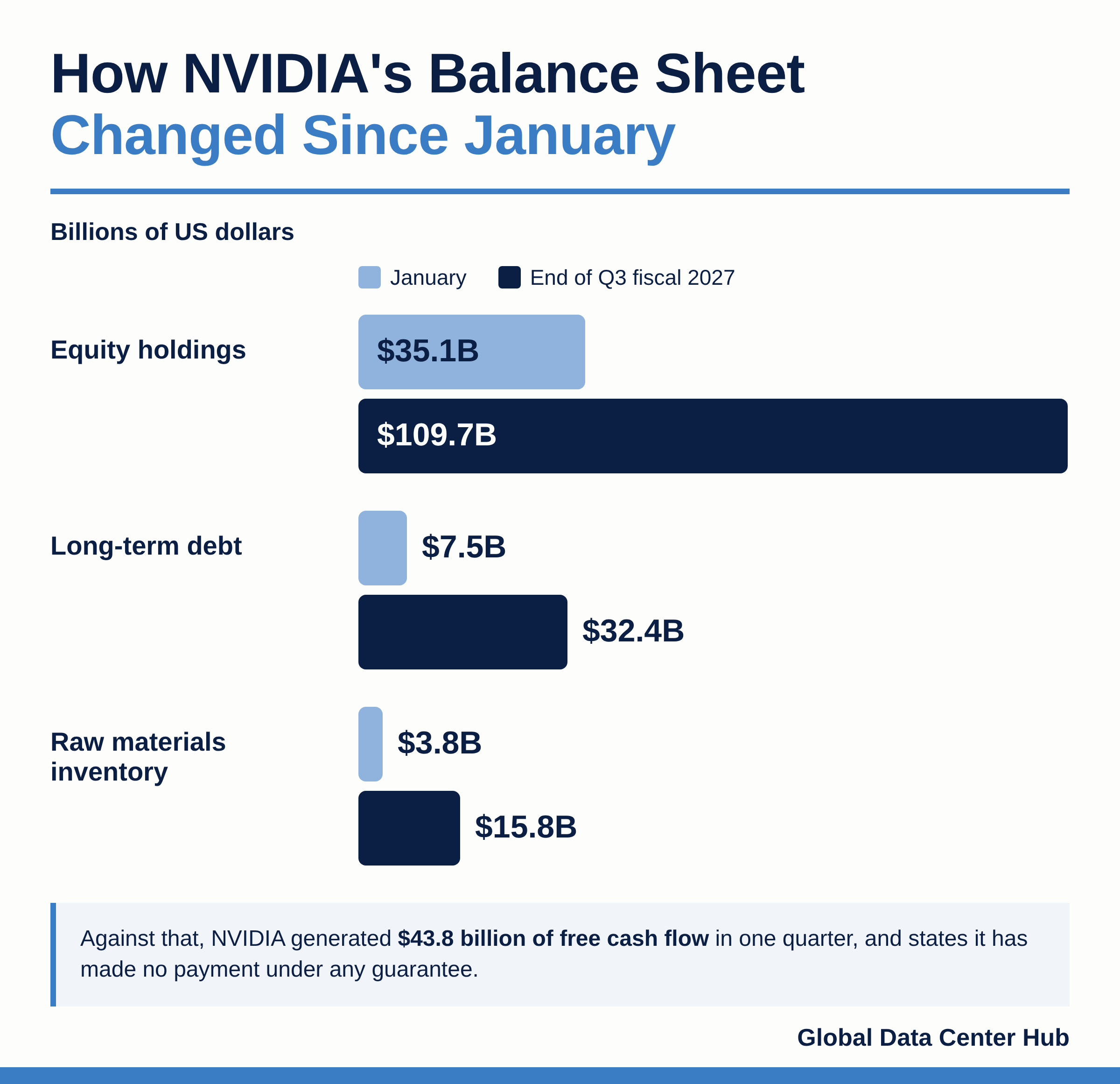
The strongest objection to this reading is simple. NVIDIA states it has made no payment under any guarantee. The first PORTS-Pike guarantee does not take effect until fiscal 2029. And $118.0 billion is a ceiling, not a loss estimate.
Against that ceiling, NVIDIA generated $43.8 billion of free cash flow in one quarter, 37.8% of revenue. It returned $28.1 billion, about 64% of that cash, through $22.1 billion of buybacks and $6.0 billion of dividends.
It has $227.3 billion of buyback authorization left and plans to use it through fiscal 2028.
That objection is right about solvency. It misses the direction of travel.
Long-term debt rose to $32.4 billion from $7.5 billion in January. Receivables reached $81.0 billion, and days sales outstanding rose to 64 from 60.
NVIDIA cites Rubin shipment timing and extended terms for some investment-grade customers. Customer support is showing up in working capital, not just in footnotes.
NVIDIA is also marking exits. The CFO commentary states that neocloud commitments take effect only if the neoclouds secure financing and the compute is “deployed, made operational, and accepted by us.”
Otherwise they “could be reduced or eliminated.” Kress called this a clarification, not a change.
Her stance on future support was narrower. NVIDIA is “rigorously evaluating future investments, commitments and guarantees,” she said, and named land, power and shell as the most likely area for future financing support, alongside prepayments from investment-grade customers.
The Australia plan fits that shape: up to 2 GW of land, power and shell capacity with NVIDIA cloud partners by the end of calendar 2027.
Read together, NVIDIA is moving its support away from the compute layer and toward the physical site. That is where power gets secured, and where the asset outlasts any one GPU generation.
The Disclosure Gap Lands Where the Exposure Is
The quarter’s governance break would matter less if NVIDIA’s role were still simple.
Jensen Huang resigned as President, CEO and director on November 11, after the board opened an independent investigation on November 8. Colette Kress is interim CEO and remains CFO.
Chair Harvey C. Jones said on the call that the board “does not intend to reinstate Jensen as CEO.”
The Wall Street Journal has reported an SEC civil probe into NVIDIA’s disclosures, which NVIDIA has not confirmed in its own documents.
The 10-Q was not filed by the November 17 report. NVIDIA says it will file “in the coming weeks.” That filing carries the legal proceedings, the risk factors and the guarantee footnotes.
So the document investors need to judge $118 billion of guarantee exposure is the one waiting on the investigation. And the executive who signs the financial disclosures is also running the company.
NVIDIA’s product position is not in question this quarter. Vera Rubin NVL72 racks are running at CoreWeave, Google Cloud, Microsoft Azure, OCI and Nebius.
The open question is whether the market keeps pricing NVIDIA as a chip company when a growing share of its risk looks like a lender’s.
Export Rules Now Reach the Data Center, Not Just the Chip
On November 16, the Commerce Department’s Bureau of Industry and Security released an interim final rule on remote access to advanced AI chips.
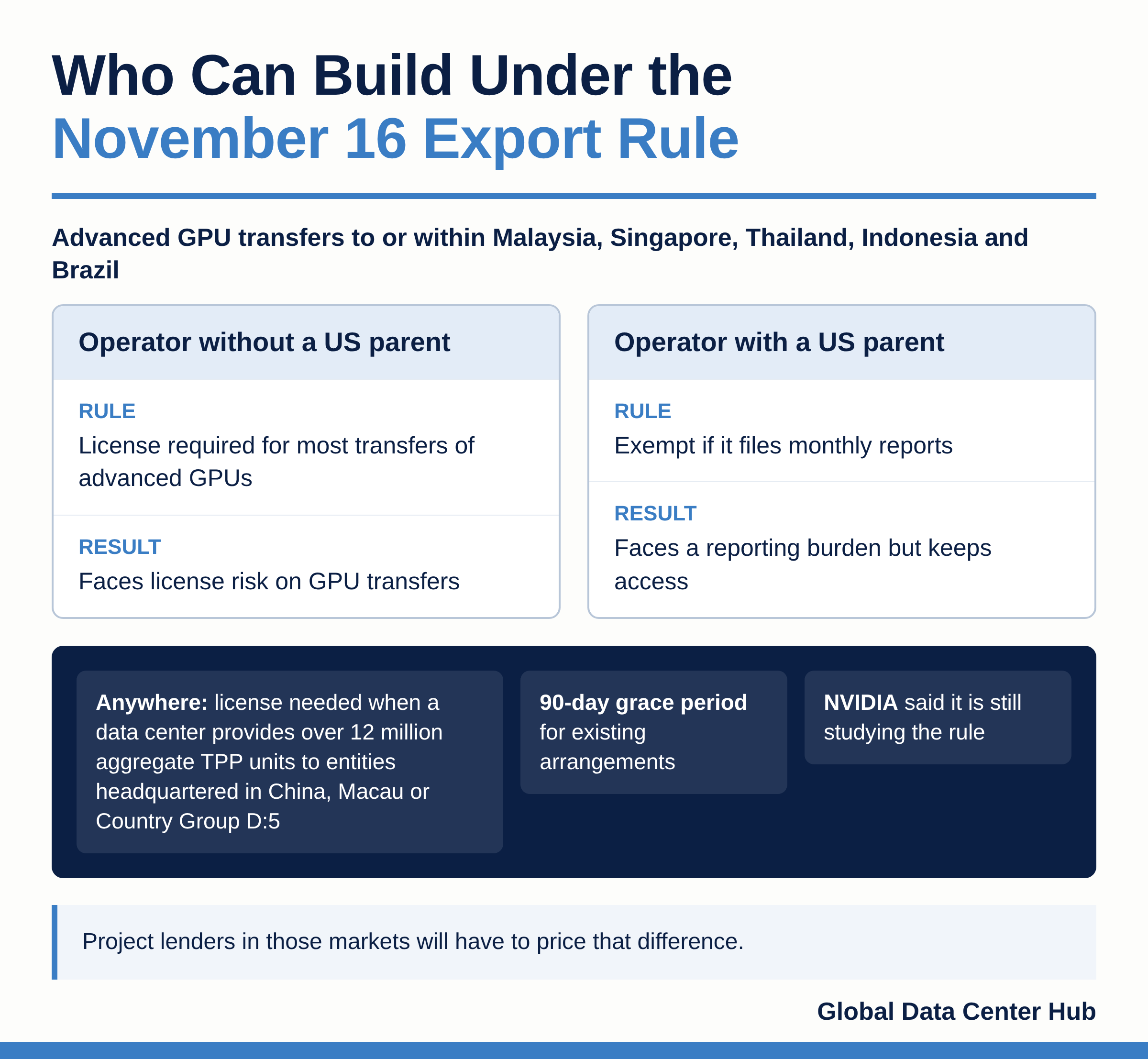
According to Sidley Austin’s summary, it requires licenses for most transfers of advanced GPUs to or within Malaysia, Singapore, Thailand, Indonesia and Brazil.
Companies with a US-headquartered parent are exempt if they file monthly reports.
It also requires a license when a data center anywhere will provide more than 12 million aggregate TPP units of compute to entities headquartered in China, Macau or Country Group D:5. Existing arrangements get a 90-day grace period.
For emerging markets, this changes who can build. A Southeast Asian or Brazilian operator without a US parent now faces license risk on GPU transfers.
A US-parented operator faces a reporting burden but keeps access. Project lenders in those markets will have to price that difference.
NVIDIA said it is still studying the rule. It has stopped shipping licensed Hopper Data Center products to China, which contributed $2.4 billion this quarter, and the Q4 guide assumes no Data Center compute revenue from China.
Separately, China and Hong Kong revenue by customer headquarters was $11.05 billion, a figure NVIDIA does not reconcile with the Hopper number.

What Resolves Next
Three signals matter.
First, the 10-Q. Watch the guarantee footnotes, the risk factors and the customer concentration disclosure. Three direct customers accounted for 36% of Q3 revenue.
The filing deadline for a large accelerated filer falls on December 4.
Second, whether Q4 margin is truly the bottom. If memory costs keep rising inside $390 billion of supply commitments, 72% to 73% in fiscal 2028 gets harder to hold.
Third, the first neocloud commitment that is reduced or eliminated. That would show the new wording works as an exit door in practice, not only on paper.
For investors, NVIDIA’s earnings now depend partly on its customers’ access to capital, which management itself named in its fiscal 2028 outlook.
For operators, NVIDIA’s support is shifting toward land, power and shell, so a secured, powered site now carries more weight in a financing conversation than a GPU allocation.
For policymakers, one chip supplier stands behind credit for a 4.25 GW campus in Ohio while export rules decide which countries can host its chips.
The Bottom Line
NVIDIA’s quarter answered the demand question again. Revenue beat, Q4 guidance rose, and management lifted its fiscal 2028 growth view to about 75% from 70%.
The question it raised is about structure. NVIDIA no longer only sells into the AI buildout.
It supplies credit, leases and equity to it, with $118 billion in maximum guarantee exposure and $109.7 billion in equity holdings.
That role is affordable on today’s cash flow. It also means NVIDIA’s risk now follows power readiness and customer financing, not just chip demand.
And the filing that would let investors measure that risk was not out when the quarter was reported.