
Welcome to Global Data Center Hub. Join investors, operators, and innovators reading to stay ahead of the latest trends in the data center sector in developed and emerging markets globally.
TL;DR
NVIDIA made a minority equity investment in Cloverleaf Infrastructure, a Houston data center site developer, under a strategic partnership announced on August 21, 2026. Neither company disclosed the investment size or the equity percentage. The announcement attaches no offtake, no chip supply agreement, and no power purchase agreement. J.P. Morgan Securities served as exclusive financial advisor to Cloverleaf Infrastructure and Kirkland & Ellis served as legal counsel.
NVIDIA declined to acquire Cloverleaf Infrastructure outright and took a minority position instead. The Wall Street Journal reported that Cloverleaf Infrastructure was working with JPMorgan Chase on strategic alternatives that included a full sale, and that the company raised $300 million at founding in 2024. Control of a site developer carries the entitlement, permitting, and interconnection liabilities that a minority stake avoids.
The NVIDIA DSX Platform enters Cloverleaf Infrastructure sites at the design phase, before utility agreements are signed. Substation sizing, floor loading, and coolant capacity are fixed during civil engineering, which moves accelerator switching cost out of procurement. Lenders underwriting powered land will need to price architecture neutrality as a separate variable.
Part One: The Record
NVIDIA made a minority equity investment in Cloverleaf Infrastructure, a privately held data center site developer, as part of a strategic partnership announced on August 21, 2026.
Neither company disclosed the size of the investment or the equity percentage acquired.
The stated purpose is to support the buildout of AI factories and to help Cloverleaf Infrastructure serve customers and utility partners meeting rising demand for accelerated computing.
Cloverleaf Infrastructure is headquartered in Houston.
Disclosed Terms And Transaction Advisors
The announcement records no price for the stake and no equity percentage.
It names no chip supply agreement and no power purchase agreement attached to the investment. It sets out no minimum customer commitment from either party.
J.P. Morgan Securities served as exclusive financial advisor to Cloverleaf Infrastructure, and Kirkland & Ellis served as legal counsel.
The Wall Street Journal reported before the announcement that NVIDIA was expected to invest several hundred million dollars.
The same report stated that Cloverleaf Infrastructure had been working with JPMorgan Chase in recent months on strategic alternatives that included a possible sale of the entire business.
Neither the figure nor the sale process appears in the announcement, and Reuters confirmed only that financial terms were undisclosed.
Founding Backers And Site Portfolio
Cloverleaf Infrastructure was formed in 2024 with an initial investment from Sandbrook Capital and NGP Energy Capital.
The company describes itself as a real estate developer working with investors, energy innovators, and utilities to deliver clean-powered, shovel-ready sites to technology companies that build and operate data centers.
Since founding it has delivered multiple gigawatt-scale projects to customers across North America.
The Wall Street Journal reported that the founding raise totaled $300 million, that Cloverleaf Infrastructure has sold projects amounting to more than 7 gigawatts of powered land, and that its pipeline exceeds 10 gigawatts.
The same report identified Wisconsin sites intended for Oracle and OpenAI. None of those figures appears in the announcement.
David Berry, Co-Founder and CEO of Cloverleaf Infrastructure, said the partnership strengthens the company’s ability to identify and develop high-quality sites.
Application Of The NVIDIA DSX Platform
Cloverleaf Infrastructure will apply the NVIDIA DSX Platform to bring site, power, cooling, computing, and facility decisions together earlier in the design phase.
NVIDIA states the platform helps customers weigh infrastructure tradeoffs and build AI factories that deliver more useful output within available power, water, and grid constraints.
Once sites are operational, NVIDIA DSX infrastructure and software are intended to optimize energy use and computing capacity.
Cloverleaf Infrastructure customers will be able to engage NVIDIA across accelerated computing, high-performance networking, infrastructure and platform software, and NVIDIA DSX.
Nico Caprez, Vice President of Global AI Infrastructure Growth at NVIDIA, said that land, power, and shell form the foundation of AI factories.
Neither company named a first joint site, a capacity target, or a delivery date.
Part Two: The Read
Three Hundred Million Is The Number That Prices This Deal
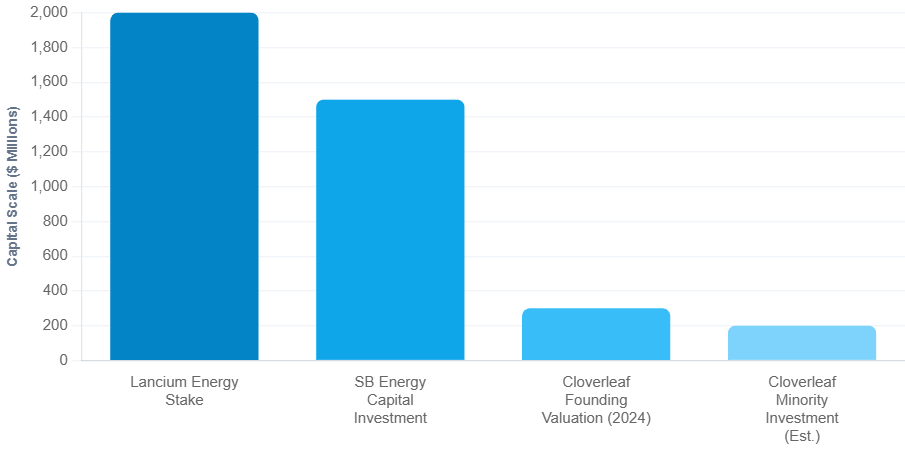
$300 million is the amount Cloverleaf Infrastructure raised at founding in 2024, according to The Wall Street Journal, and it sets the scale of what NVIDIA turned down.
The sale process and the minority structure have both been reported, and no coverage has put them together: NVIDIA had the whole company available and took a slice.
Every read treating this as NVIDIA moving upstream into land has the direction of travel backwards.
A Declined Acquisition Prices What NVIDIA Actually Wanted
NVIDIA has been writing far larger checks into the power layer.
Reporting places roughly $2 billion into Lancium and $1.5 billion into SB Energy, both ahead of this transaction, and both figures are secondary-sourced.
Against those, a company capitalized at $300 million two years ago was affordable at any structure NVIDIA preferred. It chose the smallest one available.
Control of a site developer means control of its liabilities.
Zoning, interconnection, transformer delays, water permits, and opposition become consolidated risks when a buyer takes the whole entity and a semiconductor balance sheet doesn’t make them disappear.
A minority position with a design integration attached delivers the outcome NVIDIA wants without the drag.
Watch the next site-layer investment. If it is also minority with platform integration, NVIDIA has a repeatable template, the acquisition path is closed, and site development stays fragmented for another cycle.
The Design Standard Lands Before The Interconnection Agreement
The NVIDIA DSX Platform enters at the design phase, which places NVIDIA’s density, cooling, and electrical assumptions inside the site before the utility agreement is signed.
Substation sizing, floor loading, coolant distribution capacity, and water strategy are fixed during civil engineering, and civil engineering is the least reversible layer of a data center.
That timing changes where switching costs live.
A site built around one accelerator’s power and thermal profile can require costly redesign, requalification, and utility renegotiation to switch. Procurement decisions cost little by comparison.
The choice is made years before anyone selects a chip.
Over the next twelve to twenty-four months, lenders underwriting powered land will need to price architecture neutrality as a distinct variable.
A site’s residual value depends on how many buyers can use it as entitled, and a portfolio designed to one standard has fewer of them.

Channel Access Without A Purchase Obligation
The announcement gives Cloverleaf Infrastructure customers access to NVIDIA across the full AI factory stack.
It attaches no offtake, no chip supply agreement, and no minimum commitment in either direction.
NVIDIA reaches gigawatt-scale projects years before any procurement process opens, and it owes nothing for the privilege.
Demand risk sits where it sat before, with the developers and hyperscalers who lease the land and buy the hardware.
Cloverleaf Infrastructure gains capital and a design partner, and gains no contracted revenue.
That distinction matters for anyone marking a site developer with a strategic investor on the register.
Nothing disclosed here guarantees Cloverleaf Infrastructure a dollar of NVIDIA-driven revenue.
Underwrite The Specification, Not The Stake
Private Capital. Infrastructure funds and family offices evaluating site developers should ask: when does a hardware vendor’s design standard enter the site, and what does removing it cost. Price re-specification as a line item.
Funds that skip this will buy powered land portfolios whose optionality was spent during entitlement, and they will find out at exit, when the buyer pool is narrower than the model assumed.
Public Markets. NVIDIA holders now have equity exposure to Lancium, SB Energy, and Cloverleaf Infrastructure, alongside a financing platform targeting over $500 billion in third-party capital. Each stake is individually immaterial, and none carries a disclosed size.
The aggregate is a portfolio of illiquid infrastructure exposures accreting inside a semiconductor income statement with no line item to track it. The disclosure that makes this measurable may take several quarters to arrive.
Operators. Developers and hyperscalers leasing Cloverleaf Infrastructure land inherit whatever specification the entitlement carries. Negotiate design neutrality into the site agreement now, while the pipeline is still being entitled and the terms are open.
Operators who take delivery of a finished site and then discover its constraints will pay for flexibility they could have written in for nothing.
The Standard Outlives The Stake
NVIDIA bought a position in how American AI sites get designed, and it paid a price that will look small against what the standard is worth.
The stake can be sold. The substations, the floor loads, and the coolant capacity built to one specification stay in the ground for thirty years.
The open question is whether any competing accelerator vendor can now enter the design phase at all.
Cloverleaf Infrastructure is one developer among several, and the model here is cheap to copy.
If the answer arrives as silence over the next four quarters, the design layer consolidated while the market was still counting gigawatts.