
Welcome to Global Data Center Hub. Join investors, operators, and innovators reading to stay ahead of the latest trends in the data center sector in developed and emerging markets globally.
TL;DR
New York’s Executive Order 62 froze permitting for data centers above 50 MW while 9,682 MW of data center load sat in the NYISO interconnection queue. A state with available grid capacity chose to withhold it rather than accelerate it.
The order shifts grid upgrade costs onto developers through beneficiary-pays allocation: data centers fund transmission, distribution, and network upgrades directly, ending the fifteen-year model that socialized interconnection cost across the ratepayer base and made cheap-power markets pencil.
The repricing extends beyond New York: discretionary-permit projects face a one-year delay floor with no confirmed ceiling, and as the state positions the framework as a national model, the cost-allocation structure is positioned to spread to Virginia and Texas, where far more hyperscale capacity is at stake.
Permitting Risk Now Prices Alongside Power
The signal is not the pause. The signal is that a state with grid capacity chose to withhold it.
New York held roughly 9,682 MW of data center load in its interconnection queue and answered that demand with a permitting freeze, not an acceleration.
Mainstream coverage read Executive Order 62 as an environmental measure. It is a cost-allocation measure.
The states that follow will not copy the environmental language.
They will copy the mechanism that shifts grid upgrade costs onto the developer.
Firms that underwrote New York based on power prices alone now hold assets whose feasibility depends on a variable they never modeled.
The 50 MW Threshold Targets Capital, Not Carbon
Governor Hochul set the moratorium threshold at 50 MW.
The legislature’s competing bill set it at 20 MW.
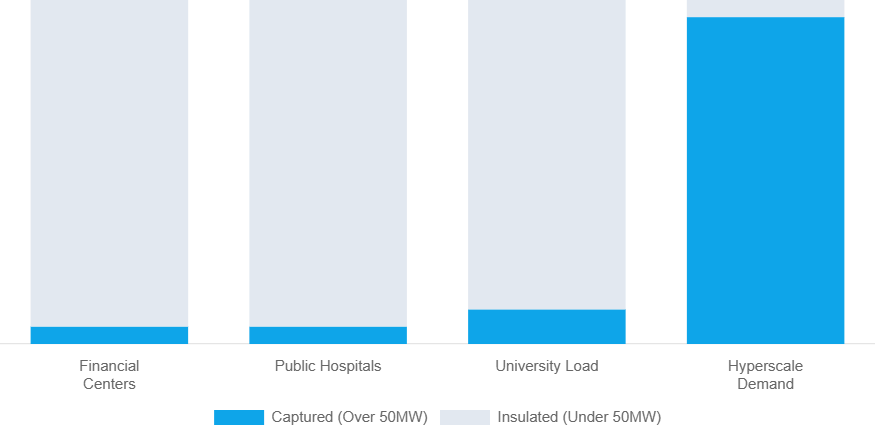
The gap between those two numbers is the entire argument. A 50 MW floor insulates back-office financial services, hospitals, and academic load while capturing only hyperscale-scale demand.
That is not an environmental line.
Environmental impact does not begin at 50 MW.
The threshold is calibrated to isolate the specific projects that carry grid-upgrade cost and community-sentiment risk, and to hand local governments a state-provided framework to extract concessions once the freeze lifts.
The number tells you the policy targets capital, not carbon. Underwrite the next state’s threshold as the tell for who it intends to tax.
Beneficiary-Pays Ends the Ratepayer Subsidy
The order directs data centers to fund grid infrastructure directly and pushes toward a dedicated utility rate class.
Doc 2’s supporting material frames the mechanism as beneficiary-pays: the developer bears one hundred percent of transmission, distribution, and network upgrade cost.
For fifteen years the siting model assumed the utility socialized interconnection cost across the ratepayer base.
That subsidy is what made cheap-power markets pencil.
New York is removing it and calling the framework a national model.
The forward read for the next 12 to 24 months is that interconnection cost migrates from an externality onto the project’s own capital stack, and the markets that adopt the rate-class structure will reprice every pro forma built on socialized grid cost.
Investor Action
Private Capital. Infrastructure funds and private equity holding New York-exposed pipeline should diligence permit status now, not at the next milestone.
The freeze shields projects already holding complete permits or under construction.
Everything in the discretionary-permit stage carries a one-year timeline floor with no confirmed ceiling, because the lift depends on DEC finalizing standards, and the crypto precedent shows DEC missing its statutory deadline by more than a year.
Re-underwrite queued New York positions with a two-year delay case and price the beneficiary-pays upgrade cost into the equity return.
The cost of waiting is holding an asset at a power-cost basis the state has already decided to raise.
Public Markets. Public equity investors holding hyperscale and REIT names with New York disclosure should benchmark exposure against the 9,682 MW that now sits behind a regulatory floor.
The immediate earnings impact is contained, because New York was never a primary hyperscale destination.
The mispriced risk is contagion.
As sponsors position this as a national model, expect the cost-allocation framework to spread to major hyperscale markets like Virginia and Texas, where far more capacity is at stake.
Waiting for that repricing to appear in a filing means buying it after the market has.
Operators. Developers and hyperscalers acting as buyers must now underwrite legislative stability and community sentiment as siting inputs alongside grid access.
The end of regulatory uniformity, in DLA Piper’s framing, means power availability alone no longer determines feasibility.
Sequence new site selection toward jurisdictions that have declared their posture and treat undeclared states as carrying latent moratorium risk.
Structure community-benefit contributions into the base case rather than negotiating them as concessions later.
A proposed surcharge on the order of one million dollars per megawatt, drawn from Doc 2 and treated here as an estimate rather than a confirmed term, is the number to model as the emerging floor.
The Verdict
New York did not pause data centers. It repriced them.
The order converts a permitting process into a cost-allocation negotiation and packages the result as a template.
The long-term significance is that the AI infrastructure build-out just acquired a second binding constraint.
Power was the first. Permitting is the second, and unlike power it does not respond to capital.
The market inflection is the shift from underwriting energy cost to underwriting regulatory posture, and the firms that build that discipline now will diligence the next moratorium before it is signed.
The open question is which state declares next, and whether its threshold targets carbon or capital.
Local benefit needs to be considered. Local zoning approval is the last mile.