
Welcome to Global Data Center Hub. Join investors, operators, and innovators reading to stay ahead of the latest trends in the data center sector in developed and emerging markets globally.
Nebius signed a $3.5 billion loan with Citi that matures in 364 days. It is built to be replaced, and that is the point of it.
The facility gives Nebius cash to keep buying GPUs and building data centers into 2027 without locking in long-term debt terms today.
The company says the facility gives it flexibility over the timing and structure of further capital raising. What must go right is just as clear.
New capacity has to reach paying service fast enough to support longer, cheaper loans before the bridge comes due on October 16, 2027.
So, the headline number matters less than the order in which the money arrives.
What Nebius Signed
Nebius signed the agreement on October 17 and announced it on October 22. The SEC filing calls it a Bridge Facility Agreement. Citibank, N.A. is the mandated lead arranger and lender, and Citi affiliates act as agent and security agent.
There are three borrowers: Nebius Group N.V., the Amsterdam parent, plus Nebius Inc. in Delaware and Nebius B.V. in the Netherlands.
The loan is secured by substantially all of each borrower’s assets. That includes the parent’s shares in the two subsidiaries, subject to excluded assets and permitted liens.
Pricing starts at Term SOFR plus 2.75%. The margin rises by 0.25 percentage points for each 90-day period after signing, up to 3.50%. On the filing’s summary terms, the steps fall around January 15, April 15 and July 14, 2027.
Nebius can prepay without premium or penalty. A minimum liquidity covenant applies. Its threshold is not disclosed.
Proceeds go to data center development, GPU procurement and general corporate purposes, according to the company announcement.
The announcement gives the maturity, the starting rate and the cap. The filing adds the bridge label, the 90-day steps, the parent as a borrower and the reach of the security.
Read together, those terms describe timing capital. A margin that climbs each quarter, paired with free prepayment, rewards early refinancing.
The cost of waiting is easy to size. If the full $3.5 billion were drawn, the margin alone would run about $96 million a year at 2.75% and about $123 million at 3.50%, before SOFR, fees or hedging.
That is a GDCH calculation on an assumption the record does not confirm. It shows why the facility rewards a quick takeout.
Two facts are not public: how much Nebius drew at closing and how much remains available. The $3.5 billion is the size of the facility, not a confirmed cash receipt.
How the Money Stacks Up
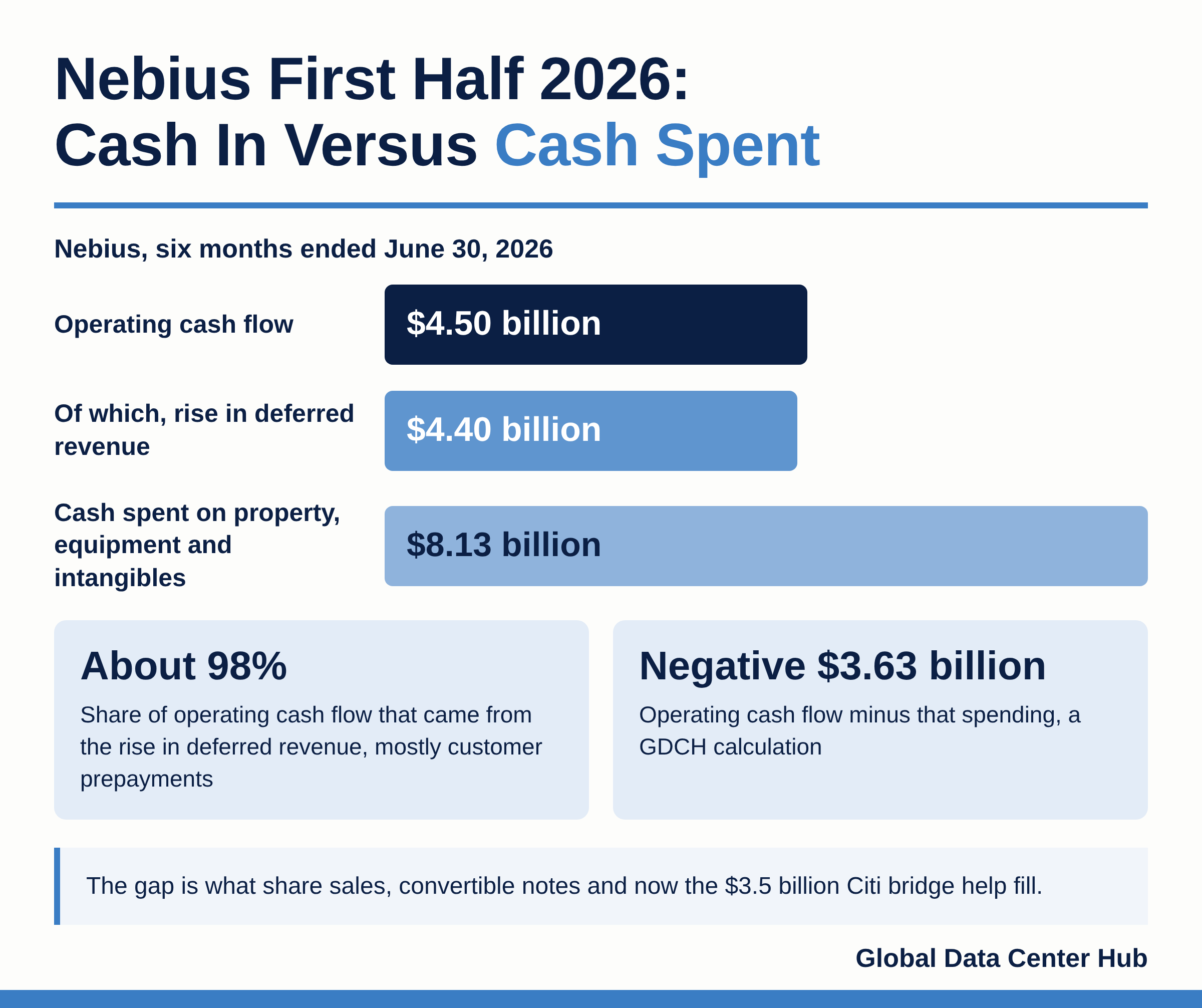
Nebius funds its buildout in layers, with customers supplying the first.
In the first half of 2026, operating cash flow was $4.5 billion. Deferred revenue, mostly customer prepayments, contributed $4.4 billion of that, about 98%.
Cash spent on property, equipment and intangible assets was $8.1 billion. Operating cash flow minus that spending was-$3.6 billion, according to the company’s financial statements.
Management says about 70% of Q2 deals included prepayments covering 50% to 60% of the related capex. It expects more than $9 billion of customer prepayments in 2026. Both are management figures, and the second is a forecast.
The capital markets supplied the next layer. Nebius sold about $2.8 billion of shares through its at-the-market program in Q2.
It closed $5.7 billion of convertible notes on August 24: $3.45 billion of 0.50% notes due 2030 and $2.30 billion of 4.50% notes due 2034. Alongside that offering, holders exchanged $800 million of older notes for about 15.8 million shares.
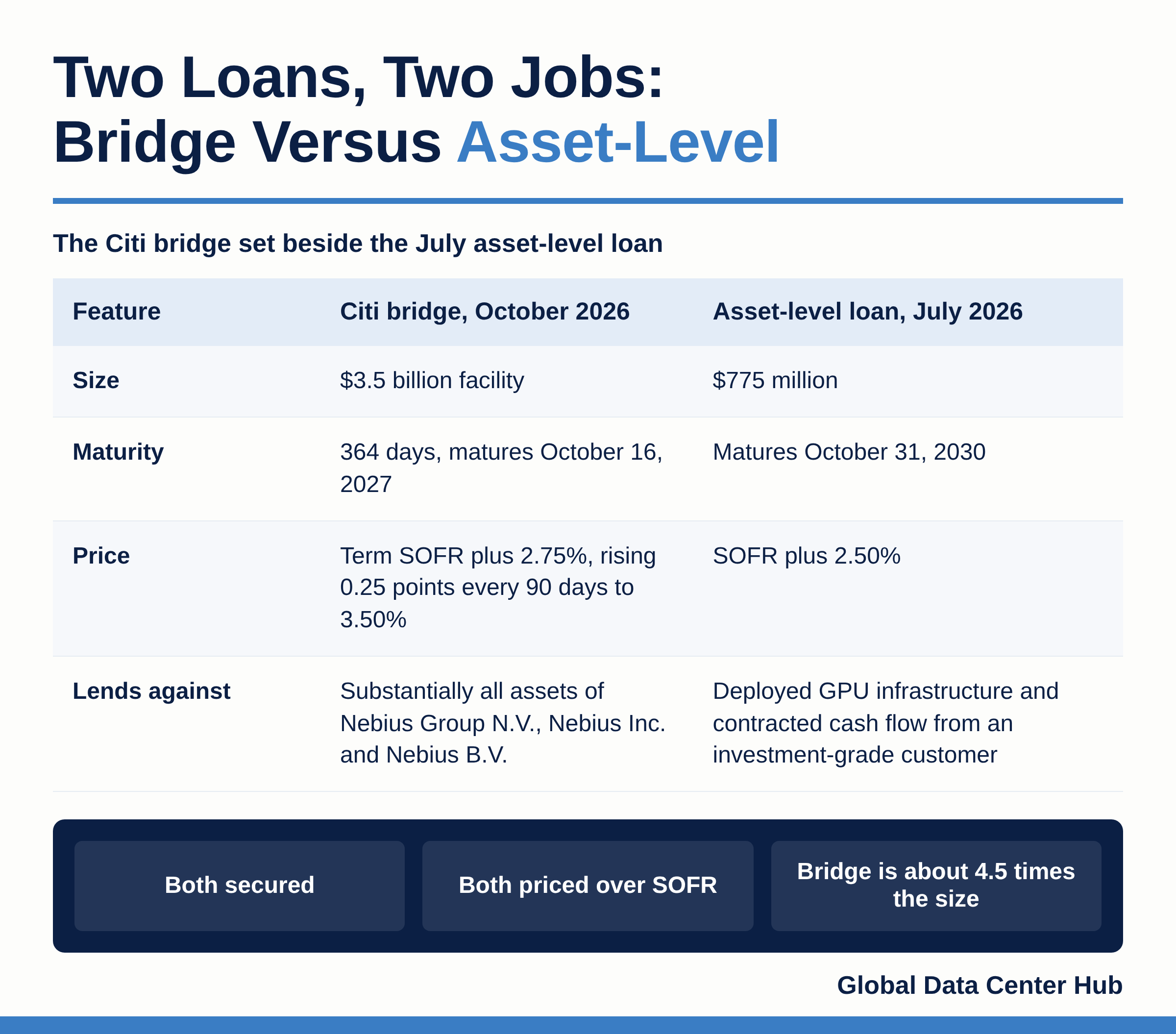
Then came the first asset-level loan. In July, Nebius announced a $775 million senior secured facility that matures October 31, 2030, priced at SOFR plus 2.50%.
Deployed GPU infrastructure and contracted cash flow from an investment-grade customer back it. That customer’s contract had already entered its servicing phase.
Nebius said the loan and the customer’s cash flows together cover more than 100% of the capex for that deployment. The figure combines two cash sources. It does not describe a loan larger than the equipment cost.
The Citi bridge sits between these layers. It is about 4.5 times the size of the July loan, shorter by more than three years, and priced higher. It also lends against the company as a whole, whereas the July loan lends against one deployment.
When a Contract Becomes Collateral
The Citi facility shows where the Bankability Gap sits for an AI cloud. The Bankability Gap is the distance between announced or contracted capacity and capacity that is truly bankable.
Bankable capacity has secured its power, financing, equipment and customers on terms that fit the asset.
On demand, Nebius has closed much of that distance. Management cites more than $40 billion of long-term commitments from investment-grade customers.
The June 30 financial statements report $37.5 billion of remaining performance obligations, with 36% expected to become revenue within 24 months. The two are different measures and should not be added.
What remains is a question of financing form. The July loan was written against capacity already running for a customer. An asset-backed lender takes security over hardware and an assigned stream of payments. Both are easier to value once the hardware is installed and the customer is paying.
So, the bridge funds a specific stretch: the months between a signed contract and a deployment a lender will finance for years. The binding layer is capital, and it binds at that conversion step.
Construction-stage capacity has to become service-stage collateral. Equipment delivery, power and commissioning set the pace. Nebius is building at scale on that front.
In August, it raised its year-end contracted power target to 5 GW and plans to deploy more than 1 GW a year starting in 2027. Contracted power means secured land and power commitments, which come before energized, billable capacity.
The calendar makes this concrete. Nebius’s Meta agreement includes $12 billion of dedicated capacity orders over five years, deployed in tranches starting in early 2027.
In August, management said that capacity was on track for early 2027. The first Meta tranches land inside the bridge’s life.
There is evidence that the sequence works. The Microsoft contract made both parties’ obligations conditional on Nebius confirming it had secured the required capex financing.
The Q2 shareholder letter reports that all capacity tranches under that contract have now been delivered. Contract, financing and delivery have happened in that order once. The July loan showed the final step, an operating deployment turned into secured debt that runs to 2030.

What It Means on Each Side of the Table
For lenders and private credit, the bridge points to a pipeline. If Nebius repeats the July structure, each deployment that reaches service becomes a candidate for a multiyear secured loan.
The terms to watch are advance rates, reserves, the reach of any parent guarantee and how assets are released from the corporate security package.
Broad corporate security can sit awkwardly beside asset-level loans unless the documents let assets move into a separate vehicle. The executed agreement, which is not public, decides that.
For operators and developers, delivery dates now carry financing weight. A site that energizes on time supports the next asset-backed loan. A site that slips lengthens the bridge-funded stretch, at a margin that rises every 90 days.
For policymakers and utilities, a facility of this size shows access to bank capital. It does not, by itself, show that any single campus is funded through energization. Incentives and grid commitments work best when tied to project milestones.
For investors outside the US, the model has a second path. Under the partnership model Nebius introduced in July, partners finance and own the infrastructure and hardware while Nebius supplies software, system design and customers.
The Q2 letter lists sites in Finland, Israel, Iceland, the UK, France, Estonia and Spain. Partner-owned capacity moves the financing question to whoever owns the building and the chips.