
Welcome to Global Data Center Hub. Join investors, operators, and innovators reading to stay ahead of the latest trends in the data center sector in developed and emerging markets globally.
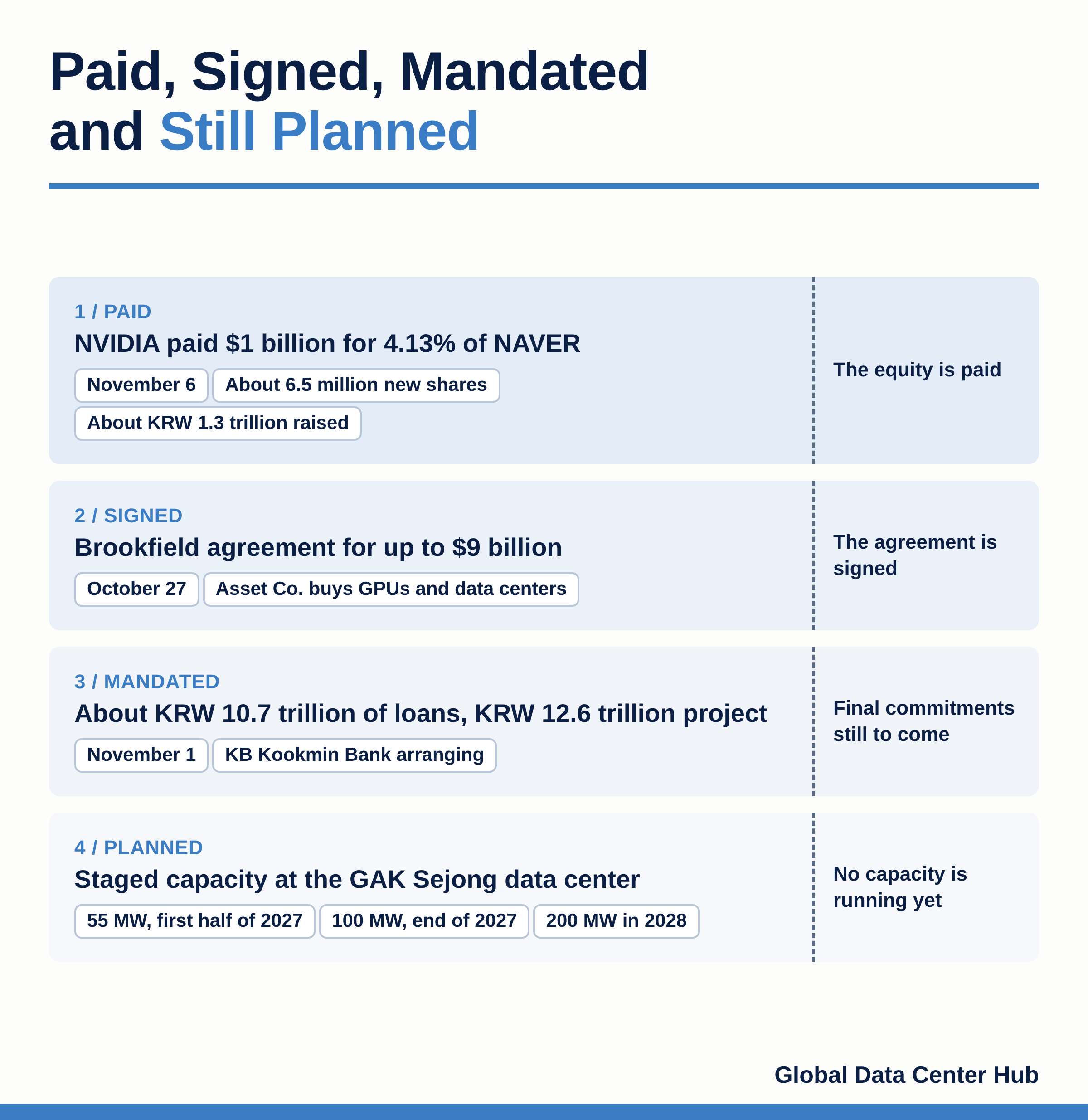
NVIDIA paid $1 billion for 4.13% of NAVER on November 6.
That payment was the last step in a sequence that began with a condition. NVIDIA would invest only after NAVER secured at least $9 billion of separate committed financing for computing infrastructure.
Brookfield signed that agreement with NAVER on October 27.
The headline reads as an equity story. Underneath it sits a credit structure. A Brookfield-funded company will own the GPUs and the buildings.
NAVER Cloud will run them and pay a fee to use them. Korean banks will lend against that fee. NAVER stands behind the fee.
That chain is what lets a GPU fleet be financed like infrastructure. It also sets what has to go right. NAVER Cloud has to sell the computing.
What Is Signed, What Is Paid, What Is Still Planned
The NAVER release of October 27 calls it a $9 billion agreement, with investment of up to $9 billion. It replaces the nonbinding term sheet the three companies described in NVIDIA’s July 24 announcement.
On November 1, KB Kookmin Bank announced a mandate to arrange about KRW 10.7 trillion of loans for a KRW 12.6 trillion project, according to The Korea Times.
Hana Bank, Shinhan Bank, Woori Bank and NH Investment & Securities are reported as participants. The Korea Herald notes that final commitments have not been disclosed.
On November 6, NVIDIA completed its payment. NAVER issued a little over 6.5 million new shares, raising about KRW 1.3 trillion, The Korea Times reported.
The July terms had pointed to 4.5% and 7,241,564 shares at KRW 204,500 each, per The Korea Herald. The dollar amount held. The share count fell once the exchange rate was fixed.
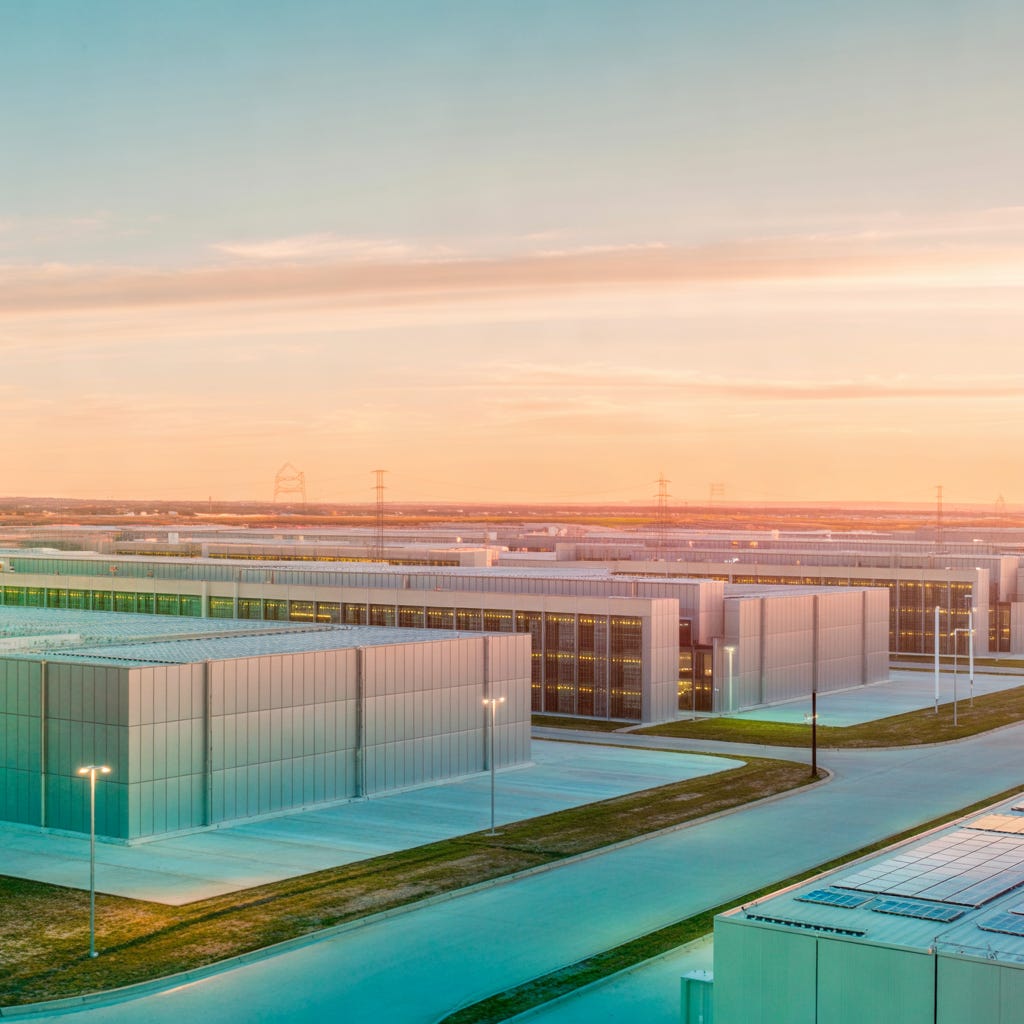
The capacity plan is staged at the GAK Sejong data center: 55 MW in the first half of 2027, 100 MW by the end of 2027 and 200 MW in 2028. NAVER describes the wider project as a 1-gigawatt-scale global AI factory.
So, the status is clear. The equity is paid. The infrastructure agreement is signed. The loans are mandated, with final commitments still to come. No capacity under this structure is running yet.
Brookfield Owns the Hardware, NAVER Cloud Runs the Business
Brookfield will form a special purpose company, tentatively named Asset Co., to buy GPUs and data center assets. A Brookfield investment vehicle will fund 100% of its capital.
Asset Co. supplies computing to NAVER Cloud, which operates the AI factory and sells services to customers.
NAVER Cloud pays usage fees, and NAVER says those fees are tied to business revenue. In its words, that link eases financial pressure in the early stage.
NVIDIA brings two things. One is the platform: the DSX AI factory stack, with Blackwell and Vera Rubin systems named in the July announcement. The other is $1 billion of new equity at the parent.
Here is what the split makes possible. NAVER can build toward 200 MW without paying for the hardware up front. It keeps the customer relationship and the operating role.
Brookfield gets an asset with a named payer and a parent behind that payer. Brookfield already manages about $100 billion of AI infrastructure and about $12 billion in Korea, according to NVIDIA’s July release, so this sits inside a market it knows.
The Fee Contract Is What the Banks Lend Against
KRW 10.7 trillion of KRW 12.6 trillion is about 85%. That is my calculation based on the bank-reported figures. The final leverage will be set at loan close.
The repayment source is what makes this deal worth studying. The Korea Times reports that repayment relies on expected long-term revenue from selling AI computing capacity.
Project loans usually rest on real estate or power plants. KB Kookmin describes the deal as Korea’s first GPU financing and its largest syndicated loan arrangement.
The Korea Herald adds two details that matter for any lender. Lenders focus on the long-term service fees and NAVER Cloud’s ability to pay them. And GPU resale value is hard to predict.
That is where the guarantee comes in. NAVER guarantees NAVER Cloud’s fee obligations for up to eight years, per its release, with a nominal amount of KRW 18.74 trillion, The Korea Herald reported. The guarantee does not cover the syndicated loan itself.
So, the credit runs in a line. The banks lend to the Brookfield side. NAVER Cloud pays the Brookfield side.
NAVER Cloud’s payments are backed by NAVER. The KRW 18.74 trillion figure is nominal. NAVER’s release says the guarantee creates no actual cash outflow.
One piece is missing from the public record. The fee is described as revenue-linked and also guaranteed. Those two terms pull in different directions.
The disclosed material does not show the formula: whether there is a minimum payment, how the fee moves when sales are slow, or what happens to the GPUs at the end.
That formula decides how close this is to infrastructure credit, and how much stays with NAVER.
Funded Outside, Reported Inside
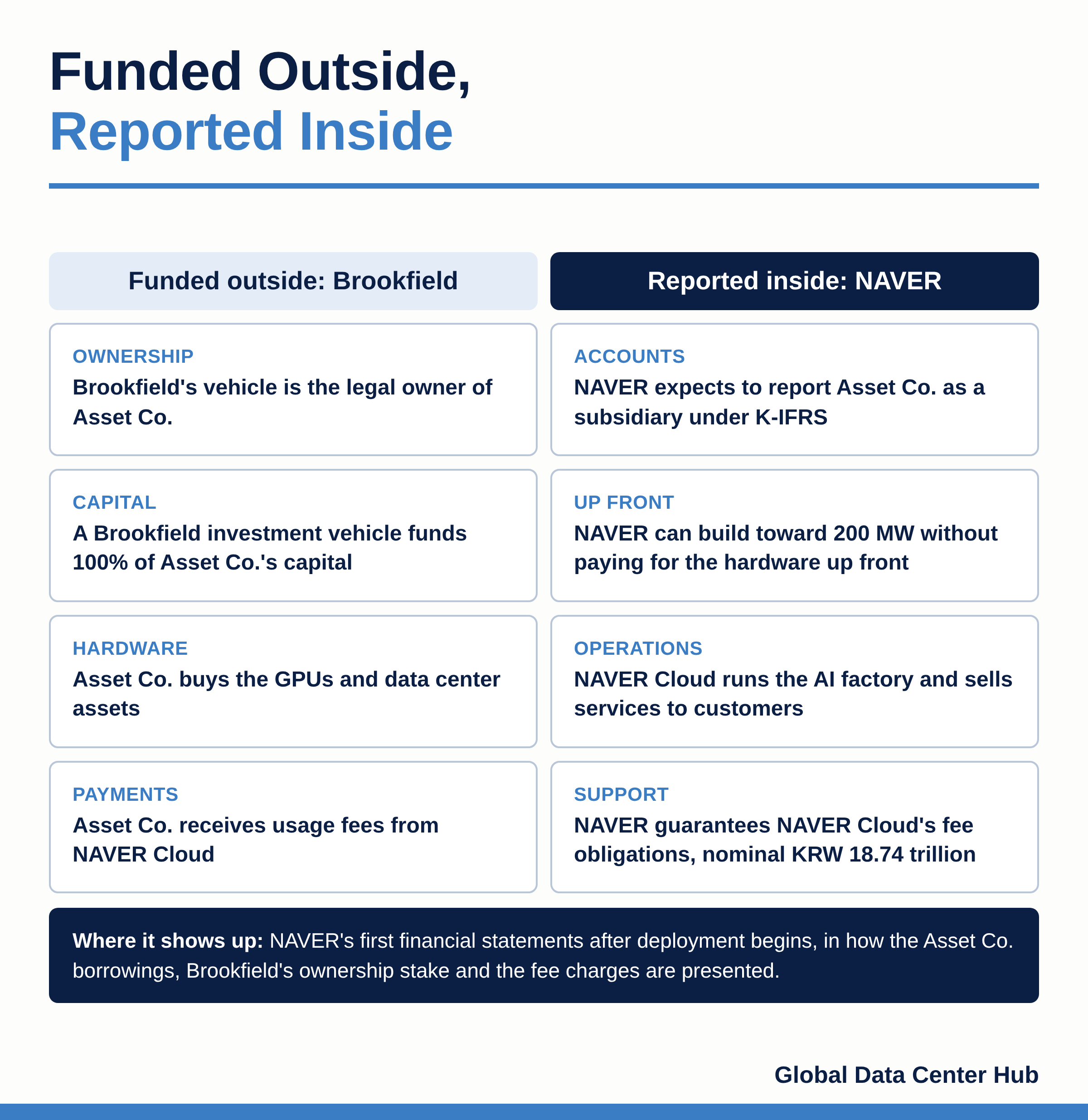
NAVER expects Asset Co. to be a NAVER subsidiary, because NAVER has control under K-IFRS. Brookfield funds all of the equity. NAVER consolidates the company.
Brookfield’s vehicle is the legal owner. NAVER is expected to report the company as its own.
External funding eases what NAVER pays up front. The assets and the borrowing behind them are expected to stay in NAVER’s group accounts.
You will see the real picture in NAVER’s first financial statements after deployment begins.
Look for how the Asset Co. borrowings, Brookfield’s ownership stake and the fee charges are presented.
Where It Binds: Paying Customers for the First 200 MW
The Bankability Gap is the distance between announced capacity and capacity that has secured power, financing, permits, equipment, customers, and returns. This deal moves one stage of NAVER’s plan much further along.
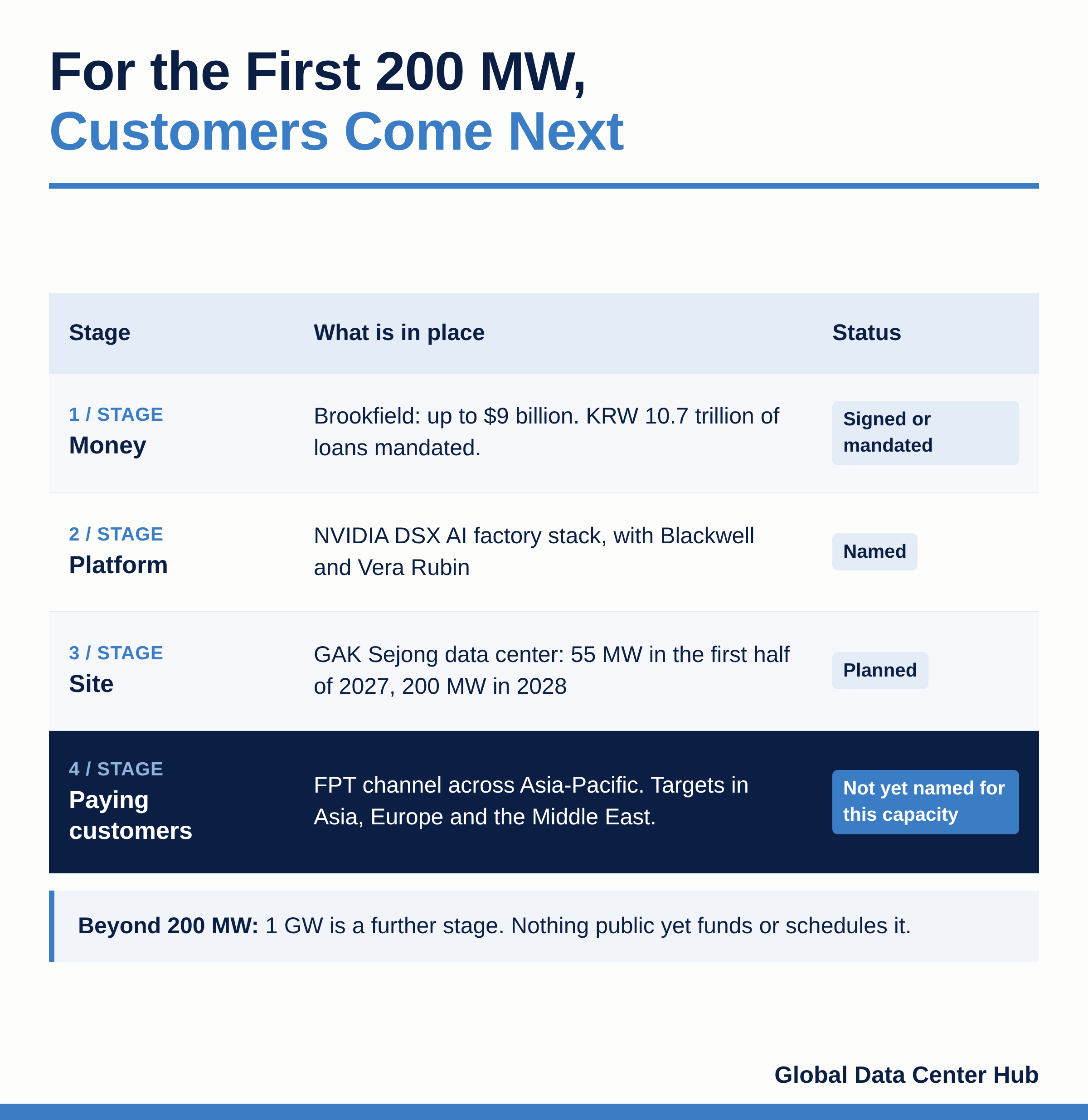
The money side of the first 200 MW is now signed or mandated. The platform is named. The first site is NAVER’s GAK Sejong data center.
The binding layer is demand. The loans are repaid from what NAVER Cloud sells, so the customer book drives the outcome.
NAVER has not named customers for this capacity. Its stated targets are enterprise and government clients in Asia, Europe and the Middle East.
NAVER is building its route to market. In October, NAVER Cloud and Vietnam’s FPT announced cooperation on AI factories and GPU-as-a-service across Asia-Pacific, including Korea, Japan and Vietnam, per FPT and NAVER.
That is a sales channel. No purchase commitment for this capacity has been disclosed.
The 1 GW figure is a further stage. The financing here is tied to the period through 2028. Nothing public yet funds or schedules the rest.
What NVIDIA’s Stake Adds
The NVIDIA condition turned $9 billion of financing into a gate. NAVER had to show committed infrastructure money before the equity arrived.
That order is useful for anyone reading the deal. The infrastructure came first, and the parent capital followed.
The equity is new shares, so the $1 billion goes to NAVER itself.
NVIDIA was set to become NAVER’s third-largest shareholder, behind the National Pension Service and BlackRock, according to The Korea Herald.
The stake is equity. NVIDIA has not disclosed any purchase of this capacity, revenue support, or residual value support for the project.
The Investment Lesson
For lenders, read the fee formula before the guarantee amount. A large nominal guarantee tells you who stands behind the payments.
The formula tells you how much those payments are when demand is slow. Ask for both and ask how the fee schedule lines up with your loan repayment schedule.
For operators, the model is worth copying when you have the customers but not the hardware balance sheet.
A capital owner holds the GPUs. You run them, sell them, and pay for use. The value of that model is parent-guaranteed consolidation.
The capital owner carries the funding, and the operator keeps the responsibility.
For policymakers, this is national AI capacity financed largely by a domestic bank group, against a computing contract.
Banks and supervisors will need their own view on GPU resale values and fee formulas.
The check comes in the first half of 2027. When the first 55 MW starts, look for named customers and their contract lengths. Then set them against a guarantee that runs up to eight years.