
Welcome to Global Data Center Hub. Join investors, operators, and innovators reading to stay ahead of the latest trends in the data center sector in developed and emerging markets globally.
TL;DR
MTN Digital Infrastructure entered a strategic partnership with a UAE-based data center investment platform on August 27, 2026, operating through a new vehicle called Africa Data Hub Holding Limited. MTN disclosed no capital commitment, no equity split, and no financial close date. Ralph Mupita said phase one targets 150MW in South Africa and Nigeria and that MTN will hold a minority position.
The party funding Africa Data Hub Holding Limited is Tarek Al Ashram’s own investment firm, not the KKR-backed Gulf Data Hub he founded. Bloomberg reported the distinction on August 27, 2026. Gulf Data Hub operated around 40 megawatts when KKR agreed to acquire a stake in January 2025, and Gulf Data Hub is not a party to the MTN transaction.
Africa Data Hub Holding Limited has no disclosed jurisdiction, equity split, or committed capital, which leaves a co-investor or lender with nothing to underwrite. MTN contributes land, grid access, licenses, and Bayobab fiber, and takes the minority position. The equity split and the holding company domicile are the disclosures that convert the announcement into a transaction.
Part One: The Record
MTN Group announced on August 27, 2026, that MTN Digital Infrastructure has entered a strategic partnership with a UAE-based data center investment platform to accelerate the development of AI-ready digital infrastructure platforms across Africa.
The announcement disclosed no capital commitment, no equity split, and no financial close date.
The partners will operate through Africa Data Hub Holding Limited, a new vehicle that MTN says will serve as the platform through which future digital infrastructure opportunities are developed and scaled across key African markets, with an initial focus on South Africa and Nigeria.
Bayobab, MTN’s digital connectivity business, is a shareholder in the partnership and will provide open access connectivity and go-to-market support through its pan-African network.
The Partner And His Platform
MTN’s release names the founder of the UAE-based investment platform as Tarek Al Ashram and describes him as an experienced data center developer, operator and investor with an established track record across the Middle East.
The release does not name the platform itself. Al Ashram founded Gulf Data Hub, a data center company established in 2012 and headquartered in Dubai.
KKR announced in January 2025 that funds affiliated with it would acquire a stake in Gulf Data Hub through its Global Infrastructure strategy, and the two parties committed to support more than $5 billion of investment in Gulf data center capacity.
Gulf Data Hub operated around 40 megawatts across the United Arab Emirates and Saudi Arabia at that point.
Bloomberg reported on August 27, 2026, that Al Ashram will back Africa Data Hub Holding Limited through his own investment firm.
Scope, Markets And Capacity
Ralph Mupita, MTN Group chief executive, set out the scope of the first phase at the group’s interim results presentation.
Capacity reported him saying the partnership is looking at 150MW as phase one, in South Africa and Nigeria only, and that the partners will build out as demand requires.
Mupita also said MTN will hold a minority position in the venture and described the group’s approach to AI infrastructure as partner led. No percentage has been published.
Mazen Mroué, chief executive of MTN Group Digital Infrastructure, said the partnership brings investment, infrastructure expertise, connectivity and market access into a single platform capable of supporting hyperscalers, cloud providers, enterprises and technology innovators across Africa.
Part Two: The Read
The Credibility In This Deal Sits On Another Balance Sheet
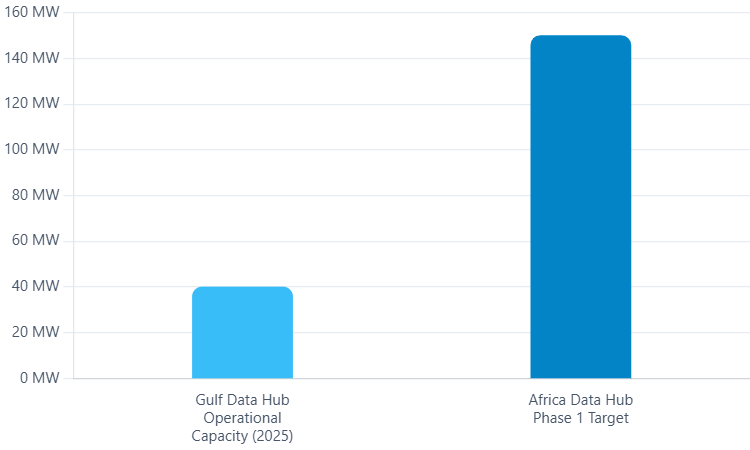
Gulf Data Hub operated roughly 40 megawatts when KKR agreed to buy into it in January 2025. Africa Data Hub Holding Limited is targeting 150 megawatts in phase one.
Coverage of the announcement has repeatedly set the phrase KKR-backed Gulf Data Hub next to the new venture, while the Bloomberg report those same articles cite says something different: Al Ashram is funding Africa Data Hub through his own investment firm.
The track record carrying this announcement belongs to a company that is not a party to the transaction, and the balance sheet that is a party has not been described at all.
Gulf Data Hub Is Not A Party Here
The MTN release names Al Ashram. It does not name Gulf Data Hub, his investment firm, or KKR.
MTN’s own language describes a person with a track record, not an institution with committed capital.
That is an accurate description of what has been agreed, and it is a much narrower thing than the market is reading. The distinction is not pedantic.
Gulf Data Hub carries an institutional shareholder, a stated multi-billion-dollar investment programme, and an operating platform with revenue and lender relationships.
A founder’s personal investment vehicle carries whatever its founder chooses to put into it, disclosed to nobody.
Those two counterparties price differently in a credit committee, and only one of them has been confirmed here.
Watch for one event over the next four quarters.
If Gulf Data Hub or KKR is brought into Africa Data Hub Holding Limited in any contractual role, the venture becomes financeable on institutional terms almost immediately.
If neither appears, the vehicle has to raise third-party capital on a sponsor whose commitment nobody outside the deal has seen, into two markets where sponsor quality is the first question a lender asks.
MTN Contributes What Capital Cannot Buy And Takes The Minority
MTN brings land, grid interconnection, licenses, an existing data center footprint in both target markets, and through Bayobab the fiber that connects them.
The partner brings money and construction experience. MTN takes the minority position.
In South Africa and Nigeria, the binding constraint on data center development is not capital, it is power and the queue to get it.
MTN is contributing the scarce input and accepting the smaller share of the equity.
It gets paid twice for doing so: once on the minority stake, and once through Bayobab, which is a separate shareholder and sells connectivity into the facilities the venture builds.
The result is a structure that keeps 150 megawatts of construction risk off MTN’s balance sheet in the same month the group reported record margin and started buying back its own shares.
That is a coherent capital allocation policy.
It is also a template every other pan-African operator with land and fiber will now examine, and the ones that move first will trade their grid positions into ownership while grid positions still command a premium.
What Each Segment Prices Before The First Site
Private Capital should underwrite the sponsor rather than the track record.
Before indicative pricing, get four things in writing: the equity split, holding company jurisdiction, partner’s committed capital, and whether Gulf Data Hub has any contractual role.
Firms that price this off the Gulf Data Hub name are paying for a credit that has not been offered to them.
Public Markets holders of MTN are buying a minority interest in an unfunded vehicle, attached to a connectivity contract that is real and already earning. That is a reasonable thing to own.
It is not AI infrastructure exposure in the sense the share price will be asked to reflect, and the gap between those two readings widens every quarter the equity split stays unpublished.
Operators in South Africa and Nigeria now face a competitor with 150 megawatts of stated intent, existing sites in both markets, and its own fiber.
The scarce resource is the grid connection, not the capital.
Operators that have not secured their next interconnection agreement within the next two to three quarters will be negotiating for it against a party that already holds a queue position and a telecom licence in the same market.
The Equity Split Is The Next Real Disclosure
The megawatt number is the least informative thing MTN has said about this partnership.
A 150-megawatt phase one target from a sponsor whose only public operating record runs to roughly 40 megawatts is an ambition, and ambitions are free to state.
The disclosures that will actually move this from announcement to transaction are the equity split, the jurisdiction, and the first named site with a signed power agreement behind it.
Expect at least one of those inside two quarters, because a vehicle that intends to raise outside money cannot stay this quiet and still close.
The question to hold until then is simple.
When the terms arrive, whose balance sheet is standing behind the first 150 megawatts, and does that balance sheet have a name the market already trusts, or one it is being asked to trust for the first time.