
Welcome to Global Data Center Hub. Join investors, operators, and innovators reading to stay ahead of the latest trends in the data center sector in developed and emerging markets globally.
TL;DR
CoreWeave announced 360 megawatts of contracted IT power across three Indonesian facilities on August 4, 2026, and stated it will own and operate the compute environment across all three sites. The release names no landlord, no developer, and no power counterparty. CoreWeave’s ownership claim is scoped to the compute, and the facilities are targeted online in 2028.
Microsoft opened its India South Central region in Hyderabad on August 6, 2026, on land it assembled itself from 2022 across more than 110 acres. Microsoft owns the land, operates the region, and is its own tenant, backed by a $20.5 billion commitment running through 2029. Amazon Web Services has run a Hyderabad region since 2022 on $2.77 billions of announced investment.
CoreWeave held more than 3.5GW of contracted power against more than 1GW of active power as of March 31, 2026, across 49 data centers. The Indonesian 360 megawatts adds to the contracted book rather than the active one. Contracted power is an obligation with a delivery date, and the counterparty carrying that obligation in Indonesia is not disclosed.
Where the $20.5 billion went: Microsoft Opens India South Central In Hyderabad On $20.5 Billion
Three Facilities, 360 Megawatts, And One Carefully Written Clause
CoreWeave will own and operate the compute environment across all three Indonesian sites.
That is the company’s own language, and the scope of it is the story.
It does not say CoreWeave owns the facilities or power. It specifies what the company holds and, by omission, what others hold.
Two days later Microsoft opened a region in Hyderabad built on land it bought itself, starting in 2022, across more than 110 acres in Chandanvelly, the Ellikatta and Mekaguda area, and Kottur and Shadnagar.
Microsoft owns the ground, runs the region, and fills it with its own customers. There is no landlord in that structure because Microsoft is the landlord.
Same continent, same demand, two days apart, and the capital sitting underneath could not be more different.
One company put its balance sheet into the dirt. The other contracted for the output and kept its capital in the compute.
Both are legitimate. They are not the same risk, and Asian markets are now absorbing both at once.
The Neocloud Model Needs A Landlord, And Nobody Has Named This One
CoreWeave has done this before and named the partner.
Its Swedish expansion runs with Conapto, named in the announcement.
Indonesia names nobody. Either the shell partner is not signed, or it is signed and undisclosed, and the release does not let a reader choose between those.
That gap matters because the party building three facilities to hold 360 megawatts by 2028 is the one carrying construction risk, power procurement risk, and Indonesian permitting risk.
CoreWeave carries the take-or-pay obligation and the customer relationships.
Whoever builds carries the delivery. In a market where CoreWeave has no operating history, the identity of that counterparty is most of the execution question.
Over the next 12 to 24 months, expect the developer side of neocloud expansion in Southeast Asia to become the more interesting side to underwrite.
The compute operator is listed and its disclosures are public. The people building the buildings are frequently neither.
Contracted Power Is A Forward Book, Not Capacity
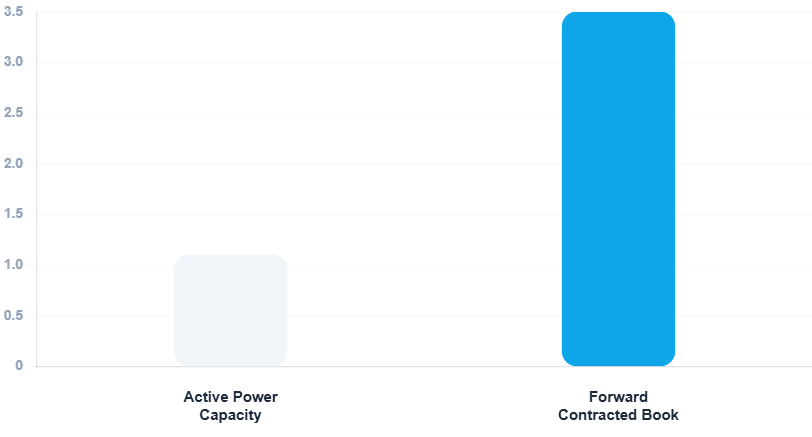
As of March 31, 2026, CoreWeave held more than 1GW of active power and more than 3.5GW of contracted power across 49 data centers.
The Indonesian 360 megawatts joins the second number. It is not capacity today and will not be capacity until 2028.
Microsoft’s $20.5 billion is also forward. The $17.5 billion tranche runs 2026 through 2029. But the instruments differ.
Microsoft has committed capital it controls, against land it already owns, in a region already live and already serving HDFC Bank, Bajaj Finserv, Adani Group, Apollo Hospitals, and Air India.
CoreWeave has committed to pay for power that does not yet exist, in facilities not yet built, for customers not yet named.
Both companies are announcing the future. One is announcing spend it can pace.
The other is announcing an obligation with a date on it.
An investor reading both as “Asian expansion” has collapsed a distinction that will matter a great deal in 2028.
The Grid Decides Whether Either Number Is Real
Telangana solved this problem in public.
The state is deploying a new 220kV grid supply, adding substations, and building flood-water canals for the Microsoft buildout.
That is a visible commitment from a counterparty with obligations, and it arrived years before the region opened.
Indonesia has no equivalent in the public record for these three sites.
No power counterparty is named, no interconnection commitment is disclosed, and no locations are given.
The demand case is real: enterprises, AI-native companies, and governments across Asia need compute close to their data and users, driven by latency and data locality requirements.
That is CoreWeave’s stated rationale and it is correct. The constraint is not demand.
For anyone underwriting either market, the grid is where the announcement stops being an announcement.
Hyderabad has shown its work. Indonesia has not yet.
What Each Segment Now Has To Underwrite
Private capital. The Indonesian opportunity in this announcement is not CoreWeave. It is whoever builds three facilities to hold 360 megawatts by 2028.
That party has a listed, contracted anchor tenant, which is the strongest position a Southeast Asian developer can hold. Find out who it is.
Funds waiting for CoreWeave to disclose the partner will be bidding against people who already knew, on assets that are already spoken for.
Public markets. Read CoreWeave’s contracted power line as a liability schedule alongside a growth figure.
More than 3.5GW contracted against more than 1GW active means the gap between the two is the company’s forward obligation, and every new market adds to it before it adds to revenue.
That is not a warning. It is the model working as designed, and it needs to be modeled that way rather than read as a backlog.
Operators. Indonesian and regional developers now have a named, listed anchor tenant looking for 360 megawatts of delivery by 2028 in their market.
That is a specific, dated, financeable demand signal, and it is rare.
Operators who treat this as a competitor announcement rather than a customer announcement will read it exactly backward.
Two Structures Meet In Asia, And Only One Has Been Tested Here
Hyperscaler self-tenancy has a track record in Asian emerging markets.
Microsoft has four Indian regions, and Amazon has run Hyderabad since 2022. The model is slow, capital-heavy, and it works.
The neocloud model has no such record in Southeast Asia.
CoreWeave’s Indonesian entry is the first serious test of whether a contracted-compute operator can site capacity in an emerging Asian market on someone else’s buildings and someone else’s power.
The answer arrives in 2028, and the leading indicator arrives much sooner, the moment a developer and a power counterparty are named.
The open question is which model the region’s own capital chooses to back.
Southeast Asian institutions can finance a hyperscaler’s shell or a neocloud’s shell, and those are different credits with different tenants behind them.
Nothing in either announcement tells them which one Jakarta is getting.