
Welcome to Global Data Center Hub. Join investors, operators, and innovators reading to stay ahead of the latest trends in the data center sector in developed and emerging markets globally.
TL;DR
Bloomberg reported on September 10, 2026, that Microsoft plans to expand data center capacity to more than 38 gigawatts by 2032, from roughly 12 gigawatts today. Bloomberg cited people familiar with the plans. Microsoft has not stated the figure in any filing, press release, or earnings call, and Reuters reported that Microsoft did not respond to a request for comment.
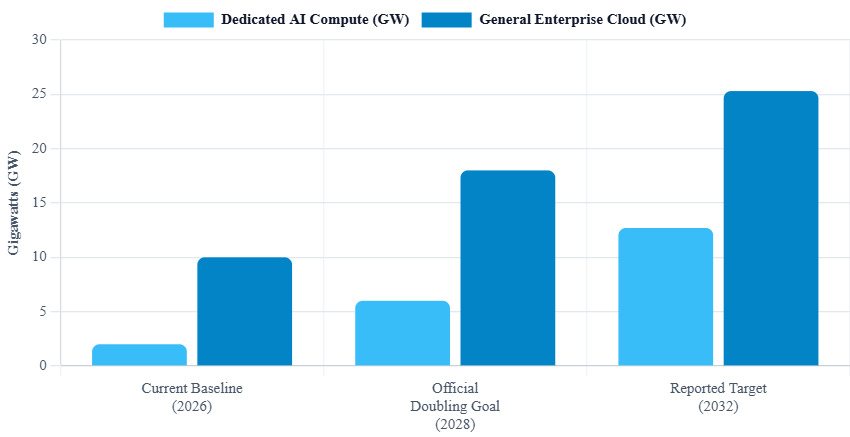
Microsoft’s confirmed guidance implies a faster near-term build than the reported 2032 target requires. Satya Nadella told investors on July 29, 2026, that Microsoft remains on track to roughly double overall capacity in two years, which works out to about 6 gigawatts a year. The reported 38-gigawatt target implies an average of about 4.3 gigawatts a year.
Microsoft disclosed $329.1 billion of leases that had not yet commenced at June 30, 2026, up from $196.6 billion the prior quarter. Microsoft said the leases are primarily data centers, commence between fiscal 2027 and fiscal 2033, and that some are subject to contractual conditions being met. The rate at which that balance commences determines when capacity arrives.
Part One: The Record
Bloomberg reported on September 10, 2026, that Microsoft plans to expand its global data center capacity to more than 38 gigawatts by 2032, up from roughly 12 gigawatts today, citing people familiar with the plans.
Reuters relayed the report the same day and said Microsoft did not respond to a request for comment.
No party has confirmed the target, and Microsoft has not stated the figure in a press release, an investor presentation, an earnings call, or a regulatory filing.
The report attaches no capital figure to the plan and names no date for a first phase.
What The Report States
According to Bloomberg, roughly 2 gigawatts of Microsoft’s current 12 gigawatts is dedicated to AI-specific chips, and that share is expected to reach about one third of the 38 gigawatts.
The reported target covers company-owned facilities and leased facilities. Reporting differs on one term.
Reuters reports that capacity rented from smaller specialist cloud providers falls outside the figure.
Data Center Dynamics reports that leased capacity from third-party providers is included, and names CoreWeave, Nscale, Lambda, IREN and Nebius among the providers Microsoft has contracted with.
Bloomberg’s sources cautioned that the projections could change with customer demand, new technology, and long construction timelines.
What Microsoft Has Confirmed
On the July 29, 2026, earnings call, Satya Nadella said Microsoft added 31 data centers across five continents in the June quarter, bringing the fiscal year total to 88.
He said the company added another gigawatt of capacity in the quarter and remains on track to roughly double its overall capacity in two years.
Dock-to-live times for new GPUs in Microsoft’s largest regions also fell by nearly 50 percent over the fiscal year.
Amy Hood said demand continues to exceed available capacity and gave no estimate of when that changes. Azure revenue grew 43 percent in the quarter.
Lease Commitments And Capital Spending
Capital expenditure including finance leases was $41 billion in the June quarter, up 69 percent year over year.
Microsoft’s fiscal 2026 Form 10-K disclosed $329.1 billion of commitments for leases that had not yet commenced at June 30, up from $196.6 billion the prior quarter.
Microsoft said the leases are primarily data centers, that some are subject to contractual conditions being met, and that they commence between fiscal 2027 and fiscal 2033 with terms of one to 20 years.
Hood said Microsoft will extend the estimated useful life of office and data center buildings from 15 years to 25, which moves more future leases into operating lease classification.
Reported capital expenditure for fiscal 2026 was approximately $145 billion, and Hood guided to more than $50 billion in the first quarter of fiscal 2027.
The leases disclosed at June 30 begin commencing in fiscal 2027.
Part Two: The Read
Microsoft’s own guidance implies about 6 gigawatts of new capacity a year.
That comes from the July 29 call, where Nadella said the company remains on track to roughly double overall capacity in two years, which takes roughly 12 gigawatts to roughly 24.
Coverage has carried that guidance and the 38-gigawatt report side by side without running the arithmetic between them, and the arithmetic inverts the story: the reported target needs about 4.3 gigawatts a year on average, slower than what management has already put its name to.
The number under pressure is the one Microsoft said out loud.
Six Gigawatts A Year Is The Real Commitment
Microsoft has added a gigawatt of capacity in each of the last three quarters.
That is the fastest run rate in the company’s history, and it produces 4 gigawatts a year, which clears the average the 2032 target requires and falls short of the doubling.
Eight quarters at 1 gigawatt gets Microsoft to 20 gigawatts. The doubling needs 24.
Somewhere in the next eight quarters the quarterly rate has to go above a gigawatt, or the guidance gets restated.
Both events are visible in disclosure Microsoft already publishes every quarter, which makes this the cheapest thing in the story to monitor and the only part of it with a near-term deadline.
The Lease Book Grew Faster Than Anything Can Absorb
The not-yet-commenced lease balance rose $132.5 billion in a single quarter.
A lease that has not commenced produces no capacity, no right-of-use asset, and no liability on the balance sheet.
It records an intention to contract, not a delivery date, and Microsoft states plainly that some of it is conditional without saying which arrangements or which conditions.
The useful-life extension compounds the reading problem: moving buildings from 15-year to 25-year lives pushes more of the future book into operating classification, which lowers reported capital expenditure without lowering what gets built.
Over the next twelve to twenty-four months the informative figure is the commencement rate, meaning how much of the $329.1 billion crosses from signed into started, and Microsoft discloses the balance every quarter for anyone who wants to difference it.
Two Gigawatts Came Off The Board Last Year
In March 2025, Bloomberg reported, citing TD Cowen, that Microsoft walked away from data center projects in the United States and Europe amounting to roughly 2 gigawatts, attributed to an oversupply of AI compute clusters.
Eighteen months later the same company has a reported six-year plan to add 26.
Bloomberg’s current sources caution that the projections could change.
The 2025 episode is the documented base rate for how a hyperscaler capacity plan behaves under a demand revision, and it happened without an announcement: the market learned it from an analyst note about abandoned leases.
A plan under quiet revision shows up first as leases that fail to commence on schedule, which is the same line item that carries the upside.
The Neocloud Boundary Decides What The Number Counts
Reuters puts rented neocloud capacity outside the 38 gigawatts.
Data Center Dynamics puts leased third-party capacity inside it and names five providers.
Two readings of one number, describing two different companies.
Under the Reuters reading, Microsoft’s effective compute supply runs above 38 gigawatts, and the reported target is a floor on the controlled estate.
Under the Data Center Dynamics analysis, an undisclosed portion of the target depends on counterparties whose project financing is backed by Microsoft contracts, making part of its capacity plan dependent on the credit those counterparties can secure.
Anyone lending to a neocloud on Microsoft offtake is already pricing that boundary.
Microsoft’s own filings will settle it before any journalist does, because a target built substantially on third-party contracts surfaces in the purchase commitment line rather than in property additions.
What Each Segment Prices Before The Next Filing
Private Capital. Treat the 38 GW figure as an unconfirmed planning input and underwrite to the commencement schedule.
For developments tied to Microsoft demand, require the lease commencement date, conditions, and remedies for failure.
Microsoft has confirmed that conditions exist but has not disclosed them.
Funds pricing to the target rather than the conditions may face the consequences from fiscal 2027, when the first tranche is scheduled to begin and pricing for the next is established.
Public Markets. Reported capital expenditure will understate the buildout from fiscal 2027 forward, and Hood said so on the call.
Holders who track capital intensity through the capex line alone will read a deceleration that has not occurred.
The pair to track is gigawatts energized against the not-yet-commenced lease balance, both disclosed quarterly.
Waiting for the capex number to reflect the build means waiting for a signal that the accounting change has removed.
Operators. Microsoft has nearly halved dock-to-live times and is activating a gigawatt per quarter, shifting the binding constraint from internal processes to counterparties’ ability to energize capacity.
Operators with secured power and interconnection positions compete for the front of a six-year window, while those still in the queue face the back after 26 GW of demand has been placed and the scarcity premium captured by others.
The Doubling Lands Before The Target Does
The 2032 date sits far enough out to be unfalsifiable, and the two-year doubling does not.
Microsoft told investors in July that overall capacity roughly doubles by the middle of 2028, which puts a checkable number on the board every quarter between now and then.
Four more quarters at a gigawatt each holds the company at its record pace and still leaves it behind.
The question for the next twelve months is whether Microsoft lifts the quarterly rate above a gigawatt or quietly redefines what doubling meant, and the first instalment of that answer arrives with the September quarter, ten years before anyone can check the other one.