
Welcome to Global Data Center Hub. Join investors, operators, and innovators reading to stay ahead of the latest trends in the data center sector in developed and emerging markets globally.
TL;DR
Meta launched the $1 billion Future Is For Everyone Fund on August 10, 2026, for the United States communities that host its data centers. Meta states the money will go to teachers, first responders, and energy and water infrastructure. Meta has not published an allocation formula, a per-community figure, a count of communities, or a spending period.
The Richland Parish teacher bonuses Meta cites as its model came from a 1 percent sales tax on construction purchases created by a 1968 parish ordinance. Meta paid Richland Parish $22.4 million under that levy in May 2026. Construction on Meta’s Hyperion campus is expected to run until 2030, and the levy applies to purchases rather than to the finished facility.
Meta confirmed the fund totals $1 billion, and Cheyenne Mayor Patrick Collins said a Meta representative told him the figure was $1 billion for each community. Collins put Meta’s footprint at 28 data centers across 23 states. The two accounts of the same announcement differ by a factor of 28.
Part One: The Record
Meta announced a $1 billion fund for the United States communities that host its data centers on August 10, 2026.
The commitment carries the name Future Is For Everyone Fund and was published inside a 6,500-word letter from Mark Zuckerberg titled The Future Is For Everyone: The Path To A Positive AI Future.
Meta states the money will support teachers, first responders, and energy and water infrastructure in the towns and parishes where it owns and operates data centers.
Meta spokesperson Francis Brennan confirmed the $1 billion figure and said the company will begin working with communities to design investments shaped by local needs.
The Fund Terms And Stated Uses
Zuckerberg described the arrangement as a community compact.
In the letter he wrote that sustainable infrastructure development means communities must benefit significantly from each project, and named high-paying local jobs, investment in schools and public services, holding energy prices flat, and environmental protection as the components.
He wrote that Meta helps keep electricity prices low by building its own energy-generating infrastructure in the places where it invests.
Meta released the model weights for Muse Glimmer, a 30-billion-parameter system, on the same day, and stated it will release open-source versions under the name Muse Spark 1.2.
The fund sits alongside the Data Center Community Action Grants program, which Meta has run since 2011 to fund schools and nonprofits in host regions.
In Fort Worth, Meta partnered with Ducks Unlimited and the Texas Parks and Wildlife Department to fund 206 acres of new wetlands in the Richland Creek Wildlife Management Area.
Richland Parish And The 1968 Levy
Zuckerberg named Richland Parish, Louisiana as the model case.
Meta broke ground on the Hyperion campus near Holly Ridge in December 2024. Construction is expected to continue until 2030.
Richland Parish collected $42.9 million in sales and use tax during the first nine months of the current fiscal year, against $21.3 million for all of fiscal year 2024-25.
Meta made a separate payment of $22.4 million to the parish in May, equal to 1 percent of qualifying purchases, with more than half flowing to the school district.
The Richland Parish School Board has collected more than $36.5 million this fiscal year, of which $16.2 million came from a one-cent sales tax created by a 1968 ordinance that funds employee bonuses.
Bonuses this year reached $50,935. The prior year maximum was $10,200.
Meta pays no state or local sales tax on data center equipment at the site for 20 years.
Once the facility receives its certificate of occupancy, a payment in lieu of taxes arrangement gives Meta an 80 percent property tax abatement for 30 years, conditioned on capital and job targets.
Meta must employ at least 500 people at the site continuously.
Undisclosed Terms And Site Count
Meta has not published an allocation formula for the fund, a figure for any individual community, a count of the communities that will receive money, or the period over which the money will be spent. Brennan said further details will follow.
Cheyenne Mayor Patrick Collins said a Meta representative told him on August 10 that the company plans to invest $1 billion in each community where it operates a data center, and that Meta operates 28 data centers across 23 states.
Meta has said the details will come in the coming months.
Part Two: The Read
The Proof Is A Construction Receipt
The number carrying Meta’s argument is $22.4 million, and it is a levy on construction purchases rather than a payment from the data center.
Coverage has carried the Richland Parish bonuses as evidence that a data center funds teachers, which inverts the mechanism, because the build funds the teachers and the build has an end date.
Every community negotiating against the Richland Parish precedent is therefore pricing a revenue stream scheduled to stop in 2030.
The Revenue Peaks Before The Load Does
Track the two tax streams separately.
The construction stream runs at 1 percent on materials, furniture and fixtures, and it scales with spending velocity.
It reached $22.4 million in a single payment against a parish that collected $21.3 million across the whole of the prior fiscal year.
The operating stream begins at the certificate of occupancy, and it arrives already reduced, at 20 percent of assessed property tax for 30 years.
The two curves move in opposite directions at the same moment.
Construction receipts fall as the last phase completes.
Power draw, water draw and road load reach their sustained maximum on the same date.
A parish that budgeted teacher bonuses against the first curve inherits the second one.
Over the next twelve to twenty-four months this becomes a drafting question rather than a political one.
Host jurisdictions negotiating in 2027 will have watched Richland Parish, and the terms they ask for will be operating-phase floors, escalators tied to megawatts rather than to construction spend, and clawbacks against the 500-job condition.
Developers who arrive with only a construction-phase benefit model will negotiate against a template that has already priced their omission.
An Unallocated Fund Behaves Like An Option
Compare the fund to the program it sits beside.
Data Center Community Action Grants runs through an external platform, publishes its criteria, and names its recipients. Applicants apply and are assessed.
The Future Is For Everyone Fund has none of that architecture.
There is no formula, no per-site figure, no community count, no spending window, and no stated audit mechanism.
That absence changes the relationship. A grant program is an application.
A discretionary pool negotiated directly with municipal government is a conversation that runs in parallel with a permit.
Discretion over the size and the timing sits with the payer, and it sits there during the period when the counterparty is voting.
The binding event in this program is the first published allocation.
Whichever community discloses a number first sets the benchmark every other mayor cites, and Meta has an interest in that number arriving late.
A disclosed ceiling sitting above an undisclosed floor: NVIDIA Did Not Guarantee The Rent. It Guaranteed The Resale.
Two Mayors Cannot Both Be Right
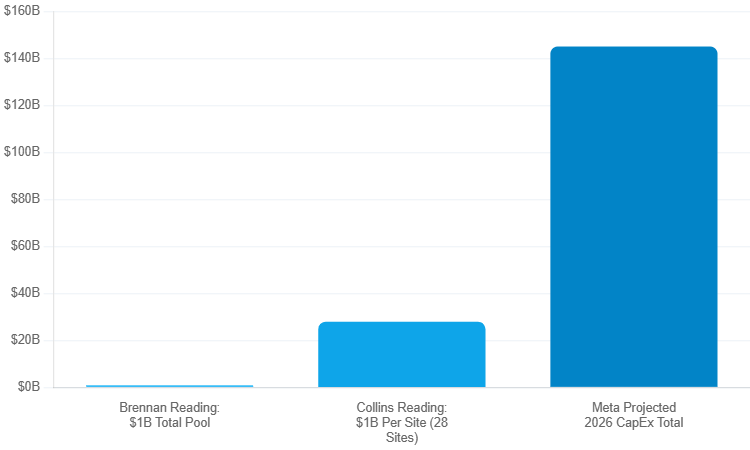
Brennan confirmed the fund at $1 billion in total.
Collins reported being told $1 billion for each community, across a footprint he put at 28 data centers in 23 states.
The first reading produces roughly $36 million per site.
The second produces $28 billion, which would be close to a fifth of Meta’s projected 2026 capital expenditure of $145 billion.
Both cannot hold, and the gap is the mechanism. An unallocated fund lets every host community model itself as the anchor.
That belief is worth more at a zoning hearing than any published figure, because a published figure tells 27 communities what they are not getting.
The gap closes the first time two mayors compare notes in public.
When it does, the fund’s negotiating value drops to the smallest confirmed allocation, and the communities that signed before the disclosure will have signed against the largest.
What Each Segment Now Prices
Private Capital. Underwriting a data center platform with host-community exposure now requires modeling the operating-phase tax base separately from the construction receipt.
The two are different instruments with different durations, and the comparable transactions in the market are quoting the first while disclosing the second.
Firms that price the construction curve into a 30-year asset will hold the political reaction when it inverts, and that reaction lands as permit delay on the next project in the same state.
Public Markets. The $1 billion is 0.7 percent of Meta’s 2026 capital expenditure and does not move the model.
Permit velocity does. Data Center Watch counted 75 projects worth $130 billion blocked or delayed in the first quarter of 2026 alone, matching the whole of 2025, and 71 percent of Americans told Gallup in May they oppose local data centers.
Holders tracking community spend are watching the wrong line. The line is time to energization.
Operators. Consent is now an input to be procured alongside power and land, and it has no published price.
Operators that bring an operating-phase benefit structure to the first council vote negotiate against Meta’s silence, which is the most favorable condition available.
Those that wait will negotiate against whatever formula Meta eventually publishes and will be asked to match it.
The First Published Allocation Sets The Price
Meta has established that a hyperscaler will pay for consent and has declined to say what consent costs.
That combination is unstable, and it resolves in one direction, because a fund with 28 possible claimants and no formula generates its own disclosure through the claimants themselves.
The question for the next two quarters is which community publishes first and what number it publishes.
If the first disclosed allocation lands near $36 million, the community compact is a rounding error on a $145 billion capital program and every subsequent negotiation starts from that anchor.
If it lands materially higher, Meta has repriced the cost of building in the United States for every operator behind it.
Watch the council minutes, not the press releases.