

Welcome to Global Data Center Hub. Join investors, operators, and innovators reading to stay ahead of the latest trends in the data center sector in developed and emerging markets globally.
On October 1, 2026, Lambda closed a $1.0 billion loan to buy GPU servers.
Moody’s rated it Baa1. Morningstar DBRS rated it A (low). Both grades sit in investment grade; the band rating agencies give to debt they judge most likely to be repaid.
If you read only the headline, you see a big loan and big demand for AI computing.
That reading holds. Lambda says the money will fund three committed customer deployments for two investment-grade customers. But the loan's structure tells you more than its size.
I want you to take away one idea. A GPU loan can borrow like safe, long-term debt when the whole loan is built around customer contracts. I use the Bankability Gap to show you why.
The Bankability Gap is the distance between capacity someone announces and capacity that gets built.
The Bankability Gap and the Contract Behind Every GPU
To get built, a project needs power, money, permits, equipment, customers, and returns. Any one of them can hold a project back. For GPU projects, money is often the hardest piece to line up.
Here is why. A GPU is the chip that trains and runs AI models. Faster chips arrive every year or two, so an older chip loses value quickly. If you lend against the chip alone, you lend against something that shrinks.
So, lenders look past the chip to the contract. When a big customer signs up to rent computing for years, it promises a stream of payments. You can lend against that promise. The chip becomes the backup.
Banks have done this for decades with power plants. A lender funds the plant because a utility has signed a contract to buy its power. This is called project finance. The contract pays the loan, and the plant stands behind it.
Lambda’s October loan follows that pattern. Lambda says it is secured by the GPU servers it pays for and by the contracted cash flows from those servers.
Contracted cash flows are the payments customers have agreed to make. Lambda says those payments come from two investment-grade customers across three deployments in multiple data centers.
Think of someone buying an apartment building with every unit already rented. A bank lends to that owner more easily, because signed leases come with the building.
The building matters. The leases pay the bank.
That is the trade I follow through this article. Tying debt to contracts opens up cheaper, longer-term money for you as a borrower. It also makes the loan exactly as strong as the contracts behind it.
How to Read a Delayed Draw on a GPU Loan
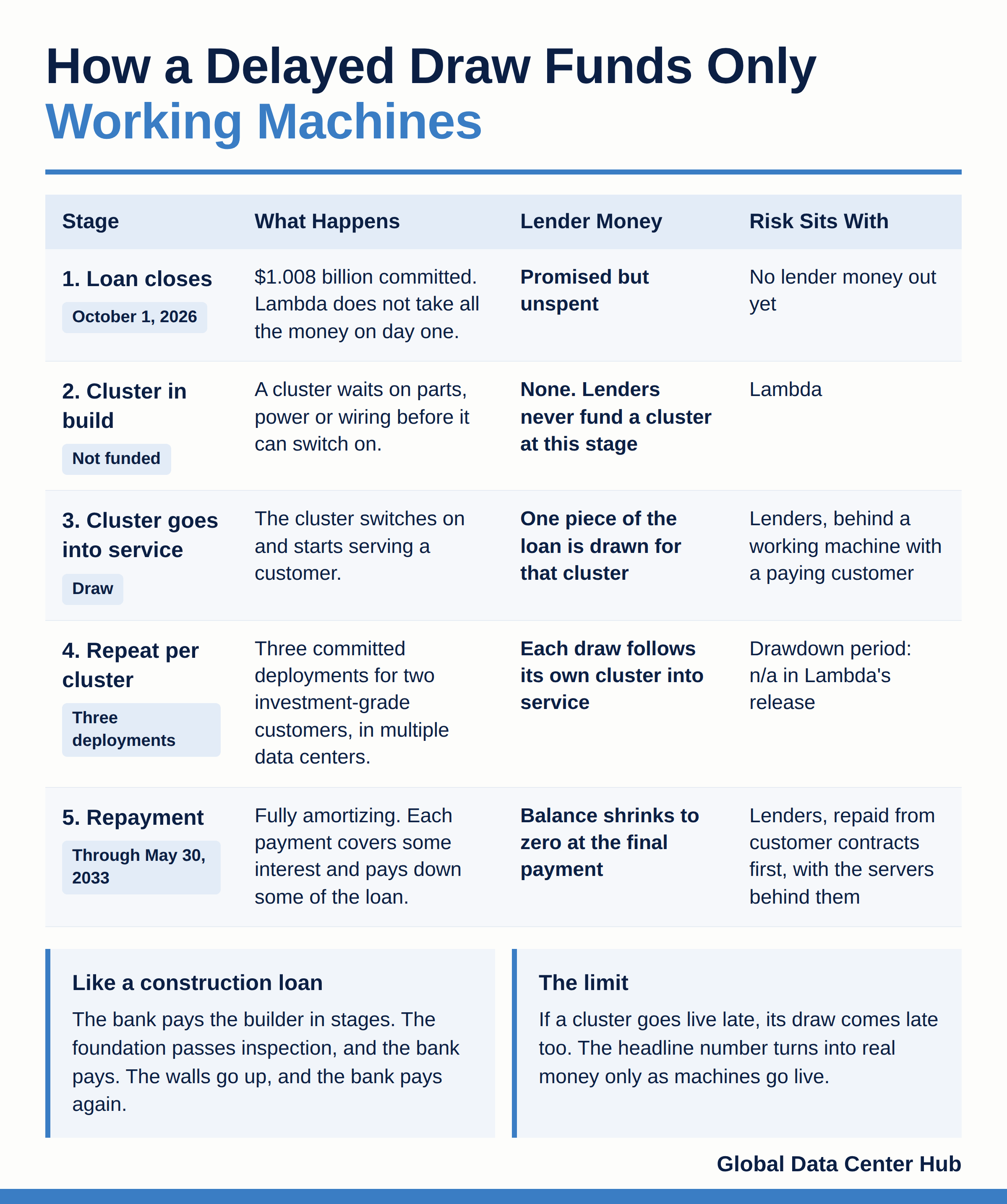
If you are new to this, you see $1.0 billion and picture Lambda with $1.0 billion in the bank. That picture is off. The October loan is a delayed-draw term loan.
A term loan has a set end date and a set repayment plan. A delayed draw means Lambda doesn't take all the money on day one. It takes the money in pieces.
Lambda says each piece is tied to a cluster going into service. A cluster is a large group of GPU servers wired together to work as one machine.
Picture building a house with a construction loan. The bank does not hand over the full amount when you sign. It pays the builder in stages. The foundation passes inspection, and the bank pays. The walls go up, and the bank pays again.
The October loan works the same way. Lenders put money in only as each cluster switches on and starts serving a customer. Until then, the money stays promised but unspent.
This changes who carries what. The lenders skip the building stage. They never fund a cluster still waiting on parts, power or wiring. That stage and its risk stay with Lambda. So, the lenders’ money sits only behind working machines with paying customers.
This structure has a track record. On March 31, 2026, CoreWeave closed an $8.5 billion delayed draw facility secured by GPU assets and a customer contract.
Moody’s rated it A3, and Morningstar DBRS rated it A (low). Lambda’s August loan used the same idea, and the October loan continues it.
This reading has limits. A delayed draw also ties the loan to the build pace. If a cluster goes live late, its draw comes late too.
Lambda’s release does not say how long it has to draw the full amount. So, treat the headline number as a promise that turns into real money only as machines go live.
Fixed Rates and the Investors Who Buy GPU Debt
The second thing to look at is the interest rate. Here the two Lambda loans part ways.
The August loan was a $926 million term loan B. A term loan B is a loan sold to a wide group of investors, often funds that buy and trade loans.
It paid a floating rate of SOFR plus 3.00%. SOFR is a benchmark interest rate that moves with the market, so the August loan’s rate moves too.
Lenders paid 99.5 cents on every dollar of the loan, a small discount that boosts their return. Moody’s rated it Baa2.
The October loan pays a fixed rate of 6.78%, with interest paid twice a year. Lambda marketed it to insurance companies and fixed income investors. Lambda describes it as its first U.S. fixed-rate financing. Moody’s rated it Baa1, one step above the August loan on its scale.
Fixed and floating work like the two common kinds of home loans. An adjustable mortgage moves with market rates. A fixed mortgage locks the payment for the life of the loan. You know your bill. Your lender knows its income.
That certainty is why insurers like fixed-rate debt. An insurer has promised to pay claims and pensions many years from now. It wants steady, known payments it can match against those promises. A long, fixed-rate loan backed by investment-grade contracts fits that need.
So, the fixed rate opens the door to a new group of buyers. Michel Combes, Chief Executive Officer of Lambda, called this the third new credit market Lambda has opened in the last 18 months.
A fixed rate spares the borrower the surprise of rising rates. The insurer, in turn, gets the steady income it needs. The two sides want the same thing.
The counterfactor sits on that same rate. A fixed-rate buyer locks in for the full term.
It cares most that every payment arrives on time, right up to the last one. That makes loan length the next thing you should study.

Contract Length Against Loan Length in GPU Debt
For any GPU loan like this one to work, one thing has to go right. The customer must keep paying for as long as the loan needs paying.
Here is how to see it. The October loan is fully amortizing. Each payment covers some interest and pays down some of the loan, so the balance reaches zero at the end. The final payment is due May 30, 2033.
The August loan ends December 31, 2030. Lambda said that loan’s schedule matched the contracted cash flows and the GPUs' useful life. The October loan runs 29 months longer.
So, the October loan needs cash flowing until mid-2033. In a deal like this, those payments come from customer contracts first. If the contracts run as long as the loan, they cover it the whole way. If a contract ends sooner, the last stretch has to come from somewhere else.
The servers would need a new customer, or their own value would have to cover what is left. By then, those GPUs would be several chip generations old.
The trade gives you two readings. The opportunity: a fully amortizing loan shrinks with every payment, so only a small part remains in the final years.
Two investment-grade customers also spread the contract base across more than one name. The condition to manage: if a contract ends before the loan does, the last payments rest on servers that lose value every year.
Both readings lead you to the same early question. Do the customer contracts run at least as long as the loan takes to pay down? Lambda’s release doesn't include contract length.
The answer sits in the loan agreement and in the rating reports from Moody’s and Morningstar DBRS, where the agencies explain each grade. Ask before money goes in, while you review the loan papers.
Match the Debt to the Contracts That Repay It
The lesson travels well past Lambda. GPU debt lasts only as long as the contracts behind it. When money arrives in step with working machines, and payments run as long as the contracts, fast-aging chips can carry slow, safe debt. Use the Bankability Gap to see where contracts close the money side of the gap, and where they stop.
If you invest in private credit or work at an insurer, set each contract’s end date beside the loan’s final payment. Where the dates line up, the contracts carry the loan. Where they part, the servers carry the gap.
If you follow public markets, read a GPU cloud company’s debt by its rate, its length, and its buyers. Those three facts show you how much of the company’s borrowing rests on contracts and how much rests on chips.
If you build or run data centers, know what lenders will pay for. A signed contract with a strong customer is what turns your GPU build into investment-grade debt. The longer and firmer your contract, the cheaper and longer your money.
If you work for a government or a development lender, the lesson is narrower. When you want local AI computing built, ask whether the planned sites have signed customers, because lenders fund signed customers.
Match the debt to the contracts that repay it. Then confirm the match, date by date.
Next, watch the rating reports on the October loan. They can show you whether the contracts and the loan end on the same calendar.