
Welcome to Global Data Center Hub. Join investors, operators, and innovators reading to stay ahead of the latest trends in the data center sector in developed and emerging markets globally.
The AI infrastructure cycle has largely been defined by hyperscaler balance sheets: demand was never the constraint, capital was the enabler, and financing strategy determined the pace of expansion.
Alphabet paused buybacks, Microsoft accelerated capex against its backlog, and Meta funded gigawatt-scale campuses through advertising cash flow.
In each case, capital structure was a strategic choice not a necessity because these companies had the cash generation to optimize their investments rather than finance survival.
IREN Limited challenges that framing by removing the element of choice.
It is converting secured, grid-connected power from Bitcoin mining into hyperscaler AI capacity, funding the transition largely ahead of revenue.
While it faces the same constraints as hyperscalers power, silicon, cooling, and grid access the difference is discretion.
For hyperscalers, capital structure is a choice. For IREN, it is the core constraint.
That is why the quarter ended March 31, 2026 demands a closer read, and why the headline miss is the least informative metric.
The Miss Was the Plan
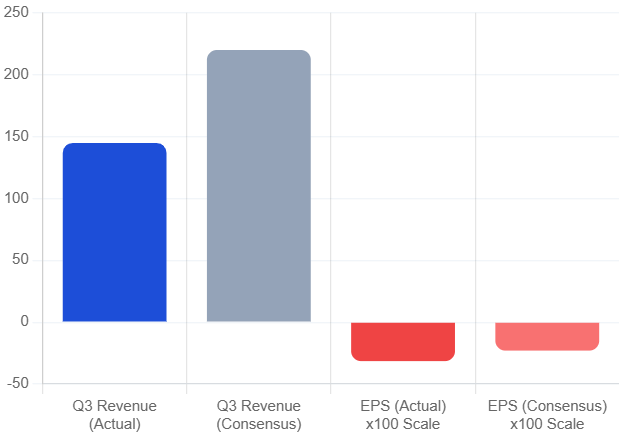
IREN reported total revenue of $144.8 million for the quarter, against consensus near $219.9 million, a shortfall of roughly 34 percent.
GAAP loss per share came in at roughly negative $0.30 to negative $0.33, missing expectations by about 36%.
The net loss widened to $247.8 million from $155.4 million, sending shares lower.
Yet within the same week, eight brokerages raised their price targets.
The reaction is less contradictory once the loss composition is examined.
IREN decommissioned Bitcoin mining ASICs to free power and space for GPU deployment, reducing Bitcoin mining revenue by 33.6% sequentially.
The $247.8 million loss was driven largely by non-cash items: a $140.4 million impairment on retired hardware and $121.2 million in depreciation on assets not yet earning at scale.
Adjusted EBITDA remained near $59.5 million, with positive underlying operating cash flow.
The income statement reflects the cost of an accelerated transition not operational deterioration.
The signal that matters sits in the segment mix.
AI Cloud Services revenue grew approximately 94 percent sequentially, lifting its share of total revenue from single digits to roughly 23 percent in two quarters.
Small in absolute terms, enormous in trajectory, it is the only line in the release describing what IREN is becoming rather than what it is leaving behind.
Owning the Stack Instead of Leasing It
IREN’s strategy is vertical ownership rather than tenancy.
It owns the land, the substation and grid interconnection, the data center shell, and the GPU hardware inside it, the opposite of the triple-net model where the operator leases and the hyperscaler procures the compute.
Ownership is capital-punishing and margin-rich: it forces IREN to carry the full buildout on its own balance sheet, and in exchange captures the entire margin stack per megawatt of energized load rather than a rent spread.
The quarter’s physical anchor is the contract book, not the P&L.
IREN signed a five-year, $3.4 billion AI Cloud managed-services agreement with NVIDIA and expanded its partnership through a right for NVIDIA to purchase up to 30 million shares at $70 each.
The warrant aligns NVIDIA’s silicon position with IREN’s equity, turning a customer relationship into a capital relationship.
This builds on the existing Microsoft AI Cloud agreement, which supports the majority of contracted revenue.
The constraint IREN monetizes is the one every hyperscaler has named as binding: power.
Its differentiation is that it secured grid-connected capacity years ahead of the AI demand curve, through a Bitcoin mining strategy that was, in retrospect, power acquisition under another label.
Converting that power into contracted AI load is the entire play. Silicon and buildings follow the megawatts.
The Balance Sheet Is the Business Model
Capital expenditure in the quarter was approximately $1.36 billion against revenue of $144.8 million. That ratio is the inversion stated numerically.
A hyperscaler funds a buildout of this relative magnitude from a river of operating cash thrown off by mature businesses running in parallel; IREN funds it from the balance sheet, against contracted revenue that begins converting in fiscal 2027.
The company carried roughly $3.7 billion in convertible notes and reported $2.6 billion of cash as of April 30, 2026, with near-term capex to be met through existing cash, operating cash flow, GPU financing, and further financing initiatives.
The symmetry is striking: a $3.7 billion ARR target by the end of 2026 sits alongside roughly $3.7 billion of debt.
One represents contracted future revenue; the other, a present obligation.
IREN’s equity depends on converting that future revenue into cash before financing costs and depreciation weigh on returns.
Unlike hyperscalers, there are no buybacks or dividends to adjust capital is fully committed to the buildout.
The trade-off is clear: the full-stack model offers higher recurring revenue and margins per megawatt, but requires carrying the balance sheet risks that traditional landlords avoid.
Its core advantage remains secured, grid-connected power capacity that cannot be replicated on the same timeline.
The Same Constraint Stack, a Different Place on It
Read against the cohort, IREN confirms the system-level pattern rather than breaking it.
Power is binding for all of them; IREN simply secured its position before demand arrived and now sells access to it, and its 94 percent sequential AI Cloud growth is the same demand signal observed earlier on the conversion curve.
Where it departs is capital access, and that is the lesson for every operator below the hyperscaler tier.
The hyperscalers convert capital risk into an optimization problem because operating cash flow absorbs the volatility.
Everyone without that cash flow must convert capital risk into a financing structure, and the quality of that structure becomes the competitive variable.
IREN’s ability to raise long-dated, low-coupon convertibles and asset-backed GPU financing at favorable terms is not a footnote to the infrastructure story.
It is the condition for that story to exist at all.
What Resolves Next
Three signals will define whether the inversion resolves in equity holders’ favor.
The first is commissioning cadence: the gap between capital deployed and revenue recognized remains the model’s largest uncertainty, with each on-schedule energized site reducing risk.
The second is ARR conversion: converting the $3.7 billion ARR target into recognized revenue from fiscal 2027 will demonstrate the shift from investment to operating scale.
The third is financing durability: the thesis depends on maintaining access to capital at terms supported by contracted cash flows as expansion continues.
Several post-quarter developments warrant monitoring but remain outside this analysis.
The most significant is an investment-grade, GPU-backed financing facility rated A and A (low), which could materially reduce funding risk if proven repeatable.
Expansion into Europe and Asia-Pacific and a further convertible issuance are also forward indicators to be assessed upon confirmation in future filings.
The structural takeaway is this: hyperscalers proved that abundant capital makes financing strategy a competitive choice.
IREN represents the harder case where capital structure is not a choice but the business itself.
Hyperscalers can absorb timing errors; IREN cannot.
The quarter’s market reaction highlights a broader shift in the AI infrastructure cycle: the focus has moved beyond capacity and capex into how the buildout is financed.