
Welcome to Global Data Center Hub. Join investors, operators, and innovators reading to stay ahead of the latest trends in the data center sector in developed and emerging markets globally.
The debate over who wins AI infrastructure has fixated on hyperscaler capex totals.
That lens misses where the more interesting structural work is happening: at the converter tier, where former Bitcoin miners are turning secured power into contracted data center cash flow.
The binding constraint across the entire cycle is energized megawatts.
The scarce capability is financing them without diluting equity or taking recourse risk onto the parent.
Hut 8’s Q1 2026 print, read correctly, is a case study in solving the second problem against the first.
Read at the headline, the quarter looks weak.
Hut 8 posted a $253.1 million consolidated net loss, missed on revenue, and missed on reported EPS.
Read at the capital structure, it is one of the cleaner infrastructure repricings of the cycle.
The company closed the quarter with a mining balance sheet and, within weeks, financed two hyperscale AI campuses in the investment-grade bond market on non-recourse terms.
The income statement and the enterprise value moved in opposite directions, and the equity followed the enterprise value.
The Signal: Accounting Noise Over a Structural Rerating
Consolidated revenue reached $71.0 million, up 226% from $21.8 million a year earlier, with $66.0 million from the Compute segment.
The headline $253.1 million net loss was driven primarily by $295.7 million in unrealized, non-cash mark-to-market losses on the Bitcoin treasury under fair-value accounting after Bitcoin fell about 22% during the quarter.
Beneath the accounting loss, gross margin expanded to approximately 64% from 14% a year earlier, reflecting stronger energy procurement and utilization rather than treasury volatility.
The market recognized the distinction: despite missing revenue and EPS expectations, the stock rallied as investors increasingly valued Hut 8 on contracted future cash flow instead of quarterly earnings.
That shifts the analytical focus.
The quarter provides context, but the investment case lies in the post-quarter capital structure.
The key value drivers, including leases, bonds, refinancings, and divestitures, were all executed after March 31.
Focusing only on quarterly results captures an accounting loss while missing the underlying business transformation.
Infrastructure Strategy: Power-First, Tenant-Backed, Density-Engineered
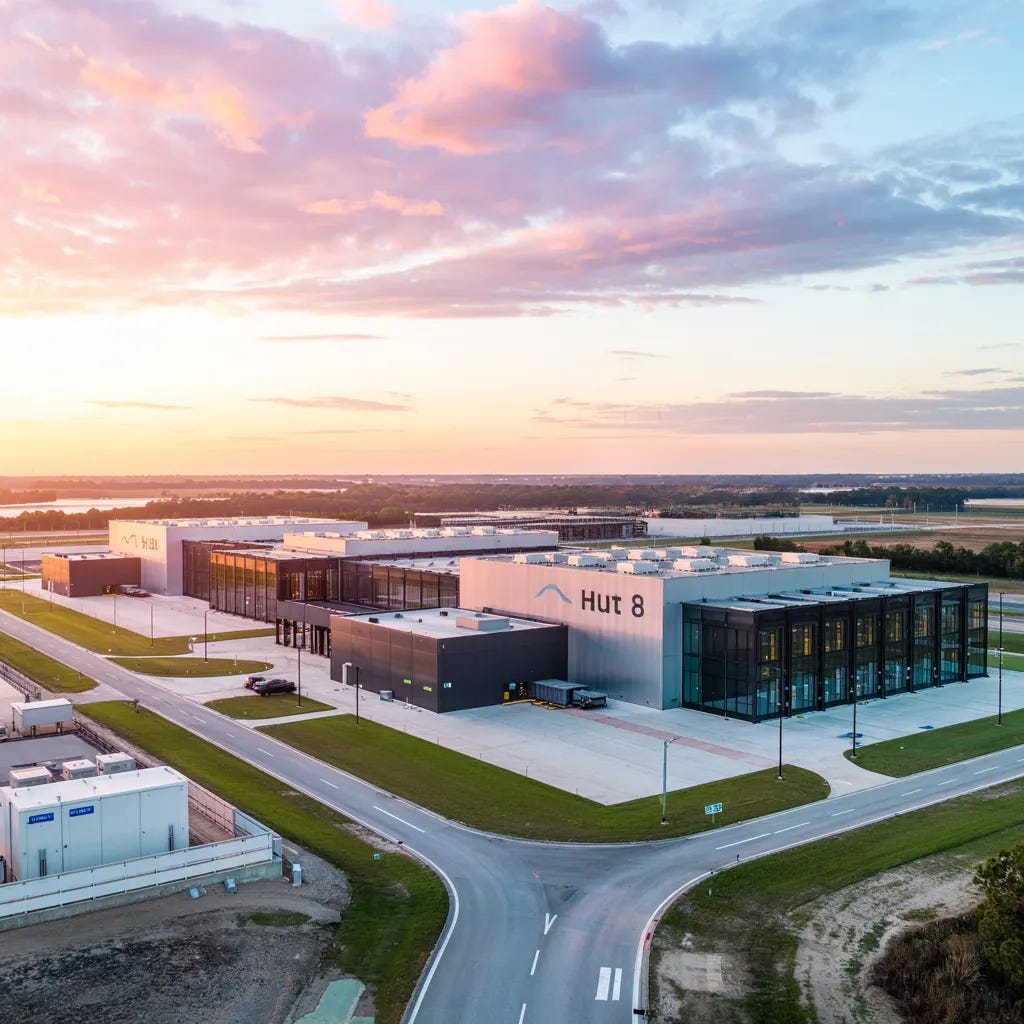
Hut 8 organizes its multi-gigawatt platform across Power, Digital Infrastructure, and Compute, but its strategy centers on developing power assets into long-term data center leases.
It isolated its mining business in publicly listed American Bitcoin Corp., where it retains an 80% stake, repositioning the parent as an energy and AI infrastructure developer serving investment-grade tenants.
River Bend, a 330 MW Louisiana campus with 245 MW of IT capacity, is fully leased to Fluidstack under a 15-year triple-net agreement backed by Google and Anthropic, with projected annual NOI of about $454 million at stabilization.
Beacon Point, a 1 GW Texas campus, has 704 MW of committed IT capacity following Phase 2 activation, supporting $19.6 billion in base-term contracts.
Its tenant is described as high investment grade but remains undisclosed.
The campuses are designed for NVIDIA’s DSX AI architecture, with liquid cooling from Vertiv and EPCM by Jacobs.
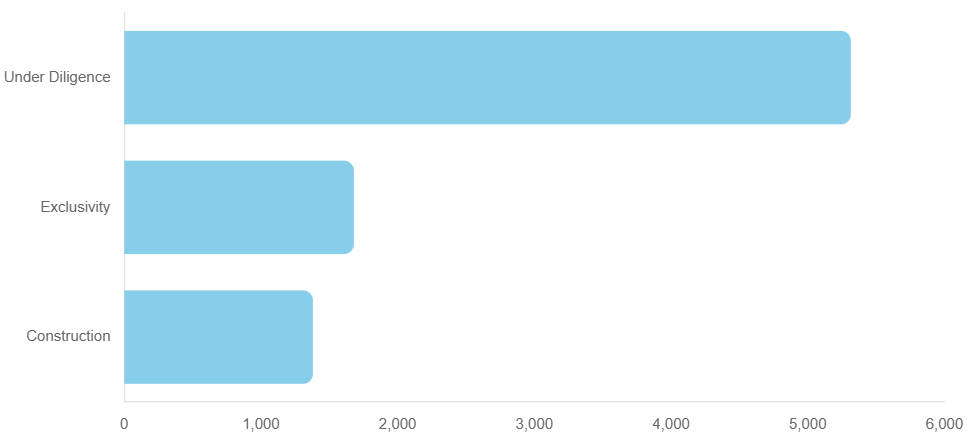
Beyond them, Hut 8 has an 8,375 MW development pipeline spanning diligence through construction.
The pipeline represents future growth, while River Bend and Beacon Point demonstrate the model already works.
Capital Allocation: The Part That Actually Reprices the Equity
Hut 8’s financing architecture distinguishes it from a mining company.
It raised $7.5 billion in non-recourse, investment-grade secured project notes across River Bend and Beacon Point.
River Bend’s $3.25 billion BBB- bond fully funded construction at roughly 95% loan-to-cost while returning $184 million of equity to the parent.
Beacon Point replicated the structure with a $4.25 billion issuance. Because the debt is non-recourse and amortized through contracted lease payments, the projects require no parent-level refinancing or equity dilution.
The parent balance sheet was strengthened alongside the financing.
Quarter-end cash and Bitcoin totaled about $1.3 billion, with $795.6 million held at the parent.
Parent-level recourse debt is limited to a $159.3 million convertible note.
Post-quarter, Hut 8 refinanced its Bitcoin-backed loan, released about 3,300 BTC as collateral, sold its 310 MW Ontario gas portfolio, and reduced crypto-related risk while retaining its 16,331 BTC treasury through a 22% Bitcoin decline.
The market is still deciding how to value Hut 8. Analyst targets range from $165 to $226, versus an average near $127 and a share price around $91.
The wide spread reflects an unresolved question: whether Hut 8 should be valued as a crypto company or as a contracted infrastructure platform.
Competitive Positioning: A Converter With a REIT’s Cost of Capital
The competitive implication is that Hut 8 has achieved the financing profile of an established data center REIT without decades of operating history.
That shift rests on secured interconnection, investment-grade tenants, and take-or-pay triple-net leases that transfer operating, tax, and power-price risk to tenants.
The bond market validated this structure with a BBB- rating, and Beacon Point’s second phase shows it is repeatable.
Hut 8 now competes with established infrastructure platforms on speed to energization and contracted backlog quality.
Its strengths are a large development pipeline and the ability to secure asset-level financing without straining the balance sheet.
Its primary risks remain greenfield execution and Bitcoin treasury volatility, which will continue to distort GAAP earnings and contribute to share-price volatility.
The Binding Constraint: Grid Before Everything
The forward risk is no longer demand or capital, both are contracted.
It is the grid.
Hut 8’s pipeline is concentrated on greenfield sites outside traditional data center hubs, where transmission is limited and utilities are tightening large-load interconnection rules.
ERCOT and others are reassessing gigawatt-scale connections.
With $7.5 billion in project debt tied to asset-level performance covenants and Q2 2027 delivery targets, any interconnection, cooling, or construction delay could postpone lease conversion into stabilized cash flow.
Three signals now matter.
First, whether River Bend meets its Q2 2027 target, validating the financing model.
Second, whether the 8,375 MW pipeline converts into signed leases, proving a scalable origination platform rather than a two-campus project.
Third, whether investors value Hut 8 as infrastructure or continue discounting its Bitcoin treasury.
For policymakers, the challenge is already clear: AI infrastructure demand and capital are moving faster than the grid can connect new capacity.
Capital structure was the first defining variable of this cycle.
Hut 8 demonstrates it is not fixed.
By pairing a mining balance sheet with secured power and investment-grade tenants, it secured infrastructure-style financing within a single cycle.
The quarterly loss was an accounting outcome; the $26.6 billion lease portfolio and the bond market’s willingness to finance it on a non-recourse basis define the business.