
Welcome to Global Data Center Hub. Join investors, operators, and innovators reading to stay ahead of the latest trends in the data center sector in developed and emerging markets globally.
TL;DR
Google announced on 9 September 2026 that it will invest at least €13 billion in Finnish data centers and supporting infrastructure across 2027 and 2028, and signed a 22-year power purchase agreement with Fortum covering up to 50 percent of the Loviisa nuclear power plant. The four locations are Hamina, Kajaani, Muhos and Vaala. Google described the package as its largest single investment in Europe.
The Fortum agreement releases €700 million of capital spending that carried no investment decision. Fortum’s Loviisa life-extension program runs to approximately €1 billion through 2050, and about 80 percent of its individual projects remained unsanctioned before the contract. Fortum states that Loviisa could not continue operating beyond 2030 without that program.
Goldman Sachs estimates that Google agreed to pay €32 per megawatt hour above the forward curve, or 1.6 times the current 2030 Finnish power price. J.P. Morgan puts the contract at roughly €80 to €90 per megawatt hour against Nordic forwards in the 50s. Neither the tariff nor the escalation formula appears in any public release.
Part One: The Record
Google announced on 9 September 2026 that it will invest at least €13 billion in digital infrastructure in Finland across 2027 and 2028.
Fortum published a stock exchange release the same day confirming a 22-year power purchase agreement with Google covering up to 50 percent of the capacity of the Loviisa nuclear power plant.
The capital funds data centers and supporting infrastructure at four locations: Hamina, Kajaani, Muhos and Vaala.
The announcement discloses no electrical demand, no compute capacity and no construction schedule by site.
Sites And Use Of Proceeds
Google has operated in Hamina since 2009, when it bought a former paper mill and converted it into a data center.
Kajaani, Muhos and Vaala are new sites. Google says its Hamina operations supported more than 600 Finnish suppliers between 2023 and 2025, including DNA, Elisa and Nokia.
The new infrastructure will serve Gemini, Search, Maps and YouTube.
Google projects an average annual contribution of €3.6 billion to Finnish gross domestic product during the 2027 and 2028 construction phase, and more than 37,000 jobs supported nationwide.
Google committed a further €31 million over four years to community programs across the four municipalities.
That package includes €10 million for research and innovation.
The Loviisa Power Purchase Agreement
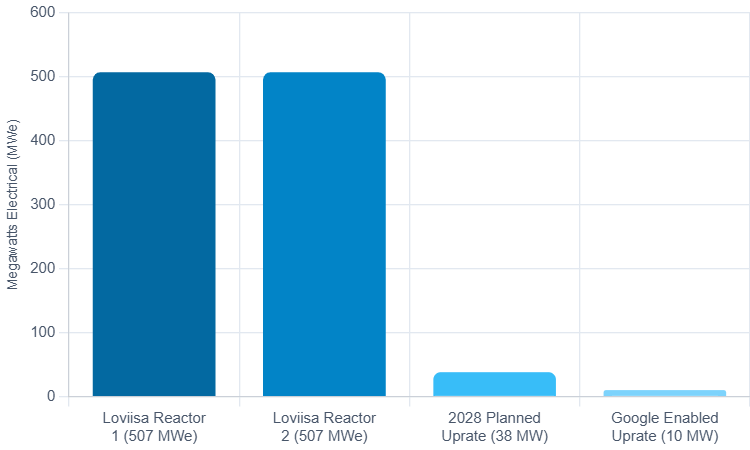
The agreement begins in 2028 at a smaller volume and reaches 50 percent of Loviisa’s capacity for the years 2030 to 2049. Loviisa holds two pressurized water reactors of 507 MWe each, commissioned in 1977 and 1980.
The plant produces about 8 terawatt hours a year, roughly 10 percent of Finland’s electricity, and employs about 580 Fortum staff.
Fortum runs an investment program of approximately €1 billion to extend operations to 2050.
About 80 percent of those projects and €700 million of the capital spending remain pending investment decisions, which Fortum will take separately.
Fortum states that the plant could not continue operating beyond 2030 without the program, and that the Google contract provides the revenue certainty to complete it.
The agreement is expected to enable a further 10 MW power increase on top of a 38 MW uprate already planned for 2028.
Fortum expects the contract to lift group comparable return on net assets by about 1.4 percentage points once half the plant is contracted.
The long-term target is 14 percent, against 11.0 percent for the twelve months to the end of June 2026. Neither party disclosed the contract price.
Wind, Storage And Grid Partnerships
Google signed onshore wind power purchase agreements with Valorem and Suomen Hyötytuuli, bringing its contracted new-to-grid onshore wind capacity in Finland to 629 MW.
A contracted 94 MW battery system near the Kajaani site is expected to connect to the grid in late 2027, and Fortum has agreed to optimize its dispatch.
The two companies also signed a memorandum of understanding covering new nuclear capacity, renewable capacity, flexibility solutions and energy portfolio management services.
Google is working with Fingrid and Business Finland to identify connection locations. Loviisa sits about 55 kilometers from the Hamina data center.
Part Two: The Read
Google Paid 1.6 Times The Curve
Goldman Sachs estimates that Google agreed to pay €32 per megawatt hour above the forward curve, or 1.6 times the current 2030 Finnish power price.
Coverage has carried that premium as an energy cost and left its mechanism undrawn: the premium is what converts four fifths of an unsanctioned capital program into a financeable one on someone else’s balance sheet.
A reader who treats this as procurement will misprice every European life-extension contract that follows it.
The Offtake Is The Investment Decision
Fortum holds a license to run Loviisa to 2050 and an investment program of about €1 billion to make that possible.
Four fifths of the projects in it, and €700 million of the money, had no investment decision behind them before 9 September.
Fortum takes each of those decisions separately, and each one needs a revenue case that Nordic wholesale prices were not producing.
Fortum’s comparable operating profit fell to €106 million in the second quarter of 2026 from €115 million a year earlier.
The company pointed to a lower achieved power price.
Google does not own the plant, does not fund the capex and does not sit on the committee that approves it.
It supplies the one input that was missing, which is 20 years of contracted revenue on half the output. Europe has a fleet of reactors facing the same arithmetic on the same timetable.
The next 12 to 24 months will show whether the marginal underwriter of European nuclear life extension is a state, a utility balance sheet, or a compute buyer with a 20-year horizon.
The Premium Prices Distance And Firmness
J.P. Morgan puts the contract at roughly €80 to €90 per megawatt hour against Nordic forwards in the 50s.
That gap pays for firmness through a windless Nordic January, and for carbon-free power carrying no interconnection queue and no construction risk.
It also pays for location, which is what the 55 kilometers between Loviisa and Hamina buy.
The premium is now a visible reference point for every European nuclear offtake negotiated after it, which is the part that travels beyond Finland.
One caution applies to the number itself.
The tariff and the escalation formula sit in a contract no outside party has read, so 1.6 times the curve is a bank estimate on undisclosed terms.
J.P. Morgan and Goldman Sachs both moved Fortum to neutral on the news, and neither moved to buy.
Power Came Before The Load Disclosure
Google contracted roughly 507 MW of nuclear capacity share, 629 MW of onshore wind and 94 MW of battery storage.
It disclosed no site demand, no compute capacity and no per-site construction schedule alongside any of it.
The same announcement paired Google with Fingrid and Business Finland to find connection points that avoid network reinforcement.
Read the sequence. In a market where the interconnection queue is the binding constraint, the supply is contracted first and the load is fitted to what the grid can already carry. Site selection in Europe will increasingly follow contracted generation.
Operators who treat power procurement as a step that follows land control are working the order backwards.
What Each Segment Prices Without The Tariff
Private Capital. European nuclear life extension has become a contractable cash flow, and the asset to look for is an operating plant with a pending capex decision and an investment-grade buyer inside transmission reach.
That describes a short list across the Nordics, Iberia and Central Europe, and it is being worked now. The cost of waiting is arithmetic.
The premium is wide because this is the first contract of its type in Europe.
After two or three more of these, the spread over the curve compresses toward the cost of capital of whoever moved first.
Public Markets. Fortum closed at €24.74 on 9 September, up 15.82 percent, and two banks raised targets to €24.30 and €25.50 the following day. What repriced is an estimate.
The tariff, the indexation and the volume ramp are all undisclosed, and Fortum’s own language is that the 1.4-point return lift arrives over time, with full volume starting in 2030.
Holders should price the ramp and treat the next quarterly hedge-ratio disclosure as the first real read on the contract.
Operators. The reference price for firm, carbon-free, adjacent European power now sits near €80 to €90 per megawatt hour on a 22-year term.
An operator without an investment-grade counterparty behind it cannot sign at that level, which narrows the field for every existing plant that comes up for a life-extension decision.
The move available is co-location next to a reactor facing that decision, negotiated before the fleet is spoken for.
The Next Contract Prices Off This One
Google did something narrower than building power and more durable than buying it.
It bought two decades of an operating asset’s remaining life, paid above the curve to do it, and took no ownership.
Through 2027 every European operator with a pending life-extension decision will test that template, and the binding constraint will be the number of reactors with a creditworthy compute buyer within transmission reach.
The first three contracts will set the band that the rest of the fleet trades in.
One question decides whether 1.6 times the curve was expensive. A premium fixed for 22 years and a premium that escalates with Nordic power are different assets, and only one of them transfers the price risk Fortum was carrying.
Ask for the escalation formula before pricing the premium.