
Welcome to Global Data Center Hub. Join investors, operators, and innovators reading to stay ahead of the latest trends in the data center sector in developed and emerging markets globally.
TL;DR
Anthropic, Macquarie Asset Management and GIC established Theseus Infrastructure on August 10, 2026, a platform that will develop, own and lease purpose-built data centers to Anthropic under long-term agreements. Macquarie-managed funds and GIC own the platform and fund the majority of the equity in each project. The parties disclosed no capital figure, no capacity target, no sites and no timeline.
The disclosed equity floor in each Theseus project is above 50 percent, and the ceiling is undisclosed. Coverage has treated Macquarie and GIC as the owners without asking who funds the remainder. Whether Anthropic holds project-level equity determines whether construction risk and asset ownership actually sit outside the company.
Anthropic committed to cover electricity price increases that consumers in host communities would otherwise face from Theseus sites. New York Executive Order 62, signed July 14, 2026, paused discretionary state environmental permits for data centers of 50 megawatts or more on the stated ground that grid upgrade costs should not fall on ordinary ratepayers. Anthropic is already developing New York capacity with Fluidstack.
Part One: The Record
Anthropic, Macquarie Asset Management and GIC announced a strategic partnership on August 10, 2026, to establish Theseus Infrastructure.
Theseus will develop, operate and lease data center infrastructure to Anthropic under long-term agreements.
Each facility will be purpose-built for Anthropic’s capacity needs.
The initial focus is the United States. The parties disclosed no capital figure, no capacity target, no site locations and no delivery timeline.
Ownership And Equity Structure
Funds managed by Macquarie Asset Management, together with GIC, will own the platform.
Those funds will also supply the majority of the equity for each individual project.
Anthropic will act as anchor tenant on each site rather than as developer or landlord.
The three parties will jointly identify and develop new sites.
Macquarie Asset Management manages US$497.6 billion in assets. GIC was established in 1981 and manages Singapore’s foreign reserves.
The parties framed the arrangement around each firm’s prior activity.
Macquarie was cited for developing, financing and operating large-scale digital infrastructure. GIC was cited for infrastructure investing globally.
Data Center Dynamics reports that Macquarie previously invested in AirTrunk and Aligned, exiting both in recent years, while GIC holds stakes in Vantage EMEA, Equinix xScale, EdgeCore, and a Brazilian joint venture.
The Ratepayer Commitment And Undisclosed Terms
Anthropic committed to cover electricity price increases that consumers may otherwise face from Theseus sites.
The company described this as consistent with commitments it announced earlier in 2026.
The parties stated that the developments will require significant capital investment and will create construction jobs and permanent operational roles in host communities.
No figure was attached to the investment; the job counts or the electricity commitment.
Theseus joins an existing set of Anthropic capacity arrangements.
Anthropic said in 2025 that it would invest $50 billion in US data center capacity, developing custom sites with Fluidstack in Texas and New York. Anthropic leases capacity from TeraWulf, Hut 8 and SpaceX.
In July 2026, Anthropic signed a 20-year lease with TeraWulf at its Hawesville, Kentucky campus covering approximately 401 megawatts of critical IT load, with initial capacity expected in the second half of 2027.
The parties said they will work together to identify and develop new sites. They gave no date for a first site announcement.
Part Two: The Read
The Majority Is Disclosed. The Rest Decides The Structure.
Macquarie and GIC will fund the majority of the equity in each Theseus project, which fixes a disclosed floor above 50 percent and leaves the ceiling open.
Coverage has read that sentence as settling the ownership question, and it does the opposite: it names one side of a split and leaves the other side unnamed.
If Anthropic holds project-level equity in the vehicles that own its buildings, Theseus is a co-investment carrying lease documentation, and the assets have not left the company in the way the announcement implies.
No Figure Exists Because No Project Exists Yet
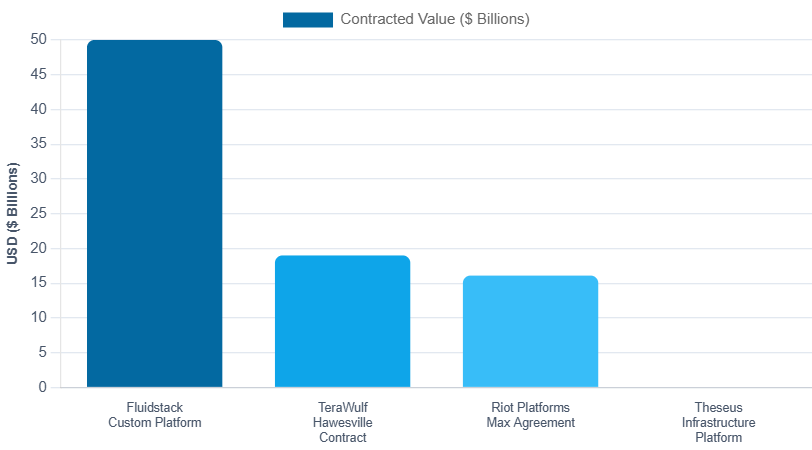
Every other arrangement in Anthropic’s compute stack carries a number.
The Fluidstack program carries $50 billion.
The TeraWulf lease carries roughly $19 billions of contracted revenue across 20 years.
The Riot Platforms agreement carries $9.1 billion with extensions to $16.1 billion.
Theseus carries none, and the reason is structural rather than evasive.
Capital has been committed to a process for identifying sites, not to assets that exist.
That distinction matters because platform announcements and funded facilities behave differently.
NVIDIA announced its own financing platform on August 10, 2026, targeting over $500 billion. Read the inverse disclosure: Nvidia's $500B AI Infrastructure Financing Platform
A platform can be announced, staffed, and quietly deprioritized without a single dollar moving.
The pattern is now common enough to have a shape: large institutional coalitions announce mobilization capacity, and the first executed project agreement is what converts the announcement into a market.
GDCH covered the same structure in NVIDIA’s $500 billion financing platform, where six memoranda produced a headline figure and no binding agreement.
For Theseus, the event to watch over the next twelve months is the first named site with a project-level equity check attached.
That is the moment the platform prices. Until then, the announcement establishes intent and a partnership, and it establishes nothing about scale.
Singapore Is Buying The Tenant And The Building
Data Center Dynamics reports that GIC has previously invested in Anthropic. GIC now also co-owns the entity that will own Anthropic’s buildings and collect its rent.
Sovereign capital is taking a position in the operating company and in the real estate that operating company occupies, inside the same compute stack.
This is a different exposure from sector allocation, and it will not surface in the diligence on either position.
A fund underwriting the Theseus equity examines lease terms, counterparty credit and construction risk. A fund holding the pre-IPO stake examines revenue growth and model competitiveness.
Neither review shows the correlation, because the correlation lives at the portfolio level and both positions clear on their own merits.
The single variable underneath both is Anthropic’s ability to pay rent through a compute cycle. If that holds, the landlord position and the equity position compound together.
If it does not, they impair together, and the lease that looked like a senior claim on a diversified sovereign book turns out to be a claim on the same credit the equity was underwriting.
Expect more of this shape over the next four to eight quarters as sovereign and pension capital moves from data center platforms into tenant-specific vehicles and expect the concentration to be visible only to whoever is looking across both books.
The Ratepayer Guarantee Is A Permitting Instrument
New York Executive Order 62, signed July 14, 2026, paused discretionary state environmental permits for data centers drawing 50 megawatts or more.
The order’s stated rationale is that the cost of electric system upgrades to serve large loads should not fall on ordinary New Yorkers.
Nearly 12 gigawatts of data center load sat in the NYISO interconnection queue as of May.
Anthropic is already developing New York capacity with Fluidstack.
Read the electricity commitment against that order and it stops looking like a community gesture.
It is a pre-negotiated answer to the precise objection that has frozen permitting in one of Anthropic’s named markets, offered before a single Theseus site has been proposed.
Sites that arrive with the ratepayer question already settled move through discretionary review faster than sites that arrive arguing about it.
The commitment is also an unpriced liability, and nobody has said where it sits.
If Theseus carries it, it is an operating expense that reduces the landlord’s yield and falls within Macquarie and GIC’s lease economics. If Anthropic carries it, it is an uncapped, undefined contingent obligation tied to a company still in registration.
Over the next twelve to twenty-four months, expect host-community negotiations across the US to converge on this term as standard, and expect the first structure that discloses where the reserve sits to become the reference point.
What Each Segment Prices Before A Site Is Named
Private Capital. Ask for the equity waterfall before the platform economics.
Two questions decide the structure: what percentage above 50 the sponsors actually fund, and whether the anchor tenant holds any project-level equity.
Firms that wait for the first Theseus project to close will underwrite against terms Macquarie and GIC negotiated on a template written to clear that deal.
Public Markets. Anthropic filed a confidential draft S-1 on June 1, 2026, after raising $65 billion at a $965 billion post-money valuation.
Long-term lease obligations, any residual commitments to Theseus, and the ratepayer guarantee appear in that document, not in the August 10 release.
Holders pricing off run-rate revenue are pricing a company whose compute cost structure sits in agreements they have not read.
Operators. The dedicated-landlord platform competes for the same tenant you do, with site co-development and a permanent lease attached.
Operators bidding Anthropic capacity in the next two quarters are bidding against a partner, not a customer.
The First Named Site Sets The Template
Theseus establishes a coalition, a structure and a role for Anthropic that sits closer to development partner than tenant.
It establishes no capital, no capacity and no schedule, and the distance between those two states is measured in one document nobody outside the three parties has seen.
Two things arrive in the next two to three quarters.
The S-1 becomes public and shows what Anthropic actually owes across leases.
The first Theseus site gets named and shows what the equity split actually is.
Ask which of those lands first, because whichever one it will set the price of every question about the other.