

Welcome to Global Data Center Hub. Join investors, operators, and innovators reading to stay ahead of the latest trends in the data center sector in developed and emerging markets globally.
Crusoe announced a $3.9 billion Series F equity round at a post-money valuation of $30.9 billion.
Atreides Management, Mubadala Capital and Valor Equity Partners co-led the round, with participation from Founders Fund, GIC, NVIDIA, Qatar Investment Authority, Oman Investment Authority, Radical Ventures, TPG and more than twenty additional investors.
Proceeds will scale the company’s existing programs, fund the build out of its AI factories, including Crusoe Spark modular data centers, and support the growth of Crusoe Cloud.
The round was announced on September 17, 2026, as the oversubscribed initial closing of an anticipated round.
The Crusoe Series F Syndicate
The syndicate spans sovereign wealth funds, public market asset managers and industrial investors.
Mubadala Capital co-led the round. GIC, Qatar Investment Authority and Oman Investment Authority participated.
Public market managers in the round include Fidelity Management & Research Company, Baillie Gifford, Tiger Global, StepStone Group, Salesforce Ventures, ARK Invest, Altimeter and accounts advised by T. Rowe Price.
NVIDIA and DPR Construction also invested. Crusoe announced its $1.375 billion Series E in October 2025 at an expected valuation above $10 billion.
Crusoe Platform And Capacity Figures
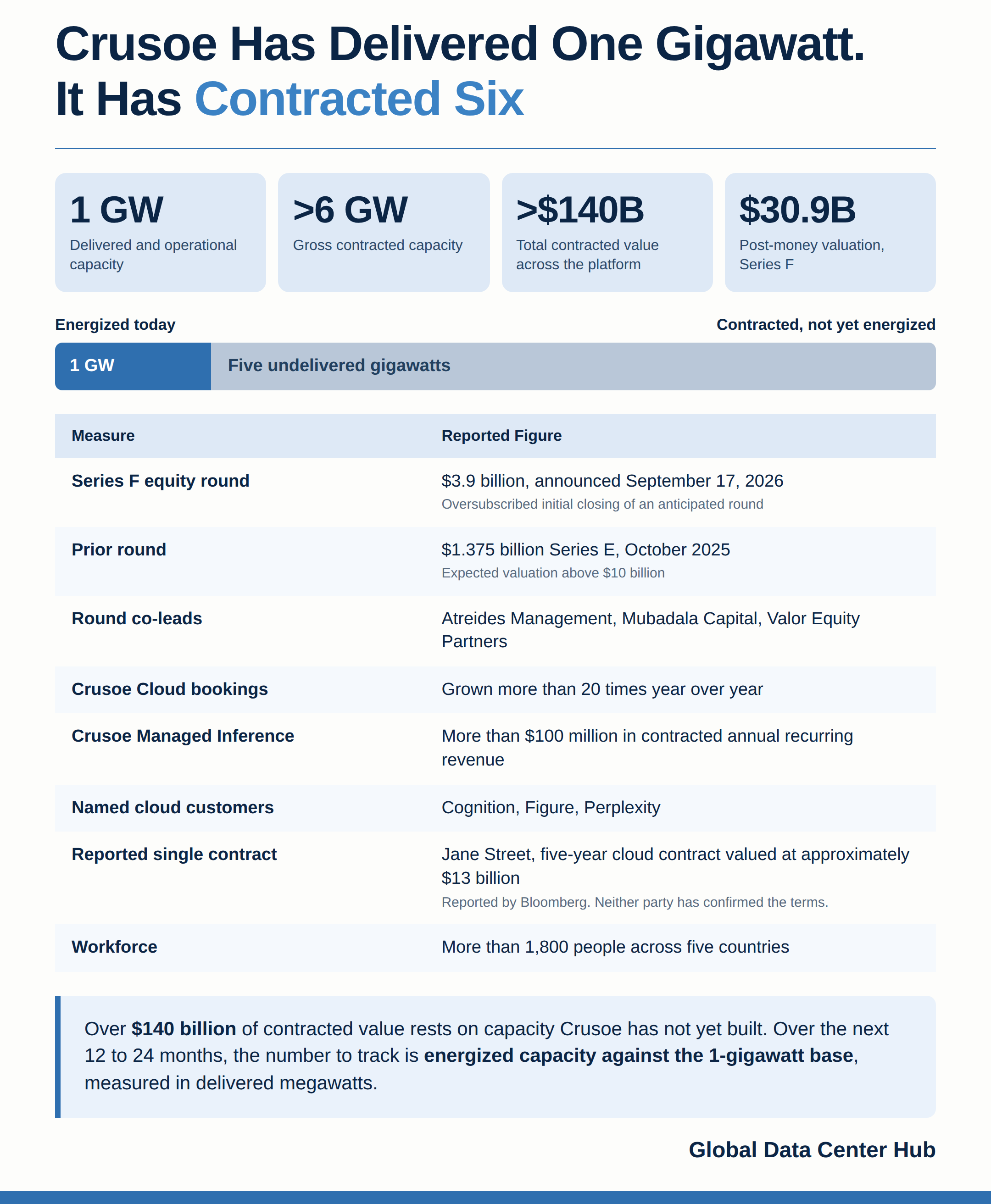
Crusoe reports more than $140 billion in total contracted value across its vertically integrated platform. Gross contracted capacity exceeds 6 gigawatts.
Delivered and operational capacity stands at 1 gigawatt.
Crusoe Cloud bookings have grown more than 20 times year over year. Crusoe Managed Inference carries more than $100 million in contracted annual recurring revenue.
Cloud customers named by the company include Cognition, Figure and Perplexity.
OpenAI trained its Astra model at the Abilene campus in Texas, which Crusoe designed and built.
The company manufactures Crusoe Spark modular data centers in the United States and states that the units shorten deployment timelines from years to weeks.
Crusoe Board Additions
Crusoe added three directors alongside the round. Thomas Seifert is the Chief Financial Officer of Cloudflare.
Bill Stein is the former Chief Executive Officer of Digital Realty Trust and serves as Chief Investment Officer at Primary Digital Infrastructure.
JB Straubel is the founder and Chief Executive Officer of Redwood Materials.
The company employs more than 1,800 people across five countries, with offices including Bellevue, Washington, and New York City.
Crusoe has not announced a timeline for completing the anticipated round beyond this initial closing.
The Round Prices Five Undelivered Gigawatts
Over $140 billions of contracted value rests on capacity Crusoe has not yet built.
Coverage of the round carried the $30.9 billion valuation at face value and did not price the distance between what the company has contracted and what it has energized.
That distance is what this round buy: time and capital to convert a contract book into operating infrastructure before the obligations inside it come due.
Demand is settled. The contracts settle it. Conversion is open, and conversion is the risk the syndicate now owns.
Where The Six Contracted Gigawatts Break
A contracted gigawatt breaks at energization. Power that is contracted but not delivered produces no revenue while delivery obligations stand.
Crusoe has published no reconciliation of its contracted value to contract duration, counterparty concentration, cancellation rights or the capital required to deliver it.
Bloomberg reports that Jane Street signed a five-year cloud contract with Crusoe valued at approximately $13 billion. Neither party has confirmed the terms.
A single reported contract of that scale shows how much of a $140 billion book can sit with one counterparty, and concentration is exactly what the disclosures do not cover.
The cost of a slip is written in the company’s own numbers.
Every gigawatt that misses its energization schedule defers the contracted value attached to it, and the book that justifies the valuation is the same book that delivery carries.
Over the next 12 to 24 months, the number to track is energized capacity against the 1-gigawatt base, measured in delivered megawatts.
The Syndicate Is Built For A Listing
The investor list is itself a signal. Fidelity Management & Research Company, Baillie Gifford, Tiger Global and accounts advised by T. Rowe Price are the buyers who anchor public offerings.
They sit in this round beside four sovereign funds and NVIDIA.
The board moves point in the same direction. Crusoe added Cloudflare CFO Thomas Seifert, former Digital Realty Trust CEO Bill Stein, and Redwood Materials founder JB Straubel.
Axios also reported meetings with investment banks about a potential listing.
The register of Crusoe’s capital has shifted from venture funds to the institutions that price public markets.
When that shift happens at a $30.9 billion mark, the next 12 to 24 months become a preparation window, whether the destination is a listing or another crossover-priced private round.
Sovereign Capital Moved To The Platform Level
Four sovereign investors sit in one private round. Mubadala Capital co-led.
GIC, Qatar Investment Authority and Oman Investment Authority participated. Sovereign wealth has long held data centers through stabilized assets and listed vehicles.
Platform equity in a private developer carries development risk, delivery risk and technology risk, and four sovereigns took it in the same round.
That choice marks where sovereigns now see the scarce asset: the platform that can originate power and deliver capacity on schedule.
For the next 12 to 24 months, expect the template to travel.
Sovereign and crossover equity sits at the platform level, and project debt and joint ventures get layered at the asset level to fund the actual buildout.

Reconcile The Contract Book Before The Mark
For private capital investors, this round resets the comparables for every AI infrastructure platform in your pipeline, and it prices contracted metrics that no public disclosure lets you verify.
Four checks belong in your process before you underwrite the next platform round at a mark like this one.
First, reconcile total contracted value: contract duration, counterparty concentration, cancellation and termination rights, and revenue recognition.
The evidence is the contract schedules, and the ask belongs in commercial diligence before the term sheet.
The reported Jane Street contract shows how much value can sit in a single unconfirmed agreement.
Second, underwrite energization. Ask for the delivered and operational base, campus-level energization schedules, and signed power and interconnection agreements.
Crusoe reports 1 gigawatt operational against more than 6 gigawatts contracted, highlighting the delivery gap.
Third, map the funding stack per gigawatt. Ask what capital beyond the equity round funds the remaining capacity and on what terms.
A $3.9 billion equity closing does not by itself fund a multi-gigawatt buildout.
Fourth, test the mark’s assumed conversion speed. Valuation rose from above $10 billion at the October 2025 Series E to $30.9 billion roughly eleven months later.
Skip these checks, and you pay for that appreciation while taking on unpriced conversion risk.
Energized Gigawatts Decide The Next Mark
This round sets a template for financing private AI infrastructure: contracted capacity instead of financial statements, sovereign and crossover equity at the platform level, and delivery risk consolidated within one company.
The shift is that private infrastructure is now priced like a business with backlog, without the disclosure that backlog typically carries.
The timing is specific. Crusoe’s valuation roughly tripled in eleven months, driven by its contract book.
That book is ultimately validated through delivery, measured in energized capacity.
Watch the delivered base, whether the anticipated round closes, and whether reported listing preparations advance, as these shorten the window for contracted capacity to convert into reported results.
The open question is the one the syndicate answered with $3.9 billion: whether the buildout can move as fast as the book. You will know before the next mark does.