
Welcome to Global Data Center Hub. Join investors, operators, and innovators reading to stay ahead of the latest trends in the data center sector in developed and emerging markets globally.
For two years the AI infrastructure debate has been an argument about totals.
The question was whether Amazon could sustain $200 billion in capex, Alphabet could fund AI over buybacks, and Meta could execute gigawatt-scale campuses.
The underlying premise remained the same.
These are companies with mature cash engines choosing how much internal cash flow to redirect into physical buildout.
CoreWeave breaks that premise. It has no cash engine to reallocate, no margin cushion to compress, and no buyback to pause.
Its capital structure is not one input among many but the entire enterprise, which makes its first quarter of 2026 the purest test of a question the hyperscaler prints could never isolate.
On what terms will the market lend against silicon that has never survived a depreciation cycle at this scale.
The answer this quarter was not the backlog that dominated the headlines nor the earnings miss that moved the stock.
It was a financing structure, and it changes the unit economics of every neocloud that follows.
The Signal: A Rating, Not a Number
On March 31, CoreWeave closed an eight and a half billion dollar delayed-draw term loan, the facility it labels DDTL 4.0.
The size is not what matters. The rating is.
It is the first GPU-collateralized financing to earn an investment-grade profile, A3 from Moody’s and A-low from DBRS, priced at SOFR plus 225 basis points floating and 5.9 percent fixed.
Its first such facility in 2023 carried a rate near 15 percent, secured only by the resale value of the hardware.
In under three years the same collateral has moved from high-yield pricing to an investment-grade stamp.
It is a market deciding GPU fleets, structured correctly, can be underwritten the way data-center shells, fiber, and towers are, long-duration, contracted, and non-recourse.
The mechanism is the story. The debt sits in a bankruptcy-remote subsidiary, backed by GPU hardware and contracted Meta cash flows. In substance, Moody's and DBRS rated the collateral not CoreWeave.
It is Meta’s credit and the residual value of Blackwell silicon, ring-fenced away from the operating company’s own fragility.
Infrastructure Strategy: Buying Power That Already Exists
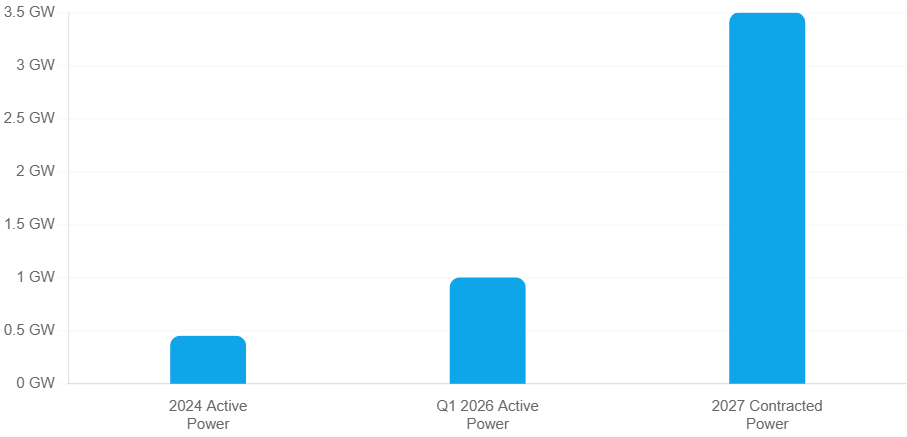
CoreWeave avoids the two things that gate everyone else, greenfield construction time and grid interconnection queues, by retrofitting powered shells rather than building from raw land.
It surpassed one gigawatt of active power this quarter and expanded contracted power past three and a half gigawatts.
Its Core Scientific hosting agreements and the Galaxy Digital Helios lease in West Texas are mining-to-AI conversions, stranded power-secured land where the interconnection was already fought for.
That same Core Scientific partnership is the quarter’s litigation overhang.
A December 2025 report revealed the building partner had flagged delays for nine months, and a securities fraud class action now alleges CoreWeave concealed them.
Capital Allocation: The Company Is the Balance Sheet
Revenue grew 112 percent year over year to 2.08 billion dollars, beating consensus.
The GAAP net loss widened to 740 million dollars, driven not by deteriorating unit economics but by capital-structure costs.
Net interest expense reached 536 million, up 103 percent and guided toward 650 to 730 million next quarter, consuming more than a quarter of revenue.
Total debt stands at roughly 24.9 billion dollars against 4.8 billion of equity, a debt-to-equity ratio above five, and a current ratio of 0.46, with current liabilities exceeding liquid assets more than two to one.
The company depends on continuous access to debt markets and customer prepayments to meet near-term obligations and posted free cash flow of negative 4.7 billion against 7.7 billion of capex.
This is the inversion of the hyperscaler thesis.
When Alphabet pauses buybacks to fund capex, it exercises optionality from a position of surplus.
CoreWeave has no such choice. It cannot return capital because it does not generate free capital, and it cannot slow the buildout without stranding the contracts that justify the debt.
The capital structure is not a lever the company pulls. It is the thing the company is.
One ring-fenced facility earning investment grade does not make the consolidated entity investment-grade.
It makes one tranche financeable at a cost rivals cannot match.
Competitive Positioning: The Moat Moved to Cost of Capital
The conventional read of CoreWeave’s advantage is GPU access, reinforced this quarter by a two-billion-dollar Nvidia equity injection.
Where every serious neocloud can eventually secure silicon, the durable differentiator is the cost of the capital used to buy it.
A company financing GPUs at SOFR plus 225 can price workloads a rival financing at high-yield rates cannot profitably match.
The rating moved the competitive frontier from who has GPUs to who has the cheapest structured capital secured against the best tenants.
The backlog reinforces this, reaching 99.4 billion dollars with net revenue retention at 155 percent.
Counterparty quality is the real asset.
The backlog is not revenue visibility. It is collateral.
The structural tension lies in the collateral itself. Meta's $35.2 billion commitment underpins CoreWeave's investment-grade debt, yet Meta is also building its own sovereign AI infrastructure.
The tenant securing the debt today could reduce its reliance tomorrow, leaving CoreWeave with excess capacity, weaker pricing power, and debt sized for full utilization.
The instrument that earned the rating and the risk that could break it are the same relationship.
The Category Question CoreWeave Just Opened
No cash engine funds a combined hyperscaler capex approaching 700 billion dollars indefinitely from operations.
Debt is entering the buildout at every layer, and the unresolved question is on what terms lenders will price physical AI assets whose residual value is unknown, because no GPU generation has yet depreciated through a full cycle at hyperscale.
When Microsoft or Amazon borrows, the credit rests on the parent’s cash flow and the GPU collateral is incidental.
When CoreWeave borrows, the GPUs and the tenant contract are the credit, making the A3 rating the first clean market price on GPU-backed, non-recourse infrastructure debt.
If it holds through a depreciation cycle, the neocloud category stops being an equity story and becomes a structured-credit one.
If the collateral erodes faster than the contracts amortize, the short thesis that residual GPU values fall below the secured balances becomes the sector’s defining risk.
What Resolves Next
Three signals will settle which reading is correct. First, the second-half margin ramp.
Management guided full-year adjusted operating income of $900 million to $1.1 billion, with only about $81 million expected in the first half meaning the outlook depends on new capacity reaching full utilization on schedule.
Another key test is financing: the May DDTL 5.0 facility priced below investment grade, raising questions about whether GPU-backed investment-grade debt is repeatable.
Finally, tenant concentration remains the biggest risk, as the same customer supporting the debt is also its largest vulnerability.
For investors, the key question is whether earnings can outpace interest and depreciation.
For operators, investment-grade tenants are now essential to securing low-cost capital.
For policymakers, concentration risk is growing as a single hyperscaler drives demand, backs the debt, and could ultimately become a competitor.
CoreWeave didn't prove GPU-backed debt is infrastructure debt it proved markets are willing to price it that way before depreciation tests the collateral.
The next two years will determine if that assumption holds.