
Welcome to Global Data Center Hub. Join investors, operators, and innovators reading to stay ahead of the latest trends in the data center sector in developed and emerging markets globally.
The market views Cipher Digital’s first quarter as a successful transition from Bitcoin mining to AI infrastructure.
While mining revenue and earnings disappointed, investors focused on its contracted data-center backlog.
That view is only part of the story.
The backlog is underwritten not by Cipher’s balance sheet, but by two investment-grade counterparties, financed through non-recourse project debt with one parent-level obligation outside that structure.
This is the distinction that determines whether the backlog is durable or merely large.
The AI infrastructure debate has spent two years on capital intensity, on which operator can clear the largest capex number.
For a developer of Cipher’s scale, the deciding variable is different.
It is the quality of the credit standing behind the leases and the architecture of the debt raised against them.
Cipher has assembled both. It has also concentrated both.
The Quarter the Mining Line Stopped Mattering
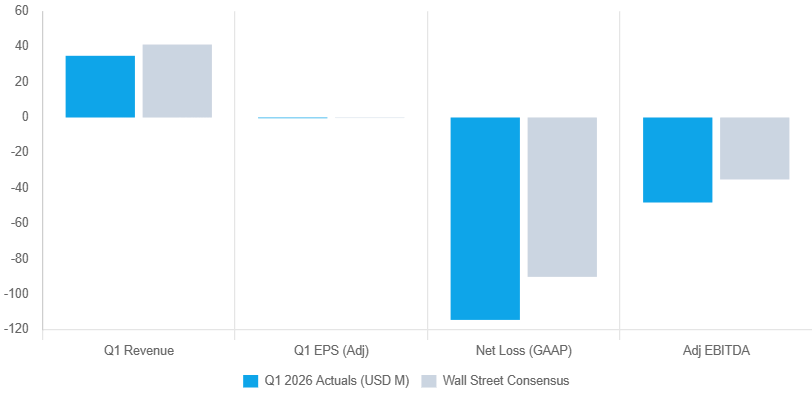
Cipher reported $34.84 million in revenue for the quarter ended March 31, 2026, down 28.8% year over year and 41.7% sequentially, with both revenue and EPS missing consensus.
The company posted a GAAP net loss of $114.3 million, an improvement from the prior quarter, while Adjusted EBITDA came in at negative $48.0 million.
The financial results, however, are not the main signal.
The revenue decline was intentional as Cipher accelerated its exit from Bitcoin mining before data-center lease revenue begins.
Interest expense rose sharply as project debt was issued ahead of rent commencements.
The quarter reflects a business absorbing financing costs during its transition, with investors largely valuing the contracted backlog over near-term earnings.
The more important development is Cipher's three contracted hyperscale data-center projects, totaling 700 MW of gross capacity and backed by $11.4 billion in contracted revenue over 10–15 years.
The portfolio is expected to generate $787 million in annual net operating income from late 2026 through 2036, marking a shift from volatile mining income to long-term contracted cash flows.
The critical question is not the size of the backlog, but the quality of the credit supporting it.
Two Tenants Behind Eleven Billion
Cipher’s backlog is concentrated around two counterparties.
Black Pearl, a 300 MW site in Texas, is backed by a 15-year triple-net lease with Amazon Data Services, guaranteed by Amazon.com (AA-), and valued at roughly $5.5 billion.
Stingray, a 100 MW Texas site, is also leased to Amazon under a 15-year triple-net agreement with industry-leading economics.
Barber Lake, a 300 MW project leased to Fluidstack, differs because the tenant is unrated.
Instead, Google provides credit support through a recognition agreement covering up to $1.73 billion in obligations in exchange for warrants representing a 5.4% pro forma stake.
The structure is straightforward: two of the three projects depend on Amazon, while the third relies on Google's credit backing.
Roughly $7.5 billion of the contracted backlog is tied to Amazon, with the remainder effectively supported by Google.
This is not a flaw securing investment-grade counterparties is sound infrastructure finance but it means the backlog should be viewed as concentrated exposure to two hyperscalers rather than broadly diversified revenue.
If either Amazon or Google changes its infrastructure strategy, that concentration becomes the key risk behind the headline backlog.
Five Tranches Built to Contain It
The debt architecture is the answer to the concentration, and it is the most sophisticated part of the story.
Cipher carries roughly $5.2 billion of total debt principal, and its structure matters more than its size.
The site notes are non-recourse and issued at the project entity: $1.73 billion at Barber Lake at a 7.125% coupon, $2.0 billion at Black Pearl at 6.125%, and $810 million at Stingray at 6.000%, the descending coupons tracking improving credit perception as the lease book built.
Each tranche is secured by first-priority liens on its own site and serviced only by that site’s rent. A default at one campus cannot cascade to the parent or to the other campuses.
The concentration exposure is real, and the project-finance structure is engineered precisely to wall off each instance of it.
This is the mechanism that separates Cipher from a levered miner.
The ring-fence converts single-tenant risk into contained, site-level risk.
It is why long-only infrastructure capital has rotated into a name that was recently a high-beta crypto proxy.
The structure earns the re-rating.
The Gap the Ring-Fence Does Not Close
The financing structure has one key weakness.
Above the non-recourse project debt sits $1.47 billion of parent-level convertible notes $173 million due 2030 and $1.30 billion due 2031.
Unlike the site debt, these obligations are not supported by lease cash flows but by Cipher’s corporate liquidity and, if necessary, equity dilution.
With mining winding down and rents yet to begin, this remains the company’s primary financial exposure.
Timing increases that risk.
Rent at Black Pearl and Barber Lake is expected to begin in late 2026, with Stingray following in 2027, while project debt starts accruing interest beforehand.
Although Cipher ended the quarter with $715 million in unrestricted cash and $3.51 billion in restricted construction cash, execution remains critical.
Amazon can terminate leases after prolonged construction delays, potentially leaving project debt without its intended cash flow.
The structure protects against tenant default—not construction delays.
What Resolves Next
Three signals will determine whether the backlog converts to the cash flow the market is pricing.
First, on-time rent commencement at Black Pearl and Barber Lake in late 2026; the 180-day termination grace period makes the delivery schedule a credit event, not merely an operational one.
Second, the parent convertible position, which must be refinanced or diluted through and is the one liability the ring-fence does not reach.
Third, conversion of the 3.3-gigawatt development pipeline into signed leases at comparable credit quality, which is the only path that diversifies the two-tenant concentration rather than deepening it.
For investors, Cipher should be valued on counterparty credit, not capacity.
For operators, it demonstrates how project-finance discipline can unlock institutional capital, though parent-level risk remains execution-dependent.
For policymakers, hyperscaler balance sheets are becoming the credit backbone of digital infrastructure, with grid access in Texas and PJM remaining the key bottleneck.
Cipher did not escape the volatility of mining by getting bigger.
It did so by borrowing two of the strongest balance sheets in technology, tranche by tranche, and accepting the one gap the borrowing left open.