

Welcome to Global Data Center Hub. Join investors, operators, and innovators reading to stay ahead of the latest trends in the data center sector in developed and emerging markets globally.
TL;DR
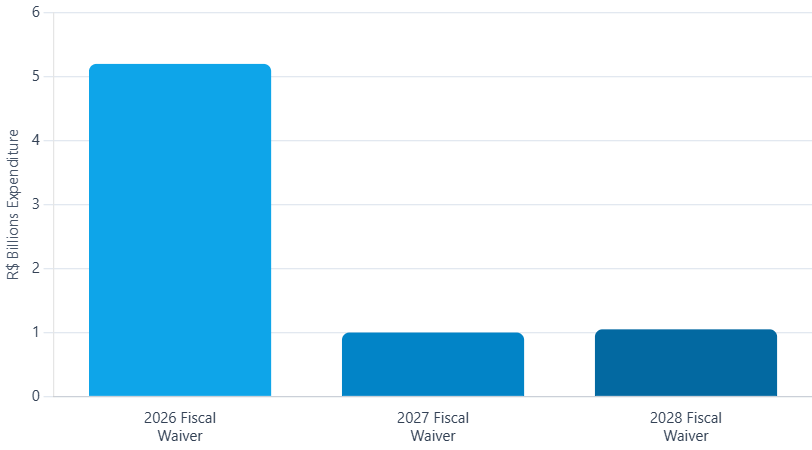
Brazil’s Senate approved PL 278/2026 on September 1, 2026, creating Redata, the special tax regime for data center services. The bill suspends PIS/Cofins, PIS/Cofins on imports, IPI and the Import Tax on ICT equipment entering a data center’s fixed assets. The government estimates the relief at R$5.2 billion in 2026, R$1.0 billion in 2027 and R$1.05 billion in 2028. A companion bill, PLP 74/2026, cleared the Senate 66 votes to none on September 3.
Article 11-J of Redata ends three of the four federal waivers on December 31, 2026, leaving the Import Tax as the only levy waived across the regime’s five-year term. PIS/Cofins and IPI are extinguished on January 1, 2027, under Constitutional Amendment 132 of 2023 and replaced by CBS and IBS. Redata is worth R$1.0 billion a year from 2027, one fifth of its first-year value.
Brazil’s Senate widened Redata’s energy standard from clean or renewable sources to renewable or low-emission sources through a drafting amendment, admitting gas-fired generation. The amendment class was chosen to avoid returning the bill to the Chamber of Deputies. The statute leaves the definition of low emission to executive decree.
Part One: The Record
Brazil’s Senate approved PL 278/2026 on September 1, 2026, creating Redata, the Regime Especial de Tributação para Serviços de Datacenter.
The bill suspends four federal taxes on information and communications technology equipment bought or imported for data center fixed assets.
The government estimates the relief at R$5.2 billion in 2026, R$1.0 billion in 2027 and R$1.05 billion in 2028.
The Senate passed the text by symbolic vote without changes to its merits and sent it to President Luiz Inácio Lula da Silva for sanction.
The Four Taxes And The Qualifying Goods
Article 11-C suspends PIS/Pasep and Cofins on revenue, PIS/Cofins-Importação, IPI, and the Import Tax.
The suspension covers electronic components and other ICT products destined for the fixed assets of an approved company.
It converts to a zero rate once the company meets its commitments and puts the asset into service.
The covered products are set by executive decree and once published that list may only be amended to add goods.
The IPI suspension excludes goods industrialized in the Manaus Free Trade Zone.
The Import Tax suspension includes them and is otherwise limited to goods with no equivalent national production, a test the Senate amended from no similar national product.
Suppliers under contract to an approved operator may seek co-authorization and take the same suspensions on their inputs.
Counterpart Obligations And Regional Terms
Approval carries five commitments.
The company must make at least 10 percent of installed processing, storage and data handling capacity available to the Brazilian domestic market.
It must meet sustainability indicators set by decree. It must cover its full electricity demand through supply contracts or self-generation from renewable or low-emission sources, a standard the Senate widened from clean or renewable sources.
It must hold a Water Usage Effectiveness index at or below 0.05 liters per kilowatt-hour, measured annually. It must invest 2 percent of the value of benefited goods in Brazilian research and development.
North, Northeast and Center-West projects receive a 20 percent reduction on the capacity floor and the research commitment, to 8 percent and 1.6 percent.
At least 40 percent of research funds the regime generates must go to those regions.
The capacity floor may be replaced by an additional 10 percent research investment.
Receita Federal grants authorization. Companies under the Simples Nacional regime are barred.
Missing the capacity floor suspends benefits on new purchases and, after 180 days uncured, cancels authorization and bars the group for two years.
The Companion Bill And Presidential Sanction
The 2026 budget had earmarked R$5.2 billion for the provisional measure that first created Redata, and that authorization lapsed when the measure expired.
A companion bill, PLP 74/2026, placed Redata among the exceptions to fiscal rules limiting new tax benefits in 2026.
Redata was struck from the rapporteur’s report on September 3 and restored before the vote.
The Chamber of Deputies approved the bill that day and the Senate approved it hours later by 66 votes to none.
Both texts sit with the president. Neither is in force.
Part Two: The Read
R$1.0 Billion Is What Redata Is Worth From 2027
Redata is worth R$1.0 billion a year from 2027, one fifth of its first-year value.
Coverage has carried the five-year term and the R$5.2 billion headline without reading Article 11-J, whose second paragraph ends the PIS/Cofins and IPI waivers on December 31, 2026.
An operator underwriting a 2028 energization on the strength of a five-year regime is underwriting one tax, not four.
Three Of Four Waivers Die With The Taxes They Waive
Article 11-J gives the Article 11-C benefits a five-year term.
Its second paragraph then limits the benefits attached to the first three items on that list to December 31, 2026, subject to Constitutional Amendment 132 of 2023 and Complementary Law 214 of 2025.
Those three items are PIS/Cofins on revenue, PIS/Cofins on imports, and IPI. The fourth is the Import Tax.
The reason is the consumption tax reform. PIS/Cofins and IPI are themselves extinguished on January 1, 2027, and replaced by CBS and IBS.
A waiver cannot outlive the tax it waives. Nothing in the statute carries equivalent relief into CBS.
The official fiscal series confirms the reading. R$5.2 billion in 2026 covers four taxes.
R$1.0 billion in 2027 and R$1.05 billion in 2028 cover the Import Tax alone, which is the only levy the reform leaves standing.
Published commentary has attributed the 81 percent drop to an initial import wave normalizing. The statute supplies a simpler explanation.
The consequence over the next four quarters is a procurement race into 2026.
Every server, switchgear set and power distribution unit that clears customs before December 31 carries relief on four taxes.
Everything after it carries relief on one and recovers the rest through CBS input credits on whatever timetable the transition rules set.
That converts an absolute cost saving into a working capital position, and Brazilian input credits have never been quick to monetize.
A Baseload Standard Passed As A Drafting Correction
The energy commitment moved from clean or renewable sources to renewable or low-emission sources.
That change was made as an emenda de redação, the amendment class reserved for wording, chosen precisely because a merit amendment would have sent the bill back to the Chamber of Deputies and past the legislative window. Hugo Motta objected to the maneuver.
The wording class does not match what the wording does. Low-emission admits gas-fired self-generation, which clean or renewable did not.
The statute leaves the definition to executive decree.
Brazil’s principal pitch to hyperscale tenants is a grid that runs overwhelmingly on hydro, wind and solar, and the sovereign has now made the eligibility standard behind that pitch conditional on a decree nobody has read.
Watch the decree, not the law. It sets the emissions threshold, and with it whether a gas turbine behind the meter in São Paulo qualifies on the same terms as a wind contract in Rio Grande do Norte.
The Domestic Capacity Floor Has A Published Price
Redata’s sovereignty commitment is priced.
An operator must reserve 10 percent of installed capacity for the Brazilian market or invest an additional 10 percent of the value of its benefited hardware in domestic research.
The second option is a fee, and the statute publishes it.
Capacity ceded free to research institutions or public bodies counts toward the floor with a multiplier set by decree.
The multiplier and the fee together decide what Redata produces. Set the multiplier high and the floor is cheap to satisfy with donated capacity.
Leave the fee attractive and export-oriented operators buy their way out, and the regime becomes an equipment subsidy with a research levy attached rather than a domestic compute program.
Neither number is in the statute. Both are in the regulation.
What Each Segment Prices Before December 31
Private Capital. Underwrite Brazilian data center capex on two tax cases, not one. Model the 2026 procurement window at four-tax relief, with later periods using Import Tax relief plus CBS credit recovery. Keep the monetization period as an explicit variable, not working capital. Funds that underwrite a single five-year case will carry a cost base that is right for four months and wrong for fifty-six.
Public Markets. The listed exposure runs through operators with Brazilian platforms, Digital Realty’s Ascenty among them, and through the equipment vendors selling into the 2026 window. Brasscom projects US$92 billions of cumulative investment between 2025 and 2031, US$69 billions of its equipment. That projection is not conditioned on which taxes survive 2026. Holders should expect a 2026 revenue pull-forward and should ask whether guidance separates it from run rate.
Operators. Land the equipment order before December 31 or accept a different cost base. That is a procurement decision available now and unavailable in January. Operators also carry the regulatory risk that the other two segments only price: the emissions threshold, the capacity multiplier, and the product list, all set by decree, all capable of moving a project’s eligibility after the capital is committed.
The Decree Outranks The Statute Here
Brazil has spent a year fighting over Redata’s headline and delegated its economics.
The emissions threshold, the capacity multiplier, the covered product list and the compliance timetable all sit in a regulation that does not yet exist, and three of the four tax waivers expire before most projects that qualify for them will energize.
The regime that matters is the one the executive writes, and it will be written under the same deadline pressure that produced a baseload energy standard passed as a spelling correction.
The question for the next two quarters is whether the CBS transition carries equivalent relief for data center hardware.
If it does not, Redata was a four-month import window with a five-year name, and every capital plan built on the longer number reprices on January 1.
An important milestone for Brazil’s data center industry.
The ReData tax regime represents a significant opportunity to attract new investments, strengthen digital infrastructure, and support the development of more sustainable energy solutions.
As demand for data centers continues to grow, the connection between digital infrastructure, reliable power, and sustainability will become increasingly important.
Exciting times ahead for Brazil’s data center market! 🇧🇷