
Welcome to Global Data Center Hub. Join investors, operators, and innovators reading to stay ahead of the latest trends in the data center sector in developed and emerging markets globally.
TL;DR
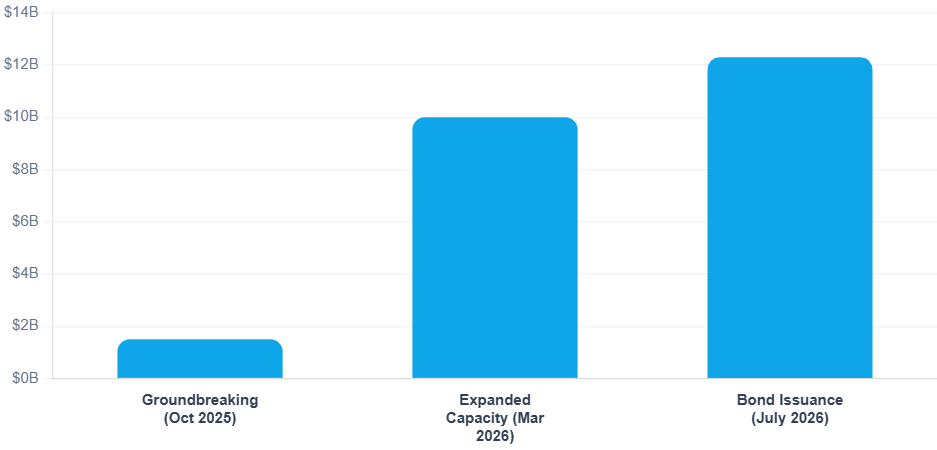
S&P and Fitch disagree by one notch on identical paper because they disagree about what secures it. S&P assigned Sopaipilla Investor, LLC’s $12.3 billion notes a preliminary A+; Fitch assigned an expected AA-(EXP). The notes are secured by the issuer’s accounts, revenues, and equity interests in the joint venture, and exclude a direct mortgage on the land and buildings.
Meta holds 20 percent of the El Paso joint venture and absorbs the construction, operating, and residual obligations that determine whether bondholders are repaid. Meta is contractually obligated to begin paying base rent in December 2028 whether or not the buildings are complete, and a residual value guarantee sized to outstanding principal triggers if Meta declines to renew.
The El Paso structure is the second execution of a template, not a one-off, and the next hyperscaler SPV financing will be priced against how these two agencies resolved the same question. Meta’s Louisiana Hyperion campus used an identical 80/20 joint venture with Blue Owl Capital, raising roughly $27 billion through Beignet Investor.
The Security Package Is The Signal
Two rating agencies looked at the same $12.3 billion of paper and arrived one notch apart.
S&P Global Ratings assigned a preliminary A+ with a stable outlook.
Fitch Ratings assigned an expected AA-(EXP).
Most coverage recorded the split and moved on to the headline figure.
The split is the most useful disclosure in the transaction.
It is a disagreement about what actually secures these notes and by extension, what any subsequent hyperscaler SPV bond is worth.
Miss it, and you are pricing the next one off a number rather than off a structure.
The Missing Mortgage Explains The Notch
The notes are secured by the issuer’s accounts, revenues, and equity interests in the joint venture.
They exclude a direct pledge on the physical land and buildings.
A bondholder in default does not foreclose on a data center. They take the equity interests in the vehicle that owns one.
S&P’s A+ sits one notch below Meta’s own AA- corporate rating.
That discount is the price of the absent asset pledge.
Fitch reads the same structure and lands at AA-, level with Meta, on the view that the contractual transfer of construction, operating, and power supply risk to Meta makes the physical security question close to academic.
Both reads are defensible, which is what makes the split informative.
It marks the exact boundary of the off-balance-sheet template.
If the market ultimately prices toward Fitch, hyperscaler SPV paper trades as a synthetic corporate obligation of the tenant, and sponsors can raise larger amounts against thinner security. If it prices toward S&P, every subsequent structure carries a notch of drag that compounds across a $12 billion issue.
Over the next twelve to twenty-four months, the volume of paper coming from this template will settle the question in the secondary market rather than in the rating committee.
Meta Pays Rent Whether Or Not The Buildings Exist
The lease terms tell you where the risk actually landed.
Meta’s tenant subsidiary is obligated to begin paying base rent in December 2028, regardless of whether the campus is complete or operational.
Deferral applies only under force majeure, landlord funding defaults, or landlord-directed work stoppages.
Abatement under a landlord-directed delay is capped at $218 million and offset by delayed start-up insurance.
Meta funds construction cost overruns above 105 percent of the fixed construction budget.
Under the triple-net lease, Meta bears property taxes, utilities, insurance, routine maintenance, capital repairs, and structural replacements.
The leases carry no service level agreements tied to uptime or server performance, so there is no operational trigger that would let Meta withhold rent.
At lease expiry, a residual value guarantee sized to cover outstanding principal triggers if Meta declines to renew.
Read the package together and the credit becomes legible.
Bondholders are exposed to Meta’s willingness and ability to honor a lease, and to almost nothing else.
Construction risk sits with Meta. Operating risk sits with Meta. Obsolescence risk sits with Meta through the residual guarantee.
What the bondholder holds is a long-dated claim on the covenant of a single investment-grade technology company, wrapped in project finance documentation.
That is a materially different instrument than the infrastructure debt it resembles, and it should be underwritten as corporate credit with a real estate overlay rather than the reverse.

Investor Action
Private Capital. Infrastructure and credit funds evaluating hyperscaler SPV paper should underwrite the tenant covenant first and the asset second, because the security package makes the asset a secondary recovery path rather than a primary one.
The diligence question is not what the campus is worth in 2035 but what Meta’s credit is worth in 2035, and whether the residual value guarantee is enforceable against the entity that actually holds the cash.
Funds that continue to underwrite these as infrastructure assets will misprice the correlation in their books: five hyperscaler SPV positions across five sponsors are not diversified if three of them name the same tenant.
Waiting for a secondary market to establish where this paper trades means buying the next primary issue without a comparable.
Public Markets. Equity investors tracking Meta should treat the SPV lease obligations as debt-equivalent commitments that do not appear as debt.
The December 2028 rent commencement is a fixed cash obligation independent of whether the asset produces anything, and the residual value guarantee is a contingent principal-sized liability at expiry.
Credit investors holding Meta corporate paper are now structurally subordinated in a specific sense: the SPV bondholders have a direct lease claim on assets Meta operates, plus a guarantee, while corporate bondholders hold a general claim.
Model the aggregate lease and guarantee exposure across Hyperion and El Paso before the next campus is announced, because the disclosure will lag the commitment.
Operators. Data center developers and operators competing for hyperscaler tenancy now face a sponsor set that includes BlackRock, Blue Owl, and the institutional credit market rather than only their traditional capital providers.
The template rewards operators who can accept triple-net terms with no service level agreements and fund overruns above a fixed threshold.
Operators that cannot absorb that risk transfer will find themselves bidding against balance sheets that can.
The strategic decision is whether to compete for this capital or position around the assets it will not finance, and that decision gets harder each quarter the template is repeated.
The Verdict
The El Paso financing is the second execution of a structure that was novel eighteen months ago and is now standard.
Meta ran the same 80/20 joint venture in Louisiana with Blue Owl Capital, raising roughly $27 billion through Beignet Investor.
Two sponsors, two vehicles, one tenant, one template.
The inflection is not the size of any individual issue.
It is that hyperscaler capital expenditure has migrated from corporate balance sheets into a market where institutional credit investors hold the debt and the technology company holds the obligations.
That market now has to decide what the paper is.
The S&P and Fitch split is the first formal disagreement about the answer, and it will get resolved in secondary trading over the next twelve to twenty-four months, not by argument.
The open question is what happens to this structure when a tenant’s credit moves the wrong way.
Every protection in the El Paso package points back to Meta. None of them is worth more than Meta is.