
elcome to Global Data Center Hub. Join investors, operators, and innovators reading to stay ahead of the latest trends in the data center sector in developed and emerging markets globally.
TL;DR
Anthropic has reportedly agreed to pay Nscale roughly $45 billion over six years for 460 megawatts of computing capacity at the Monarch Compute Campus in Mason County, West Virginia. Bloomberg first reported the terms on August 26, 2026, citing people familiar with the matter. Neither Anthropic nor Nscale has confirmed the agreement, and no contract terms have been published.
The reported terms imply $16.3 million per megawatt per year, or roughly 31 percent of allocated build cost returned annually. Reported Phase 1 economics of approximately $71 billion across 1.35 gigawatts put Anthropic’s allocated capital cost near $24 billion, against $45 billions of payments. A contract returning build cost 1.86 times in six years amortizes the NVIDIA Vera Rubin silicon inside the term.
Nscale retains the residual value of a 460-megawatt accelerator fleet at the end of the term in roughly late 2033, and no public disclosure prices it. Anthropic pays for the hardware across the six years and holds nothing at expiry. The residual and renewal terms are most likely to surface in Nscale’s listing document rather than in any announcement.
Part One: The Record
Anthropic has reportedly agreed to pay Nscale roughly $45 billion over six years for artificial intelligence computing capacity in West Virginia.
Bloomberg first reported the agreement on August 26, 2026, citing people familiar with the matter, and CNBC and Reuters followed with the same terms from the same class of sources.
Neither Anthropic nor Nscale has confirmed the deal.
Nscale has not commented, no contract terms have been published, and every figure below is reported rather than announced.
The reported commitment covers approximately 460 megawatts at the Monarch Compute Campus in Mason County, West Virginia, according to Bloomberg.
Capacity is scheduled to begin coming online in late 2027. The reported term averages roughly $7.5 billion a year.
Capacity, Silicon, And Delivery Timeline
Nscale will deploy NVIDIA Vera Rubin systems at the site, per Bloomberg and CNBC.
The 460 megawatts cover the first of three planned buildings at Monarch, which Blockspace calculates at about 34 percent of the campus first phase.
Nscale has designed Phase 1 to hold 1.35 gigawatts of computing capacity and targets delivery by early 2028.
Reporting carried by TradingKey puts Phase 1 development cost at approximately $71 billion, including around $47 billion for chip purchases.
Nscale separately identifies more than $20 billion in planned capital investment.
Campus Scale And Onsite Generation
The Monarch Compute Campus occupies more than 2,250 acres, with a long-term expansion path exceeding 8 gigawatts.
The campus generates its own electricity rather than drawing from local utilities.
Caterpillar is supplying G3500-series natural gas generator sets, and Nscale targets 2 gigawatts of onsite generation by early 2028.
Nscale has said the development will use closed-loop cooling without municipal drinking water.
Planning documents cited by Bloomberg project 4,375 construction workers at peak, 645 direct operating jobs, and roughly 3,600 indirect jobs across the state.
Site History And Prior Tenants
Nscale acquired the Monarch site in March 2026 through its purchase of American Intelligence & Power Corporation.
Fidelis New Energy and 8090 Industries previously sponsored the development.
Nscale announced a letter of intent with Microsoft for up to 1.35 gigawatts at the campus.
Semafor reported that Google and Microsoft were both in talks for capacity at Monarch before the lease went to Anthropic.
Governor Patrick Morrisey issued a statement calling the reported agreement an extraordinary vote of confidence in West Virginia, and credited State Senator Glenn Jeffries for the state marketing effort.
Anthropic has signed other large compute agreements, including a $50 billion partnership with Fluidstack and capacity arrangements with Amazon Web Services, CoreWeave, and Akamai, according to Data Center Dynamics.
Nscale is preparing a public listing, with reports putting the target raise at around $3 billion.
Part Two: The Read
The Signal Is $16.3 Million Per Megawatt
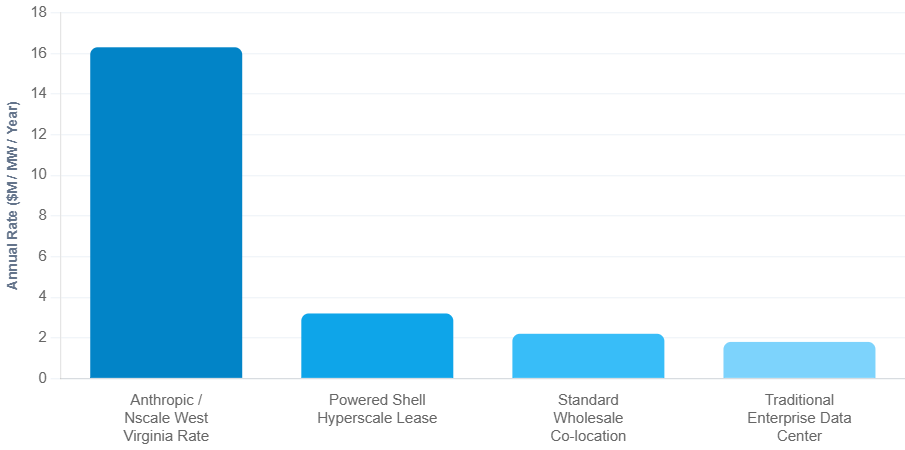
The number that describes this contract is $16.3 million per megawatt per year.
That is what $45 billion over six years buys across 460 megawatts, and it is a rate of return on build cost that no coverage of the deal has calculated.
Every figure needed to run it has been public since August 26.
The consequence of leaving it unrun is that the market is reading a real estate lease when the payment profile describes something else entirely.
The Payment Profile Amortizes Chips Inside The Term
Take the reported Phase 1 economics at face value.
Approximately $71 billions of development cost across 1.35 gigawatts works out to roughly $52.6 million per megawatt, of which the reported $47 billion chip line accounts for about $34.8 million.
Anthropic’s 460 megawatts therefore carries an allocated build cost near $24 billion. Against that, six years of payments total $45 billion.
The ratio is 1.86 times. Annual rent runs at roughly 31 percent of allocated capital cost.
A stabilized wholesale data center lease does not return its build cost inside the term, because the building outlives the tenant and the landlord underwrites the reversion.
This contract returns the build cost nearly twice over in six years.
The silicon is being paid off inside the lease, and the shell and the power plant are riding along.
That distinction determines who carries technology risk.
Over the next four to six quarters, expect lenders to demand the split be visible in the documents, with the silicon component and the power-and-shell component priced separately.
The contracts that do not break it out will trade wider.
Nscale Owns The Residual And Nobody Has Priced It
Vera Rubin capacity comes online in late 2027 on the reported timeline.
A six-year term carries the contract to roughly late 2033.
Anthropic pays for the accelerators across that window and holds nothing at the end of it.
Nscale keeps a 460-megawatt fleet of six-year-old silicon, a building, and a gas plant.
What that fleet is worth in 2033 is the single largest open variable in the transaction, and it sits entirely on the Nscale side of the table.
If the residual holds value, Nscale has financed a campus on one contract and kept the asset. If it does not, Nscale has run a six-year amortization at a decent yield and Anthropic has bought compute at a fair clip. Both outcomes are live.
Neither is priced, because no one outside the two counterparties has read a renewal clause or a residual term.
The disclosure event is not a press release. It is Nscale’s listing document.
Watch whether the residual and renewal terms appear there, because the first neocloud contract whose back end becomes public sets the template every lender after it inherits.
What a 2033 buyer can do with that hardware was decided in civil engineering, back when the substations were sized and the floor loads were set. Those choices narrow the exit buyer pool years before anyone opens the contract to renew it.

Nscale’s Project Debt Underwrites Anthropic, Not Monarch
Forbes reported that the Anthropic contract functions as the collateral that lets Nscale finance a facility that does not yet exist.
Follow what that means for the lender.
The security is a six-year receivable from a private, unrated company with no published financials and major compute obligations, including the reported $50 billion Fluidstack partnership and deals with AWS, CoreWeave, and Akamai.
The tenant history sharpens the point.
Microsoft held a letter of intent for 1.35 gigawatts at Monarch. Semafor reported Google was in talks.
The anchor tenancy landed with the counterparty that has the largest forward obligations and the least public disclosure of the three.
Over the next twelve to twenty-four months, the pricing input that moves these facilities is not West Virginia gas or NVIDIA delivery schedules.
It is the first comprehensive disclosure of Anthropic’s aggregate compute commitments.
That disclosure reprices every project financing built on an Anthropic covenant on the same day.
What Each Segment Prices Before The First Filing
Private Capital underwriting Nscale project debt or pre-listing equity should treat the $71 billion Phase 1 figure as unverified reporting and rebuild the per-megawatt stack from the chip line up.
Demand the residual definition, the renewal mechanism, and the termination waterfall before pricing.
Firms that skip this step price a real estate risk and hold a technology residual, and they find out which one they bought in 2033.
Public Markets investors have no security to trade yet, which is the point.
The event to prepare for is Nscale’s listing document.
The question to bring to it is what share of contracted backlog this single contract represents.
A backlog concentrated in one unrated private counterparty is a different security from a diversified one at the same headline number, and it will not be presented that way.
Operators competing for the same tenants should read the microgrid, not the acreage.
Monarch’s differentiator is 2 gigawatts of behind-the-meter gas generation targeted for early 2028, which removes the interconnection queue from the delivery schedule.
Sites that depend on a utility connection are selling a later date to tenants who are paying for an earlier one.
Operators who have not secured generation by the end of 2027 compete for the tenants these campuses decline.
The Contract Nobody Has Read Sets The Benchmark
The reported $45 billion is not the durable output of this transaction.
The durable output is a per-megawatt clearing rate for chip-inclusive compute capacity, established by two counterparties who have said nothing on the record, and inherited by every neocloud contract negotiated after it.
Anthropic and Nscale have set a price without publishing one.
The question worth holding for the next two quarters is narrow.
When Nscale’s listing document arrives, does it disclose the residual and renewal terms, or does it report $45 billion as backlog and leave the back end unread?
The first version gives the market a benchmark. The second gives it a number, and a number without a residual clause behind it is the thing that gets mispriced.