
Welcome to Global Data Center Hub. Join investors, operators, and innovators reading to stay ahead of the latest trends in the data center sector in developed and emerging markets globally.
Anthropic pays for most of its AI infrastructure through contracts. In the first half of 2026 it spent $482 million on property and equipment.
By June 30 it had signed about $321.4 billion of leases that had not yet started.
Those two numbers, side by side in its IPO filing, matter most to anyone who builds, powers or lends against data centers.
The capacity is contracted. It sits on other companies’ balance sheets. The tenant’s promise to pay is what lets those companies finance it.
What the Filing Shows
Anthropic, PBC filed its Form S-1 with the SEC on October 26. The audited years run from 2023 to 2025. The figures for the six months to June 30, 2026, are unaudited.
Revenue for those six months was $16.3 billion. Compute and infrastructure expense was $8.9 billion, or 55% of revenue. In full-year 2025, the same expense was 160% of revenue.
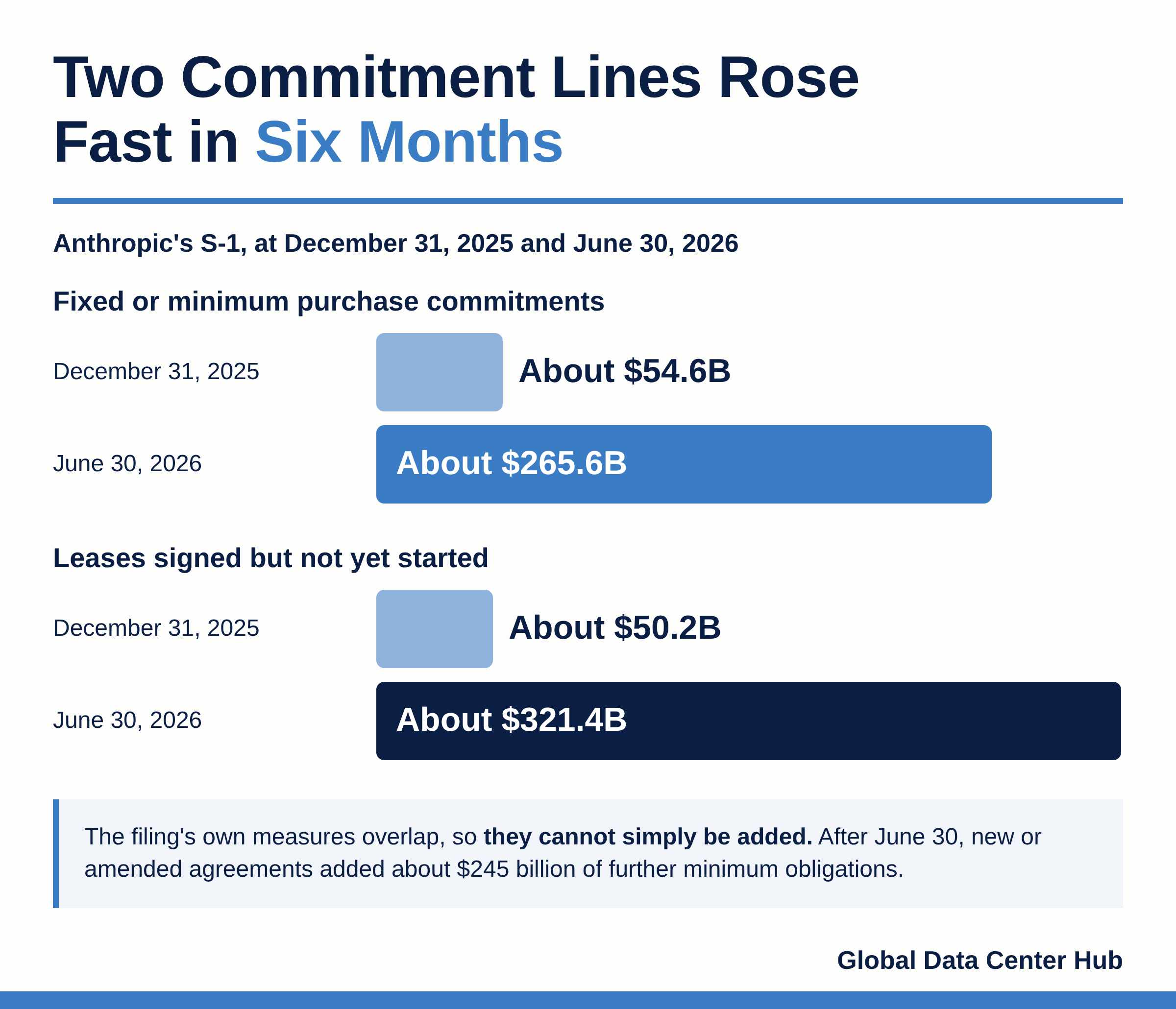
The commitments grew faster than either. Fixed or minimum purchase commitments rose from $54.6 billion at the end of 2025 to about $265.6 billion at June 30, with terms of one to 20 years.
Leases signed but not yet started rose from about $50.2 billion to about $321.4 billion over the same six months. They begin between 2026 and 2028.
After June 30, new or amended agreements added about $245 billions of further minimum obligations.
The filing also describes an estimated $125 billion to $150 billions of TPU compute for 2028 to 2031. It keeps that estimate out of its commitments table.
One number is still missing. The prospectus says aggregate committed spend is “more than $[ ]” and leaves the figure blank for a later amendment. The filing’s own measures overlap, so they cannot simply be added.
That is why the totals quoted since the filing differ. They measure different layers.
Why the Capex Line Is Small
The filing explains the model in one sentence. The strategy is “to secure data center capacity early while deferring larger accelerator investments.”
It calls the newer approach Anthropic Direct: leasing chips directly and hosting them in dedicated facilities operated on its behalf. That splits two decisions. The building is committed first.
The chips inside it are committed later. Anthropic says its first such data center facility became operational this year. It names Fluidstack USA I Inc. as a provider of data center development and operations services.
The filing explains why it commits so early. It says the company has “consistently operated in a compute-constrained environment where customer demand exceeds available compute.” It also says it has underestimated its compute needs in the past.
Locking in buildings first is the answer to that shortage. The chips follow once the space is ready.
It runs its models across four chip families: AWS Trainium, Google TPUs, NVIDIA GPUs and AMD GPUs. A building leased today can take whichever chips arrive when it is finished.
So, the money for the shell, the substation and the hardware comes from landlords, developers, chip lessors and cloud providers.
The filing says part of the build-out has been funded or supported by capital or credit support from certain of its cloud providers and chip partners.
Think of a store chain that signs a 20-year lease before the mall is built. The developer takes that lease to the bank and gets the construction loan. The store chain’s own balance sheet stays light. Its lease does the heavy lifting.
The filing expects this to shift over time. It says an increasing portion of compute and infrastructure investment will take the form of capital expenditures and other commitments, including lease obligations.
The 20-Year Layer
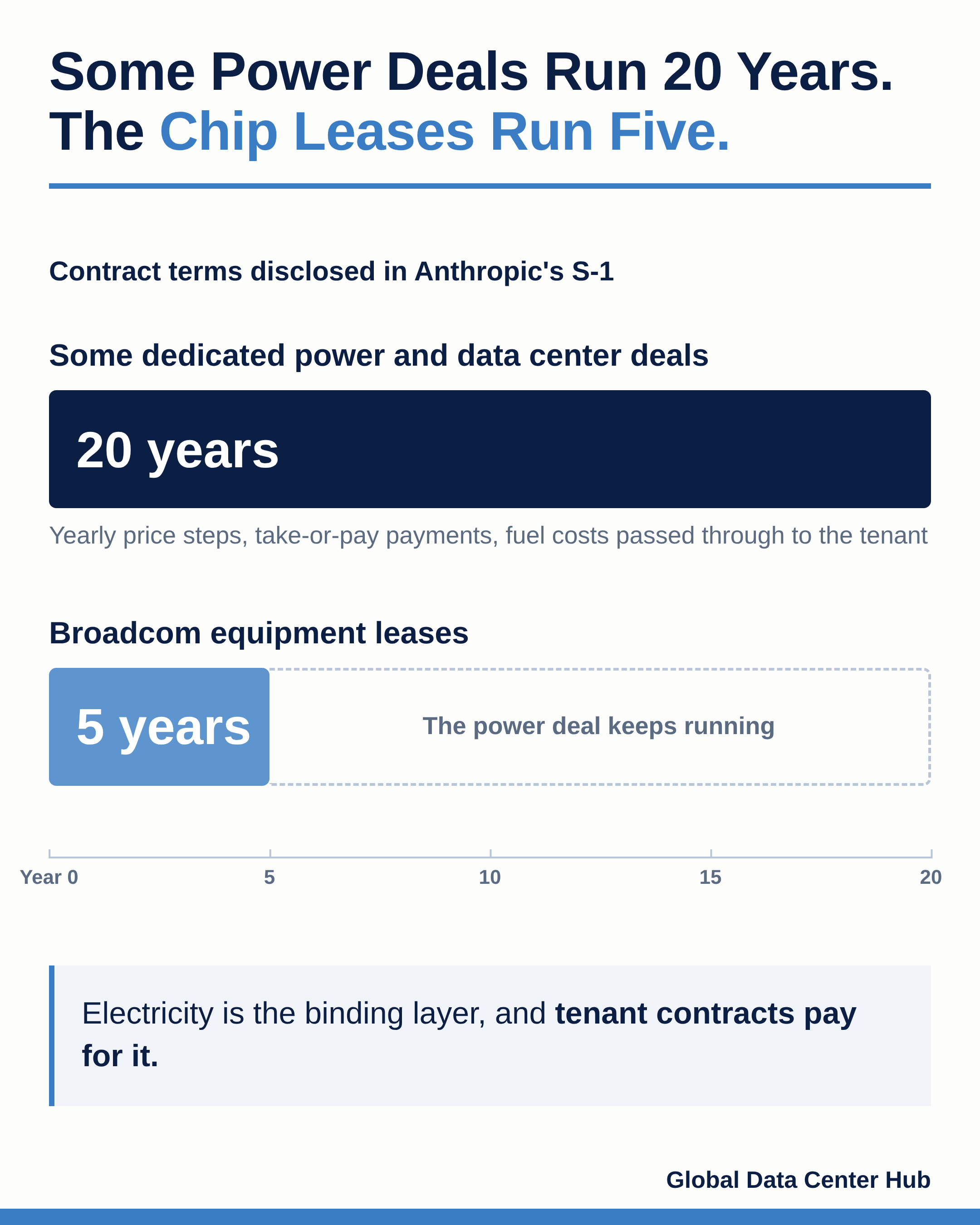
The longest terms in the filing sit in power. The S-1 says certain dedicated power and data center arrangements “have initial terms of 20 years with annual escalators.”
They include take-or-pay compute payments and fuel cost pass-throughs with no cap.
Some planned facilities rely on dedicated on-site natural gas-fired generation, with fuel costs carried by Anthropic on a pass-through basis.
The filing adds two more power items. Anthropic guaranteed a US colocation provider’s power purchase contract for up to $500 million.
It has also publicly committed to cover electricity price increases to consumers caused by its data centers, including the grid infrastructure needed to deliver that power.
This is what makes new power buildable at speed. A gas plant or a grid upgrade needs a buyer who will pay for decades, whatever happens to fuel prices.
Take-or-pay terms and a fuel pass-through give the developer that buyer. In GDCH’s reading, those terms are why power for this fleet can be financed at all.
Where It Binds: The Power Contract Outlasts the Chips
The AI Infrastructure Scarcity Stack is GDCH’s map of the eight layers that can hold a project back, from power and transmission to equipment and capital. In this filing, the binding layer is power.
The reason is time. Anthropic’s Broadcom equipment leases run five years. Compute is procured 12 to 18 months before it is available. Some power and facility terms run 20 years. On those terms, the power contract will outlast several generations of hardware.
So, a 20-year power contract rests on one thing above all: the tenant’s ability to keep paying for two decades. The chips back the chip lease.
A gas plant built for this fleet has no such fallback. In GDCH’s reading, its financing looks to the tenant’s contract.
The filing names the conditions the power layer depends on. It cites New York’s pause on state permitting for new large facilities. It cites curtailment or disconnection in Texas during grid emergencies.
It notes public controversy over data center development in some regions where it holds contracted compute.
What the filing leaves out matters as much. It gives no megawatt or gigawatt figure for any contract. It names no data center site, no utility and no power price. It discloses no renewable share.
Why the Listing Matters to the Build Chain
The S-1 ties the partner model to credit. It says reducing reliance on partner capital “is a function in part of our ability to obtain financing from independent sources on our own credit.” In GDCH’s reading, a public listing is a large step toward that kind of credit.
The trend in the numbers helps. Compute and infrastructure expense fell from 160% of revenue in 2025 to 55% in the first half of 2026. That is the line a 20-year lessor wants to see moving down.
It is also six months of unaudited results. The filing itself says operating margin may compress as large blocks of compute come online.
Lenders should read one more term closely. Under Anthropic’s amended revolving credit facility, total debt does not include compute leases and other compute financing obligations.
Leverage measured on that definition will not show the lease book. A lender sizing exposure has to add it back.
Use of proceeds does not settle the question either. The net proceeds figure is blank.
The filing lists general corporate purposes, including investments in compute and infrastructure, with no dollar split.
Outside the United States
The footprint is still almost entirely American. At June 30, 95% of Anthropic’s long-lived assets were in the US.
The filing says it has entered into leases for data center capacity in Australia and Canada. It has also signed letters of intent in other countries that it does not name.
Those depend on forming local subsidiaries, government approvals and local banking.
For governments courting this kind of tenant, two filing details matter. The ratepayer commitment is now a disclosed cost of doing business.
US export controls could restrict the countries where advanced chips may be installed, or model weights stored.
Both shape where the next leases outside the US can go.
The Investment Lesson
For developers and power providers, the contract is the asset. Read the escalators, the take-or-pay floor and the fuel pass-through before the headline value.
The filing shows a mix. Some compute contracts are non-cancelable. Others pay only as capacity is delivered or can be cancelled after an initial period. Know which kind sits under your site.
For lenders, the order is tenant credit first and hardware second. The filing also discloses cross-default terms, under which a default under certain commercial agreements could accelerate the company’s debt. Read the lease and the loan together.
A 20-year power term outlives a five-year chip lease. Price the term against the tenant and add back the lease obligations the revolver leaves out.
For policymakers, the ratepayer commitment is a template worth watching. It puts the cost of price increases a large user causes on that user, in a public filing.
The check to run comes next. About $321.4 billion of signed leases begin between 2026 and 2028. As each one starts, ask a simple question: is the power on, under a contract that runs as long as the lease?