
Welcome to Global Data Center Hub. Join investors, operators, and innovators reading to stay ahead of the latest trends in the data center sector in developed and emerging markets globally.
Chip makers are now lending their credit to the buildings their chips run in. AMD’s July deal with Core Scientific shows how that works, in filings anyone can read.
Core Scientific signed 15-year leases for 529 MW of data center capacity. AMD rents 377 MW of it directly. An unnamed neocloud rents the other 152 MW, and AMD signed credit support for those leases.
On its earnings call, Core Scientific said AMD will provide “full credit support throughout the full 15-year lease term.”
That matters because a data center is financed on its rent. When a chip maker stands behind the rent, a lender is no longer looking only at the tenant.
And the reported talks at Oracle, Broadcom and SpaceX show the same idea moving through the rest of the chip market.
What Core Scientific Filed
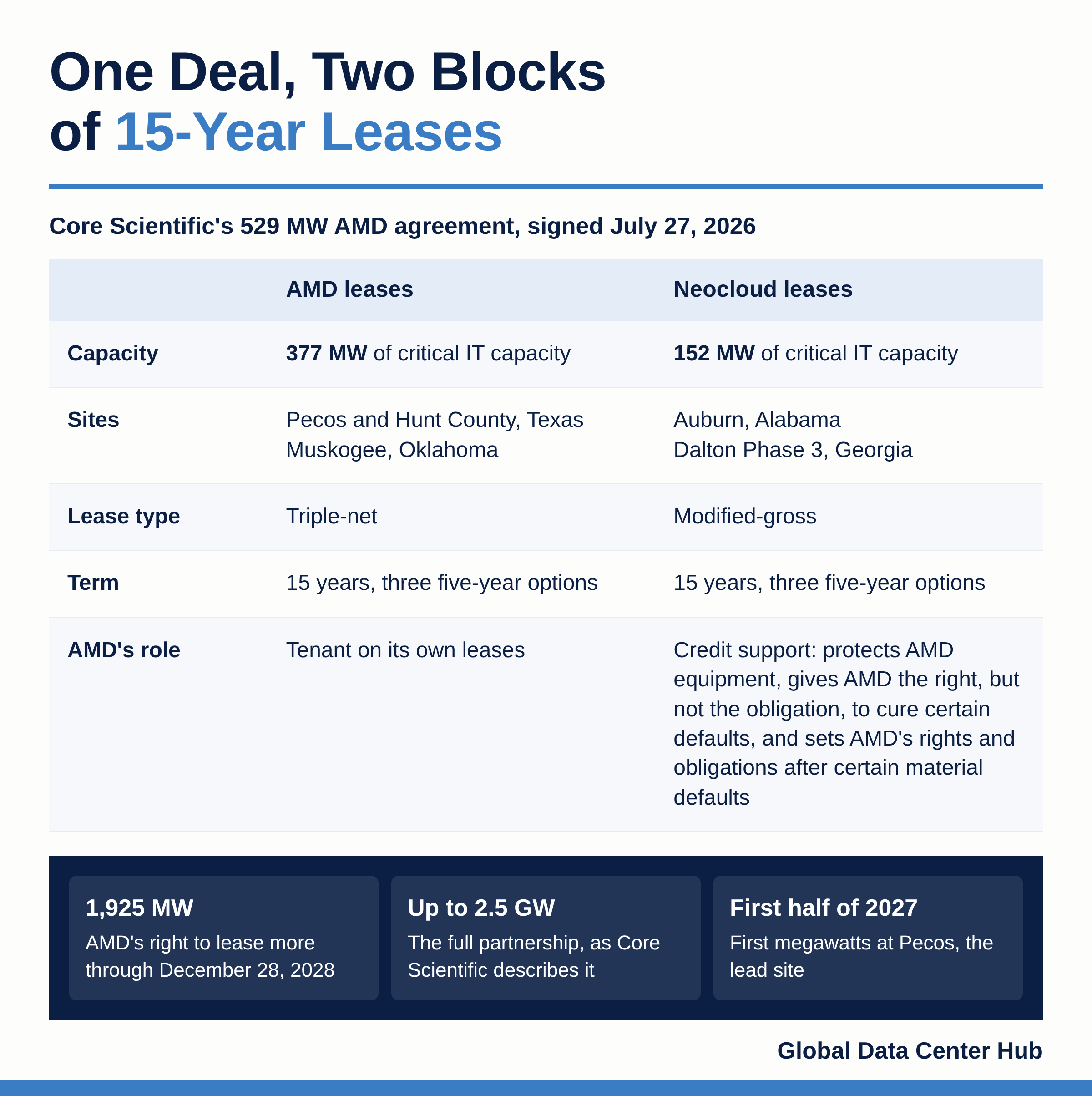
The 8-K sets out two blocks of leases, signed July 27, 2026.
AMD leased 377 MW of critical IT capacity at Pecos and Hunt County, Texas, and Muskogee, Oklahoma.
The neocloud leased 152 MW at Auburn, Alabama, and Dalton Phase 3, Georgia. Every lease runs 15 years, with three five-year options to extend.
AMD also holds a right to lease another 1,925 MW through December 28, 2028, at certain times and under certain conditions. In its prepared remarks, Core Scientific described the full partnership as up to 2.5 GW.
Management said the AMD sites run on triple-net leases and the neocloud sites on a modified-gross lease.
Pecos is the lead site. It is on track for its first megawatts in the first half of 2027.
The Support Is Real. The Fine Print Is Not Public Yet.
The filing lists three things the credit support agreements do.
They protect AMD equipment inside the neocloud’s space. They give AMD the right, but not the obligation, to cure certain neocloud defaults.
And they set AMD’s rights and obligations if certain material defaults occur.
Management’s words go further: full credit support for the full term. Both can be true.
The filing describes the agreement’s parts. The call describes its purpose.
What the record does not show is the trigger, the cap, or how a payment would flow.
The full agreements have not been filed.
So, the careful reading is this. AMD’s credit stands behind the neocloud leases; on terms you cannot yet see in full. It should not be read as AMD paying every dollar of rent the day a payment is missed.
The Warrant Math Matches the Megawatts
AMD also received a warrant to buy up to 30 million Core Scientific shares at $23.47 each. It vests at 12,222 shares for each megawatt of critical IT load in the leases.
About 6.5 million shares vested at signing.
Run the numbers and the design comes into view. 12,222 shares times 529 MW is about 6.47 million shares. That matches what vested on day one.
Thirty million shares at the same rate cover about 2,455 MW. That is almost exactly the 529 MW signed plus the 1,925 MW reserved.
So, AMD’s stake grows as AMD leases more of Core Scientific’s capacity. Every new megawatt it takes adds to the landlord’s rent roll and to AMD’s equity at the same time.
AMD’s own quarterly filing shows this is a pattern, not a one-off. As of June 27, 2026, a month before the Core Scientific deal, AMD had a maximum gross exposure of $4.1 billion from guarantees on commercial partner data center leases, with terms up to 15 years.
The filing says those guarantees “may be issued in exchange for warrants.” AMD records them as a credit derivative and says they were not material to its financial statements.
The Core Scientific filing does not say its warrant was given in exchange for the credit support. But AMD’s filing describes the general structure plainly. A guarantee goes out. A warrant comes back.
A $6 Billion Build Needs Rent a Lender Can Count On
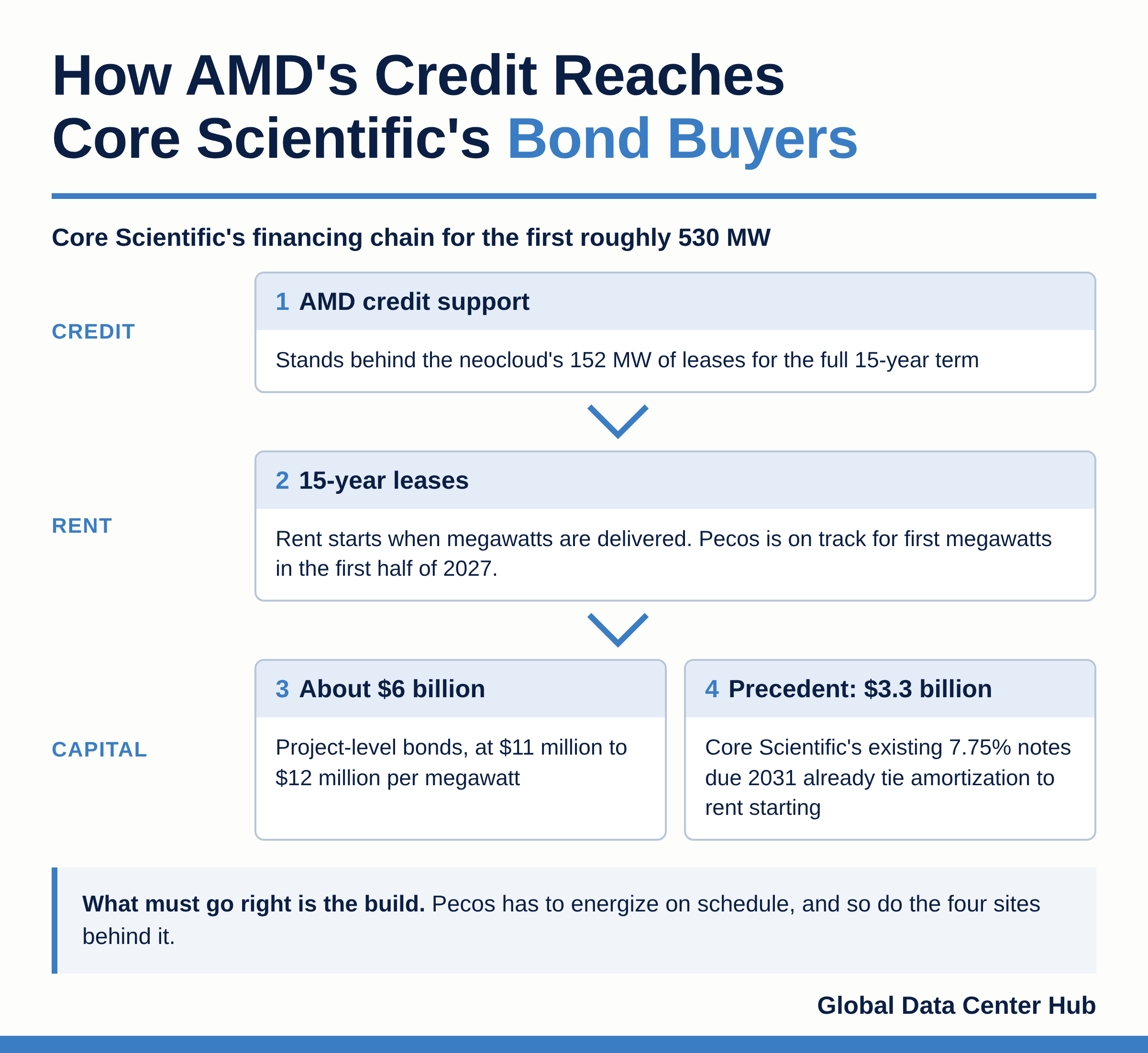
This is where the support earns its weight.
Core Scientific expects the first roughly 530 MW to need about $6 billion of capital, at $11 million to $12 million per megawatt. It plans to fund that with project-level bonds.
Bond buyers on a 15-year building want 15 years of rent they can count on. Core Scientific’s existing $3.3 billion of 7.75% senior secured notes due 2031 show how tightly the two are tied.
Its quarterly report says amortization on those notes is tied to rent starting under the related data center leases. Rent starts, and the debt starts paying down.
I read AMD’s support as a tool for closing the Bankability Gap. That is the distance between capacity that is announced and capacity that can secure power, financing, permits, equipment, customers and returns.
On the 152 MW, AMD’s credit fills much of the financing piece. A lender pricing those bonds can look at AMD’s support as well as the neocloud’s own credit.
What must go right is the build. Rent starts when megawatts are delivered. Pecos has to energize on schedule, and so do the four sites behind it.
Four Ways to Pay for the Chip
AMD backs the building. The rest of the market is working on the chip itself, in three other ways.
Broadcom backs the rack lease. Its quarterly filing for the period ending August 2, 2026, describes a five-year structure. A financial partner took over agreements to buy AI racks, along with the customer’s leases.
If the customer defaults, Broadcom owes the gap between 85% of the amount still owed and what the racks sell for. Its maximum exposure, once every rack is deployed, is about $29 billion. It had paid nothing as of the filing.
Apollo led the initial $35 billion financing for that platform in June.
The Wall Street Journal reported that Broadcom is now arranging more than $50 billion so OpenAI can buy custom chips. The talks are early. Whether that package uses the same 85% support has not been reported.
Oracle would rent its chips. Per the same report, Oracle is in talks with Apollo and Goldman Sachs on a structure where investors fund a separate company that buys chips and leases them to Oracle. No amount has been reported.
SpaceX would borrow in its own name. The Financial Times reported that SpaceX is seeking about $40 billion, roughly $10 billions of bank loans and $30 billions of investment-grade debt, with Apollo expected to lead.
CNBC reported that the GPUs could serve as collateral. Bloomberg described the talks as early.
None of the three reported deals is signed. Nvidia has a tool of its own. It says it may offer residual value support for up to 25% of a financing opportunity, assessed project by project.

The Building Outlasts the Chip, and AMD Backed the Building
Here is the structural point.
Broadcom’s support runs five years; the term of its customer’s rack leases. AMD’s support runs 15 years, the term of a building lease, with options that could take the lease to 30.
That difference sets what each vendor is backing. Broadcom’s support is tied to hardware that can be resold, and its exposure shrinks as lease payments come in.
AMD’s support is tied to powered space. Power, cooling and a long lease can host several generations of chips over 15 years.
So, AMD’s support attaches to the most durable asset in the stack. For the landlord and its bond buyers, that is a clean match: long debt against long rent, with a large credit behind it.
The structure also works for AMD. It gets 377 MW of sites for its own accelerators, a path to 1,925 MW more, and a stake in the landlord that grows with every megawatt.
The open question belongs to the deal. Fifteen years is a long time in compute. The public record does not yet show how the leases handle a chip refresh, a change in rack density, or a new tenant if the neocloud’s space ever needs one.
What to Check on the Next Vendor-Backed Lease
If you lend to data centers, read the support agreement before the headline megawatts. Ask what triggers a payment, what caps it, and whether the support steps down over time the way Broadcom’s does.
If you invest in chip makers, count lease guarantees alongside sales. AMD reported $4.1 billion of them before this deal. Watch the next 10-Q for how the Core Scientific support shows up.
If you build data centers, a vendor-backed tenant is a strong tenant. Tie rent start to energization in writing. Agree up front how a chip refresh works inside a 15-year lease.
If you set policy, the useful ask is disclosure. The Federal Reserve Bank of Kansas City found in October that broad sponsor guarantees let some special purpose vehicles in the AI build-out finance about 90 percent of their assets with debt.
Clear reporting of who stands behind which lease is what lets this kind of credit grow with confidence.
In markets where local tenant credit is thin, vendor support could become one-way large AI builds get funded. That is my reading. It is not yet a pattern outside the United States.
The next AMD quarterly filing is the check to run. If the Core Scientific support shows up as a new guarantee, you will see how much data center rent one chip maker now stands behind.