
Welcome to Global Data Center Hub. Join investors, operators, and innovators reading to stay ahead of the latest trends in the data center sector in developed and emerging markets globally.
Capital is moving toward AI chips. In one week, three large chip financings surfaced. Apollo is at the table on all three, alongside names like Goldman Sachs, Blackstone and PIMCO.
Chips are moving from company spending into something lenders will fund like infrastructure. And each deal solves the same problem with a different tool.
Oracle would rent its chips from an investor-owned company. Broadcom would stand behind its customer’s payments. SpaceX would borrow on its own name. All three still need the same thing at the end: a building with power.
What Was Reported, and What Was Not
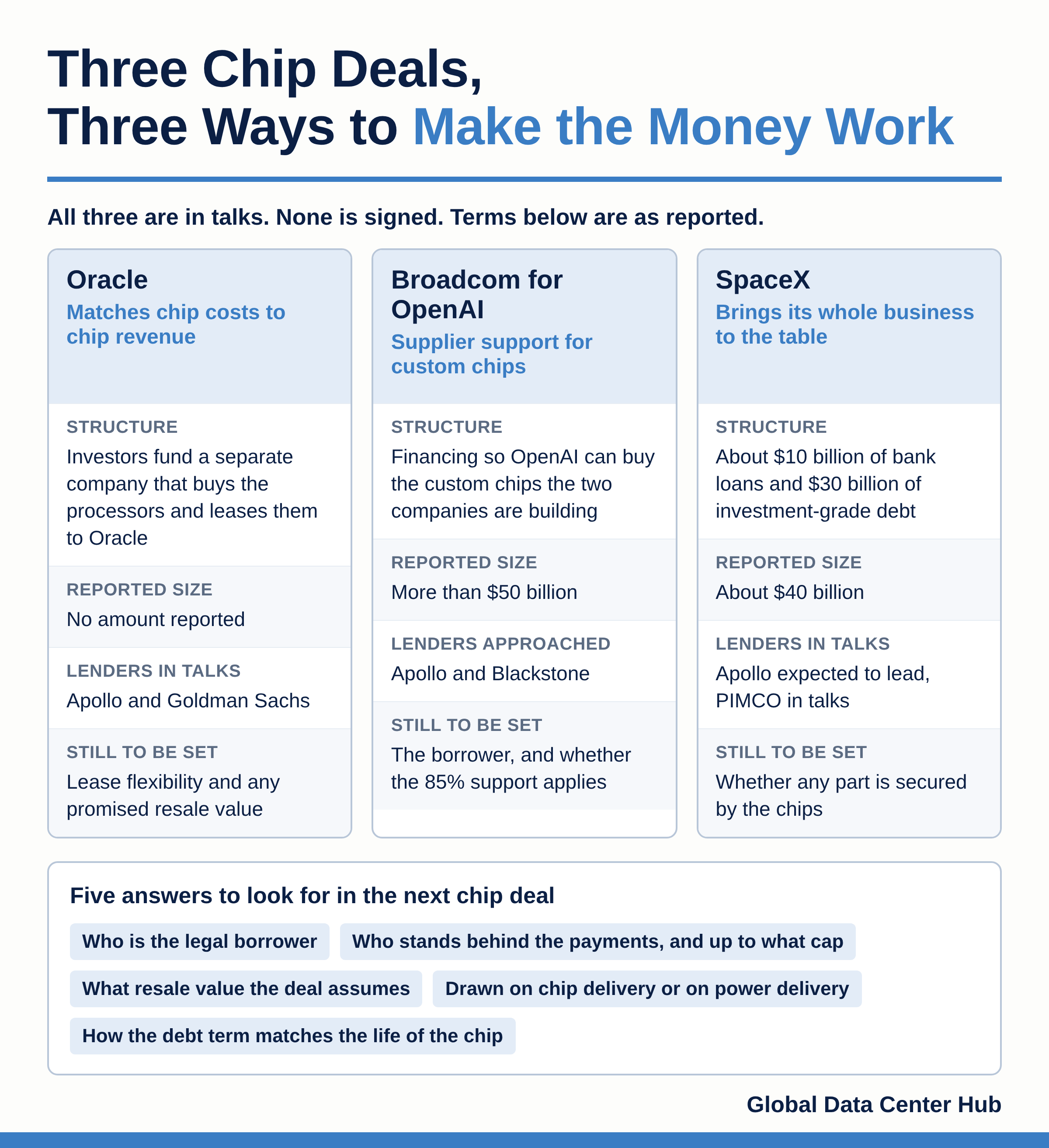
All three deals are in talks. None is signed.
The Wall Street Journal reported that Oracle is in talks with Apollo and Goldman Sachs to fund a large chip purchase. Per that report, the likely structure is for investors to fund a separate company that buys the processors and leases them to Oracle over time. No amount was reported. Oracle is still talking to other partners.
The same report said Broadcom is arranging more than $50 billion so OpenAI can buy the custom AI chips the two companies are building together. Apollo and Blackstone are among the lenders approached. The talks are early. The size could change. The borrower has not been named.
The Financial Times reported that SpaceX is seeking about $40 billion to buy Nvidia processors. The package would combine about $10 billion of bank loans with $30 billion of investment-grade debt. Apollo is expected to lead and sell the debt on to other investors, and PIMCO is among the firms in talks. The FT’s sources said the deal should close in 2027. Bloomberg described the talks as early and said they could still end without a deal.
None of the companies has confirmed these terms. The filings below are the confirmed part.
The Structures Behind These Deals Already Work
These talks build on deals that have already closed.
In June 2026, Apollo led an initial $35 billion financing for Broadcom’s AI XPV Platform, alongside Blackstone and a group of banks. It supports Anthropic’s expansion of more than 1 GW of compute. The wider platform targets over 20 GW for frontier AI labs through 2028.
In the same month, SpaceX priced $25 billion in senior unsecured notes in five tranches, with maturities running from 2031 to 2056.
And NVIDIA has partnered with Apollo, BlackRock, Blackstone, Brookfield, Goldman Sachs and KKR on platforms meant to mobilize over $500 billion of outside capital over time. That figure is a stated target, not money in place. It shows where the chip business is heading. Financing is becoming part of what gets sold with the chip.
Oracle’s Structure Matches Chip Costs to Chip Revenue
The reported logic is timing. Oracle pays for hardware before it collects the cloud revenue that hardware produces. A lease spreads that cost into payments that run alongside the revenue.
Oracle’s quarterly filing for the period ending August 31, 2026 shows why that matters. It lists $288 billion of lease commitments that have not started yet, substantially all for data centers. They are expected to begin between fiscal 2027 and fiscal 2029 and run for 15 to 19 years. The same filing puts the estimated useful life of its servers and networking equipment at six years.
So the building and the chips run on different timelines. One building lease can span two or three generations of servers. A separate chip vehicle lets each hardware refresh be paid for on its own schedule, while the building lease runs on its own.
The terms that will shape this structure are not public yet. They include whether the lease can flex with demand, whether the processors are backed by a minimum resale value, and whether the vehicle can move hardware to another site. Those terms determine how Oracle and its investors share the work.
Broadcom’s Support Is What Lets Lenders Fund Custom Chips
Custom chips are harder to fund than standard ones. A lender has fewer obvious buyers if the hardware ever has to be sold. Broadcom’s answer is to back its customers.
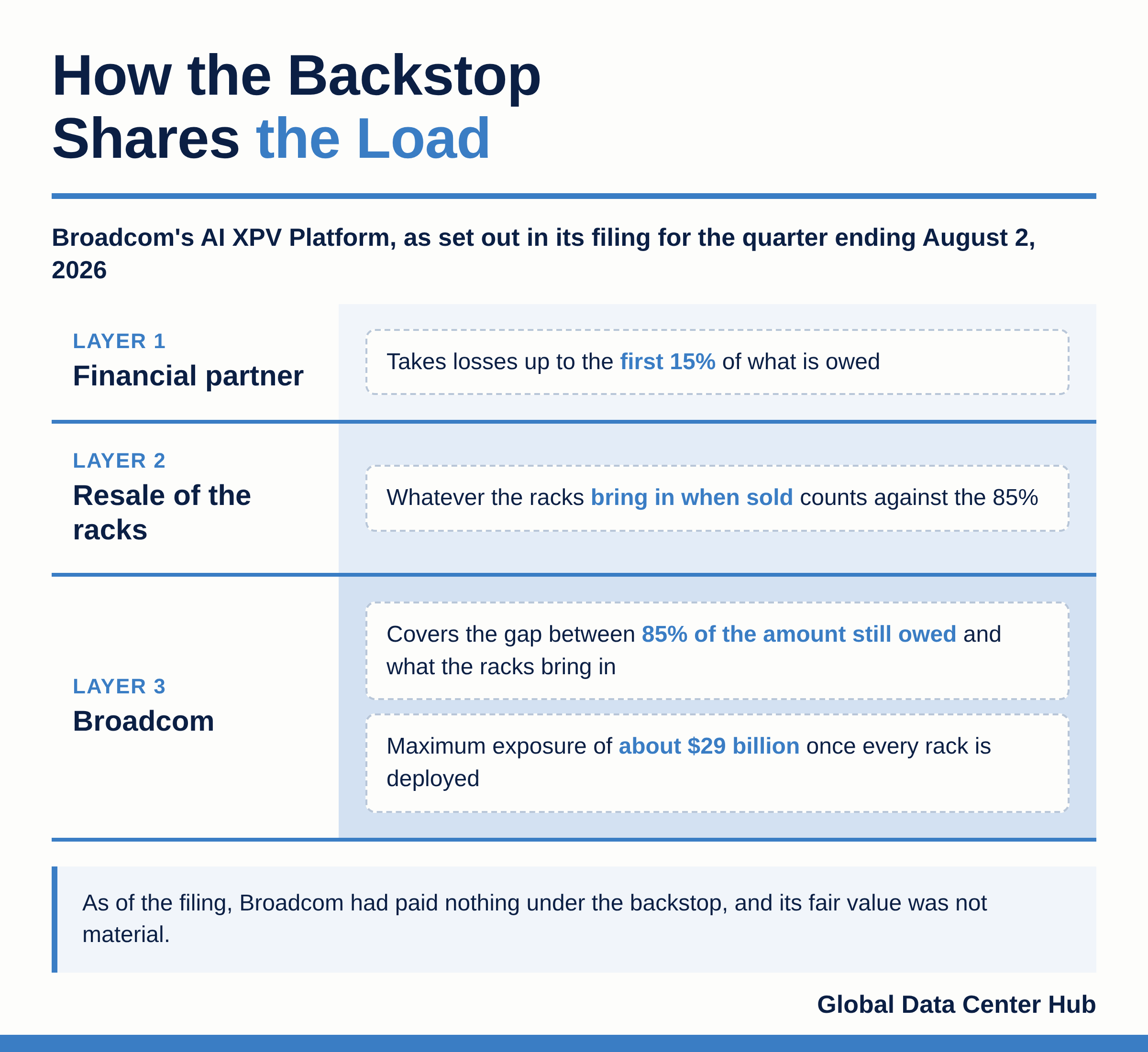
Broadcom’s quarterly filing for the quarter ending August 2, 2026, explains how its existing platform works. A financial partner took over agreements to buy AI racks built on Broadcom-designed chips, along with the customer’s leases. Broadcom backs the customer’s lease payments over five-year terms.
If the customer defaults, Broadcom owes the gap between 85% of the amount still owed and what the racks bring in when sold. Broadcom can also take over the lease or arrange a sale. Its maximum exposure, once every rack is deployed, is about $29 billion. As of the filing, it had paid nothing, and the backstop’s fair value was not material.
Here is how that 85% line shares the load. The financial partner takes losses up to the first 15% of what is owed. Broadcom covers the shortfall below that, after whatever the hardware fetches. The chip designer becomes part of the financing, which gives lenders a strong party behind a new kind of asset.
The filing also describes a separate facility. Under certain conditions, the customer may issue Broadcom up to $42 billion of convertible notes to fund its lease payments. None had been issued as of August 2. The two figures should not be added together, because the filing does not show that both would ever be drawn at once.
OpenAI and Broadcom announced in October 2025 a plan to deploy 10 GW of custom accelerators starting in the second half of 2026. The new $50 billion package would help fund that plan. It has not been reported whether it uses the same 85% support.
SpaceX Brings Its Whole Business to the Table
SpaceX’s reported package looks like a large company borrowing against its whole business, and SpaceX already has a record in the bond market. Its June notes carry coupons from 5.35% to 6.65%. Its second-quarter results reported $100 billion in cash, cash equivalents, and marketable securities as of June 30, along with 1.4 GW of compute capacity.
If the new debt is unsecured, lenders are relying on SpaceX’s launch, connectivity and AI businesses together. Repayment comes from the whole company, so the debt term and the chips' lifespan do not need to match. No one has reported whether any part of the $30 billion would be secured by the chips.
The Bankability Gap Now Sits at the Building
The Bankability Gap is the distance between announced capacity and capacity that can secure power, financing, permits, equipment, customers, and returns. These deals close much of that gap on the financing side. What remains sits at the building.
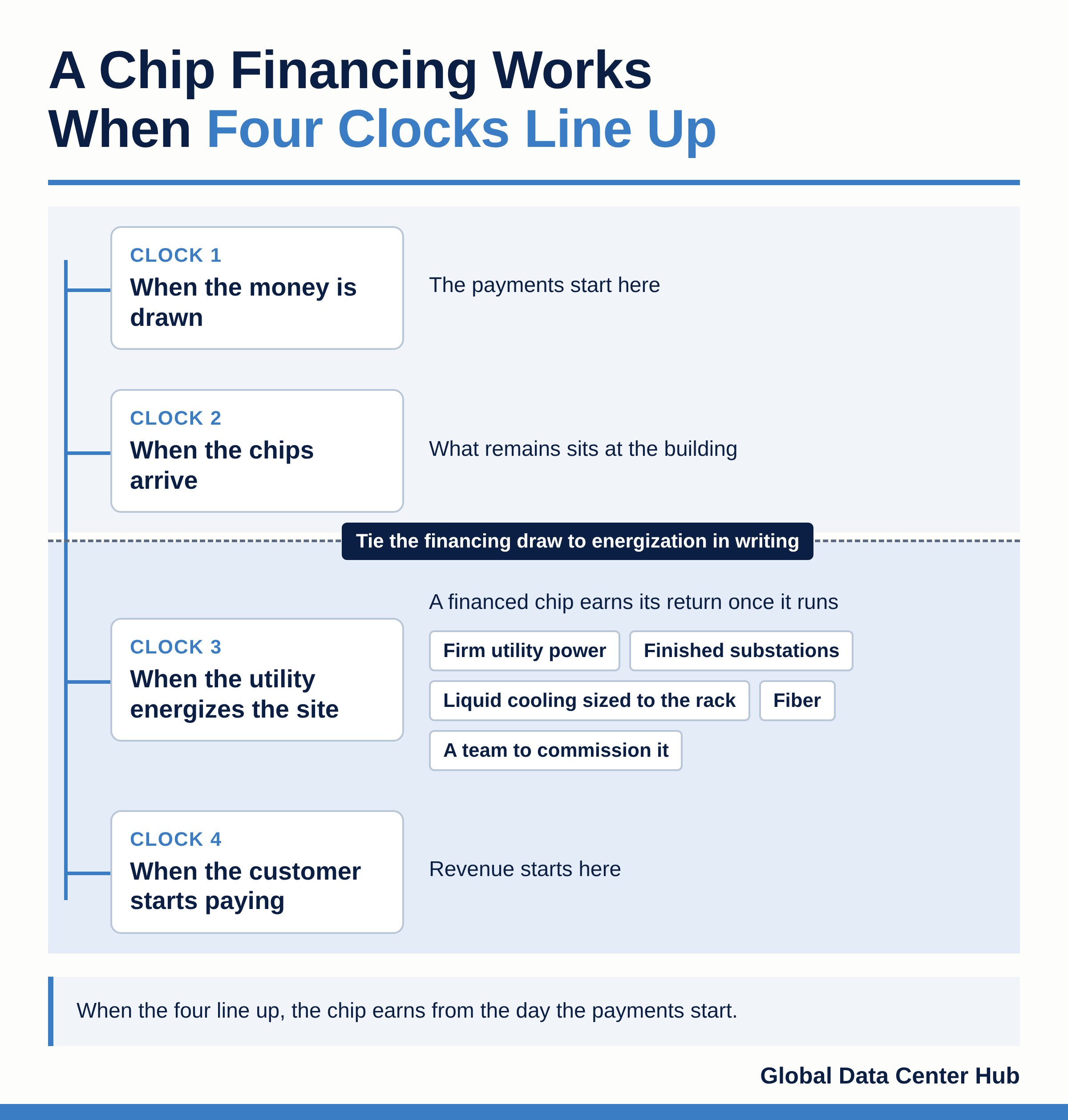
A financed chip earns its return once it runs. It needs firm utility power, finished substations, liquid cooling sized to the rack, fiber, and a team to commission it. The demand is there. The International Energy Agency projects data center electricity use rising from about 415 TWh in 2024 to about 945 TWh in 2030, with accelerated servers driving nearly half the increase.
So chip financing runs on four clocks. When the money is drawn. When the chips arrive. When the utility energizes the site. When the customer starts paying. When the four line up, the chip earns from the day the payments start.
That is good news for operators. A tenant with funded chips is a strong tenant. If you host one, tie the financing draw to energization in writing, and agree up front who handles late delivery, late power, cooling changes, or lower rack density than planned.
Regulators Are Building a Clearer Picture
The Federal Reserve Bank of Kansas City published research on October 5. It found that special purpose vehicles are the most highly leveraged entities in the build-out, with broad sponsor guarantees letting some finance 90 percent of their assets with debt. Sponsors support that debt through rent payments and residual value guarantees.
In March, the Financial Stability Oversight Council’s systemic risk committee recommended monitoring hyperscaler debt issuance and “debt-like or contingent obligations that might not be fully visible on balance sheets.” Treasury staff at the same meeting described bank exposure to private credit as contained, while noting the exact amount is unknown. The minutes of the Fed’s September meeting cited market commentary linking higher term premiums partly to heavy private debt issuance for AI infrastructure.
For policymakers, clear disclosure of leases and guarantees is what lets this kind of financing grow with confidence.
What to Look for in the Next Chip Deal
When the next deal is announced, read past the headline amount. You want five answers.
Who is the legal borrower?
Who stands behind the payments, and up to what cap?
What resale value the deal assumes for the hardware.
Whether the money is drawn on chip delivery or on power delivery.
And whether the debt term matches the chip's life.
If you invest, look at leases, guarantees and purchase commitments together, since that is how these deals are built. If you build, line up the financing draw with energization. If you regulate, ask for the backstops to be disclosed clearly.
The next filings will answer some of these. Watch whether the OpenAI package carries the same supplier support as the Anthropic platform. That single term will show how custom chips become a financeable asset.
the broadcom 85% line is the most interesting bit here. it turns a custom-chip loan into a credit question about broadcom.
that's the pattern in neocloud debt too. coreweave's first GPU loan (DDTL 1.0), secured mainly on the GPUs, cost ~15% effective. its DDTL 4.0, backed by investment-grade contracts, is SOFR + 2.25%, ~7%. IREN's GPU loan tied to microsoft: 6%. same chips, the rate follows whoever stands behind the payments.
one thing that stood out: broadcom backs 5-year lease terms while oracle depreciates its servers over 6. do you read the 5-year tenor as lenders quietly not underwriting the 6th year?