
Welcome to Global Data Center Hub. Join investors, operators, and innovators reading to stay ahead of the latest trends in the data center sector in developed and emerging markets globally.
The Warrant Is The Signal
The signal in the NVIDIA-IREN partnership is not the $3.4 billion cloud contract or the up-to-five-gigawatt pipeline.
It is NVIDIA’s acceptance of a five-year warrant for 30 million IREN shares at $70 a 23 percent premium to the $56.85 price. Chipmakers don’t pay premiums for arms-length supply relationships.
They do that when they are building distribution channels they intend to control. The mainstream coverage is anchored on the headline figures.
The structural read is that NVIDIA has begun verticalizing its compute supply chain through equity-aligned neoclouds.
Investors who frame this deal as vendor financing will misread the next 24 months of AI infrastructure capital flows.
NVIDIA Has Verticalized Through Equity, Not Acquisition
The warrant inverts a standard vendor relationship. NVIDIA already earns chip margins; the warrant adds exposure to the higher-margin stack above it managed services, utilization, and orchestration captured by equity-aligned operators.
A 23 percent premium strike is not how strategic investors price arms-length exposure. It is how they price participation in the upside of the assets their hardware powers.
The warrant-first structure preserves NVIDIA’s cash discretion: exercise can be timed against IREN’s progress toward the gigawatt-scale milestones the partnership targets.
Over the next 12 to 24 months, NVIDIA’s equity exposure to operators is the variable to track, not its silicon roadmap. The roadmap is known. The distribution architecture is being rebuilt in real time.
The silicon roadmap is known. The distribution layer above it, anchored by operators built as compute factories, not cloud providers, is being rebuilt in real time. NVIDIA's equity exposure to that layer is the variable to track over the next 12 to 24 months.
DSX Is Becoming The Operating Standard For AI Infrastructure
NVIDIA’s DSX reference architecture is the layer that locks the partnership in beyond any single GPU generation.
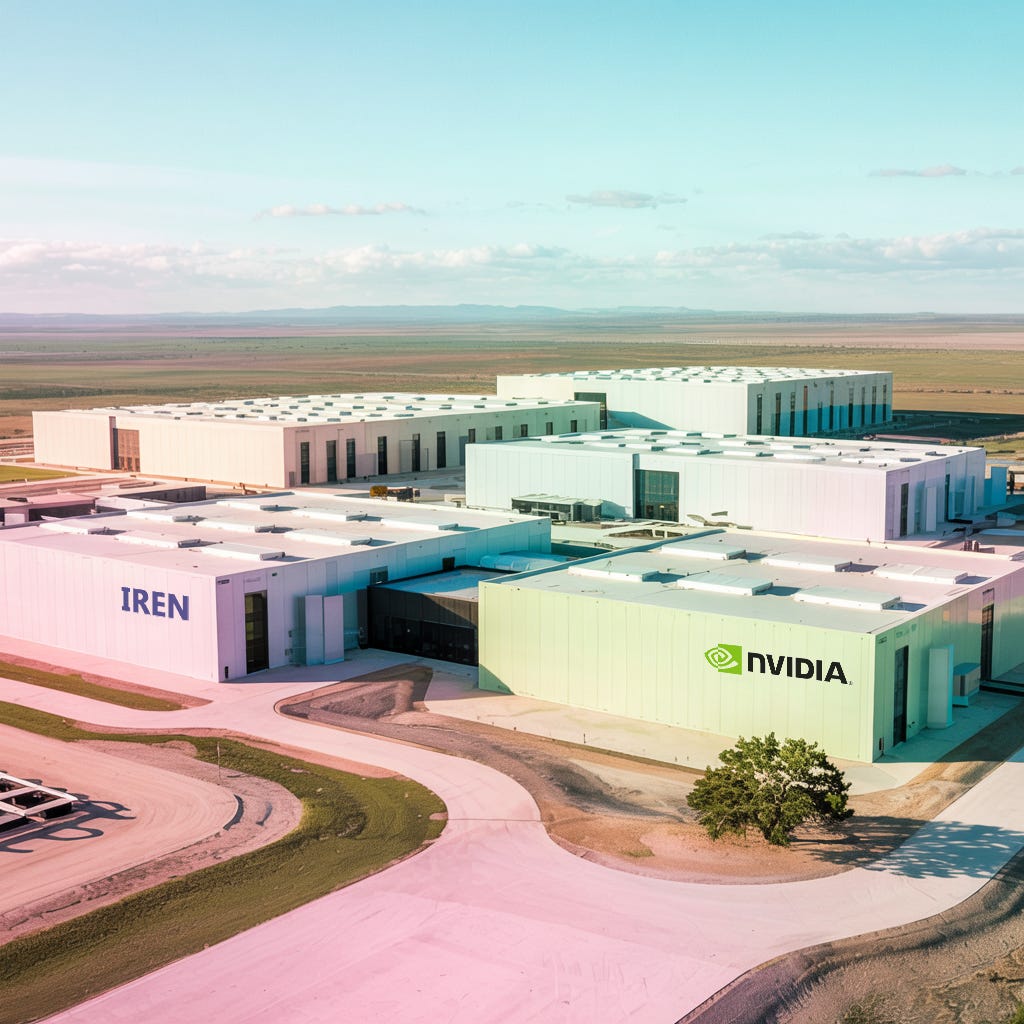
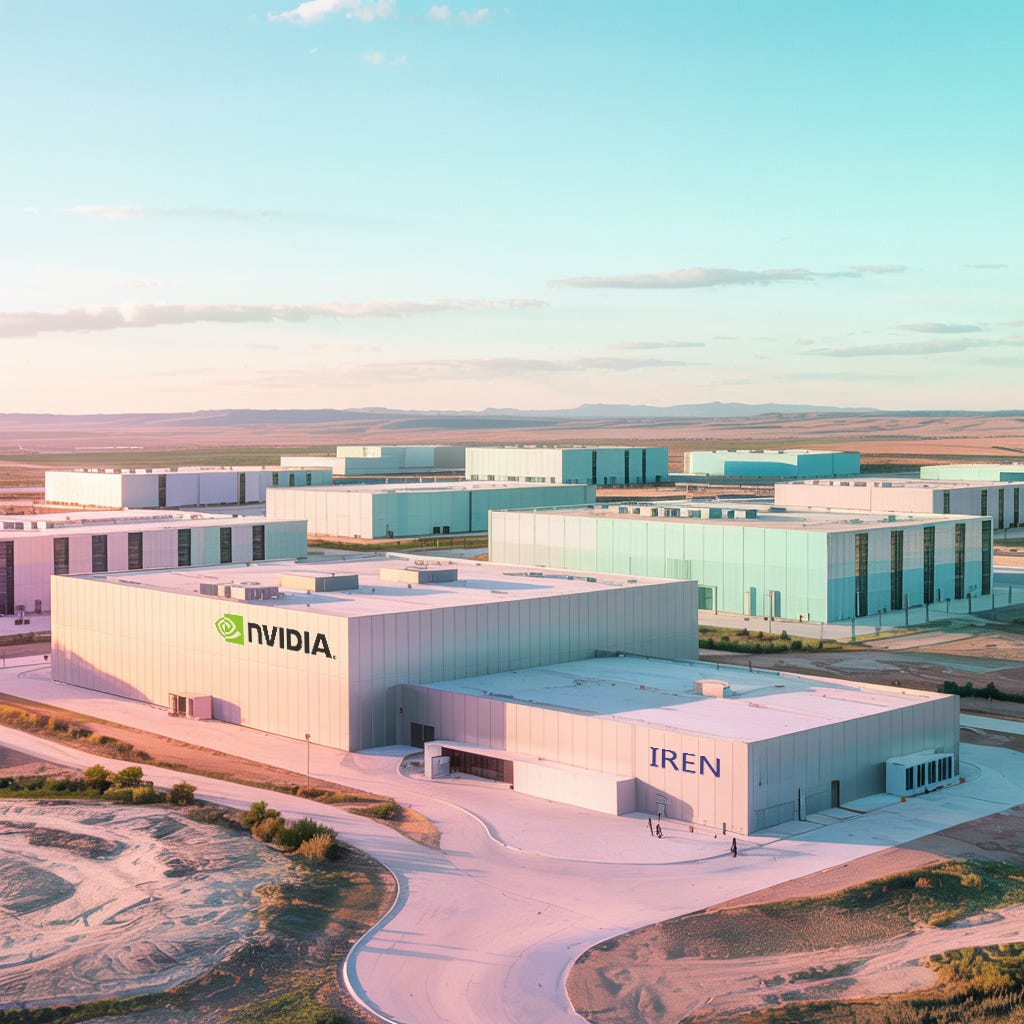
IREN’s facilities are being engineered DSX-native from the ground up, with the Omniverse Blueprint used to digital-twin every site before construction. Sweetwater is the flagship deployment.
The operating consequence is that DSX-aligned operators absorb each NVIDIA generation Blackwell today, Vera Rubin next, and the post-Rubin architectures without retrofit cost.
Operators that built agnostic infrastructure carry the structural disadvantage of higher per-megawatt deployment cost on next-generation hardware.
The cost gap between DSX-native and retrofitted facilities widens with each generation. DSX is shifting from a reference design into a de facto operating standard.
Capital allocators that recognize this early will reprice operator multiples.
Operators that delay alignment will compete for the second-tier flow.
The Neocloud Channel Has Separated From Hyperscaler Distribution
CoreWeave, Nebius, and IREN now constitute a structurally distinct distribution channel for NVIDIA hardware. Each occupies a different layer of the stack.
CoreWeave dominates frontier model training. Nebius is positioned for inference-era workloads. IREN provides the gigawatt-scale infrastructure backbone power, land, and grid-connected capacity in supply-constrained markets.
The combined effect is that NVIDIA can route compute distribution outside the hyperscaler channel without losing scale.
This matters because the hyperscalers are simultaneously building in-house AI silicon to reduce NVIDIA dependency. Trainium, Maia, and TPU are not product roadmaps; they are channel-conflict signals.
The neocloud channel is NVIDIA’s structural answer. The IREN warrant is the equity-aligned anchor of that channel.
Trainium, Maia, and TPU are not product roadmaps. They are channel-conflict signals from hyperscalers building in-house silicon to reduce NVIDIA dependency. The neocloud channel, already framed as the third pillar of AI infrastructure, is NVIDIA's structural answer, with the IREN warrant as its equity-aligned anchor.
Investor Action
Private Capital. Private equity and infrastructure funds with AI-related theses must now diligence the channel separation directly. Capacity exposure that runs through hyperscaler in-house silicon carries different counterparty risk than capacity routed through equity-aligned neoclouds. Underwriting models that aggregate the two as undifferentiated AI infrastructure exposure are structurally mispriced.
Family offices and tech-venture investors evaluating neocloud equity should benchmark whether the operator is DSX-native or DSX-retrofitted the cost structure diverges over a five-year deployment horizon. The cost of inaction is allocating against a single-channel thesis when the channel itself is bifurcating.
Public Markets. Public equity investors covering data center REITs and neocloud equities must now distinguish between operators with NVIDIA equity at the table and those without. The IREN-NVIDIA alignment is a multiple-expansion catalyst that arms-length operators do not access. Sell-side coverage that benchmarks IREN against generic data center REITs is benchmarking the wrong comp set. The right comp set is CoreWeave and Nebius equity-aligned NVIDIA channel partners with multi-billion-dollar contracted backlogs.
Public credit investors should diligence the warrant’s effect on IREN’s capital structure: a $2.1 billion potential equity infusion materially de-risks refinancing on the convertible notes outstanding. The cost of inaction is missing the channel-aligned operators before the multiple gap widens.
Operators. Data center operators outside the NVIDIA equity-aligned channel face a structural decision over the next 12 months. Building DSX-native facilities is no longer a marketing differentiator. It is the cost of competing for next-generation NVIDIA flow.
Operators that retrofit will carry higher per-megawatt deployment cost than operators that build to the reference architecture from the start. Sweetwater is the benchmark every operator’s facility design will be measured against. The cost of inaction is the structural disadvantage of operating outside the standard while the standard is still being defined.
The Verdict
The NVIDIA-IREN partnership marks NVIDIA’s shift away from relying on hyperscalers as its primary compute distribution channel. The warrant functions as the equity anchor.
The DSX architecture now serves as the operating standard, while the five-gigawatt pipeline represents the build-out. Together, they signal a verticalization of AI compute distribution that markets have yet to reprice.
Over the next 24 months, the key question is whether the equity-aligned neocloud channel becomes the dominant distribution layer for AI compute or whether hyperscaler in-house silicon regains control.
The forward-looking question for capital allocators is positioning into channel-aligned operator equity before the gap between aligned and unaligned operators becomes structurally permanent.
Do you see parallels with Oracle and Bloom? Seems as if that locked the same constraint through procurement. NVIDIA-IREN locked it through equity at a 23% premium. The distinction is whether you're buying delivered electrons or participation in operator upside.