
Welcome to Global Data Center Hub. Join investors, operators, and innovators reading to stay ahead of the latest trends in the data center sector in developed and emerging markets globally.
TL;DR
A data center is a warehouse full of computers, and the slowest part of building one is the electricity. Amazon, Microsoft, Google, and Meta have guided investors toward close to $700 billions of combined spending on data centers and computing equipment during 2026. The buildings themselves can be finished in roughly two years, while the power supply behind them takes far longer to arrange.
New power plants in the United States now wait more than five years to connect to the electricity grid. By the end of 2025, about 8,200 energy projects were waiting for grid connection, with a median wait of over five years, according to Lawrence Berkeley National Laboratory. Meanwhile, GE Vernova reported a 116 GW gas turbine order backlog in July 2026 and said it was largely sold out through 2030.
The wait for electricity is already raising household power bills across thirteen American states. PJM Interconnection, serving 65 million people across 13 states and Washington, DC, saw capacity prices jump from $28.92 to $329.17 per megawatt-day between 2024/25 and 2026/27. Its independent market monitor attributed 63% of the increase to data center demand adding about $9.3 billion in customer costs.
Ask an AI chatbot a question and the answer comes back in about two seconds.
Behind that answer sits a building the size of a shopping mall, filled with computers.
The building took roughly two years to put up.
The electricity running through it took about five years to arrange, and in a lot of places it has still not arrived.
That gap is the most important thing happening in the technology industry right now.
Almost none of it happens inside a technology company.
It happens in utility commission hearings, in turbine factories, and in a waiting list nobody outside the power sector had heard of five years ago.
The AI boom is usually described as a race for chips and money.
Both are real. Neither is what is holding it up.
What follows is the part of the story that takes place outside the data center walls, told in the order the delay actually happens.
Four companies plan to spend close to $700 billion this year
Amazon, Microsoft, Google, and Meta have told investors they intend to spend close to $700 billion combined during 2026, up from roughly $410 billion in 2025.
Most of it goes into data centers and the computers inside them.
That works out to something near $2,000 for every person living in the United States, committed by four companies in a single year.
Numbers that large tend to end the conversation.
The natural assumption is that with money like that behind it, the buildout runs at whatever speed the money can buy.
For the buildings, that assumption mostly holds.
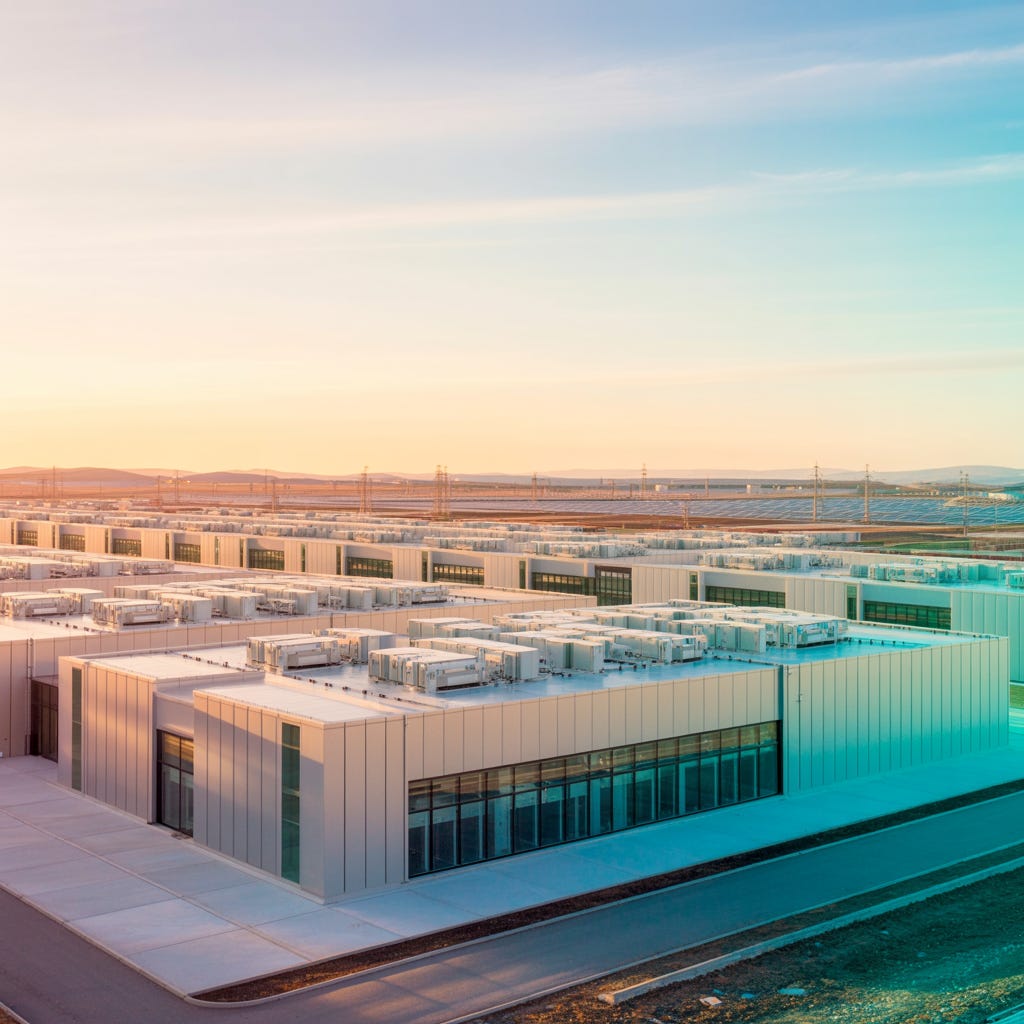
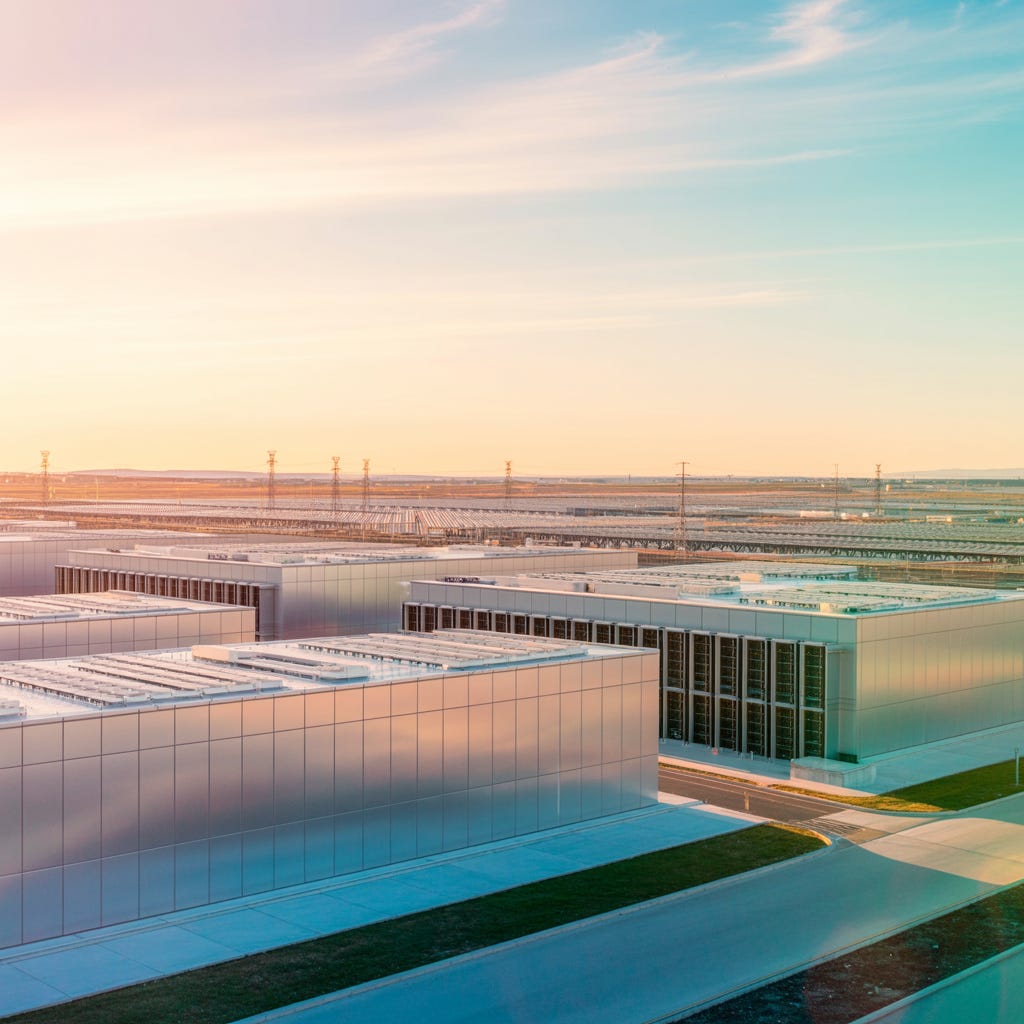
A data center is a large, plain shed with a very good floor, industrial air conditioning, and a lot of cable. American contractors build sheds well and quickly.
Sites that were bare dirt in early 2026 have steel and roofs on them by the end of the same year.
So if you have been reading about the AI buildout as a spending story, you have been watching its fastest-moving part.
The part that decides when any of it turns on sits somewhere else entirely.
Building it takes about two years. Powering it takes about five.
A finished data center does nothing until electricity reaches it, and a large one needs a genuinely unusual amount.
A single big AI campus can draw a gigawatt or more, which is roughly the output of a large nuclear reactor and enough to supply several hundred thousand homes.
That power has to come from somewhere new.
Existing plants are already spoken for by existing customers, so serving a new campus usually means building new generation, new high-voltage lines, and new substations, which are the fenced yards of humming equipment that connect long-distance power lines to a single site.
Two separate ‘waits’ sit in front of all of that.
The first is permission. Any new power plant has to be studied and approved before it can join the shared electricity network, and that study takes years.
The second is equipment. The machines that make large amounts of electricity are built in a handful of factories worldwide, and those factories are booked years out.
Neither wait responds to money in the way a construction schedule does. When a company announces a new data center, it is announcing a building.
The power that will run it is usually still an application in a queue somewhere and knowing that changes what an announcement actually tells you.
About 8,200 projects are standing in the same line
Every power plant that wants to connect to the American grid joins a waiting list, and the whole list has to be studied in order.
Engineers have to work out what each new plant does to the flow of electricity on the wires around it, and adding one project changes the answer for everyone behind it.
There is one line, and it moves at the speed of the studies.
Lawrence Berkeley National Laboratory is a federal research lab, and it publishes the standard count of this queue.
At the end of 2025 it found about 8,200 projects waiting, representing 1,312 gigawatts of generation.
For plants that actually started running in 2025, the median wait from first application to switch-on ran over five years.
Most of what is in that line never gets built at all.
In the previous edition of the same study, the lab found that of all the capacity that applied between 2000 and 2019, only 13 percent had reached operation by the end of 2024.
Applications are cheap and speculative. Finished plants are neither.
So when a headline says a hundred gigawatts of new power are coming to serve AI, what it is counting is applications.
Some of that power will arrive years late, and a lot of it will never be built at all.
The engines are sold out until 2030
The fastest way to add large amounts of electricity is a gas turbine, which is essentially a truck-sized jet engine that burns natural gas to spin a generator.
Three companies build the biggest ones, and one of them is GE Vernova.
In its results for the second quarter of 2026, GE Vernova reported 116 gigawatts of gas turbines under contract and said it expected at least 125 gigawatts by the end of the year.
Its chief executive described the company as mostly sold out through 2030.
In the first quarter of 2026 alone, data center customers ordered more of the company’s grid equipment (i.e. transformers, switchgear, substations), than they had in the whole of 2025.
Prices have moved the way prices move when a factory is full.
Wood Mackenzie (energy consultancy) projects large gas turbines reaching around $600 per kilowatt of capacity by the end of 2027, close to triple the 2019 level.
A sold-out factory is a hard limit in a way a budget is not.
When you read that a company has committed tens of billions of dollars to a new campus, the useful question is not whether the money exists, but which year’s production slot the power equipment was booked into.
In one Louisiana parish, the power plants arrive two years after the building
Richland Parish is a farming area in northeast Louisiana with fewer than 20,000 residents.
Meta is building a $27 billion data center campus there, roughly four million square feet, drawing about two gigawatts at first and potentially far more later.
Nothing in the parish could supply that. So Entergy Louisiana, the local utility, is building the power supply from scratch.
In May 2026, Entergy broke ground on the 1.5 GW Franklin Farms Power Station, with operations set for late 2028.
Meta also agreed to fund seven additional gas plants totaling over 5.2 GW, 240 miles of transmission lines, battery storage at three sites, and Entergy’s largest-ever transmission substation, capable of serving more than one million homes.
Note the dates. The buildings on that campus were already under construction in early 2026.
The power plants meant to run them are expected in late 2028 and 2029.
The project has sparked regulatory opposition. Entergy sought fast-track approval for seven new gas plants, bypassing parts of the standard review process.
Earthjustice and the Alliance for Affordable Energy argue this limits scrutiny of lower-cost alternatives and warn that after Meta’s 15-year commitment ends, Entergy’s 1.1 million other customers could bear the remaining costs.
That argument gets settled in a state commission hearing room in Baton Rouge.
Rooms like that one decide whether these campuses ever get power, and almost nobody outside the power sector is watching them.
Why this shows up on your electricity bill
Grid operators run a yearly auction in which power plants are paid to promise they will be available on the hottest and coldest days, whether or not anyone ends up needing them.
It is insurance, and every customer on the grid pays for it inside their rate.
PJM Interconnection, serving 65 million people across 13 states and Washington, DC, saw capacity prices rise from $28.92 to $329.17 per megawatt-day between 2024/25 and 2026/27.
Monitoring Analytics attributed 63% of the increase to data center demand adding about $9.3 billion in customer costs.
Pepco customers in Washington, DC now pay roughly $21 more per month in capacity charges.
The reaction has been sharp. In a Gallup survey conducted in March 2026, 71 percent of Americans said they would oppose an AI data center being built in their local area, and 48 percent said they would oppose it strongly.
That is higher than opposition to a nuclear plant nearby, which drew 53 percent.
Asked why, the largest group of opponents pointed at resource use, with water and energy each named by 18 percent.
Opposition to data centers is often described as fear of a new technology.
The survey suggests something more ordinary.
People are responding to a line on a bill and to demands on power and water in a place where the benefit arrives somewhere else.
What the buildout is really building
The chatbot answer that comes back in two seconds is the visible end of all of this.
Underneath it sits the first serious rebuild of the American electricity system in two generations, and the AI boom is the reason it is finally being paid for.
That rebuild will outlast every model, every chip, and probably every company currently financing it.
Gas plants run for decades. Transmission lines run longer.
Whatever happens to AI, the wires and the plants remain, and the terms being set now in state commissions decide who owns them and who pays.
The data centers are the reason. The grid is the result, and it is the part you will still be living with in 2050.
Which surprised you more: how fast these buildings go up, or how long the electricity behind them takes?
The two-versus-five gap matches what PJM and ERCOT interconnection queue data has been showing for a while: the building is a construction problem, the power is a queue and transformer problem. The second-order effect I watch is siting drifting toward wherever a large gas or nuclear interconnection already exists, which pushes new capacity away from the cheapest land and toward places with spare grid headroom. That also means the real constraint on AI capacity is a utility planning cycle, not chip supply, and utility planning cycles do not compress just because demand arrives faster.
Meta's commitment runs 15 years and those gas plants sit in the rate base for 30 or 40, so the fight in Baton Rouge seems to be over who pays after 15 years Has anyone put a number on what the other 1.1 million customers are exposed to in year 16? Do these data centers have to post decommissioning bonds, or are they assumed to go forever?