
Welcome to Global Data Center Hub. Join investors, operators, and innovators reading to stay ahead of the latest trends in the data center sector in developed and emerging markets globally.
Ask an AI tool a question and the answer arrives in seconds. It feels like the work of one company.
Behind that answer sits a data center, a warehouse full of computers, and the power, the walls, the machines, and the cables in it can each belong to a different owner.
That split matters more than it sounds. A headline has room for one company’s name, so a story about a tech giant “building AI capacity” can describe very different arrangements.
The giant may own the whole site. It may rent an empty building from a landlord and fill it with its own machines.
It may also rent computing that another company owns and runs. Each arrangement puts the work and the waiting in different hands.
The thread through all of it is one question. For any company in a data center story, ask which layer it owns.
The power arrives from the company that sends your electric bill
The first layer is electricity, and it usually comes from the local utility, the same kind of company that bills your home.
The International Energy Agency (IEA), the Paris-based body that tracks world energy, reported in its 2026 update on energy and AI that most data centers prefer to connect to the grid.
The amounts are large. The IEA put global data center electricity use at about 485 terawatt-hours in 2025 and projected about 950 terawatt-hours in 2030, roughly 3% of the world’s electricity demand.
A terawatt-hour is a billion kilowatt-hours; the same unit printed on a household bill.
Utilities buy their heavy equipment from manufacturers, and that adds another set of owners.
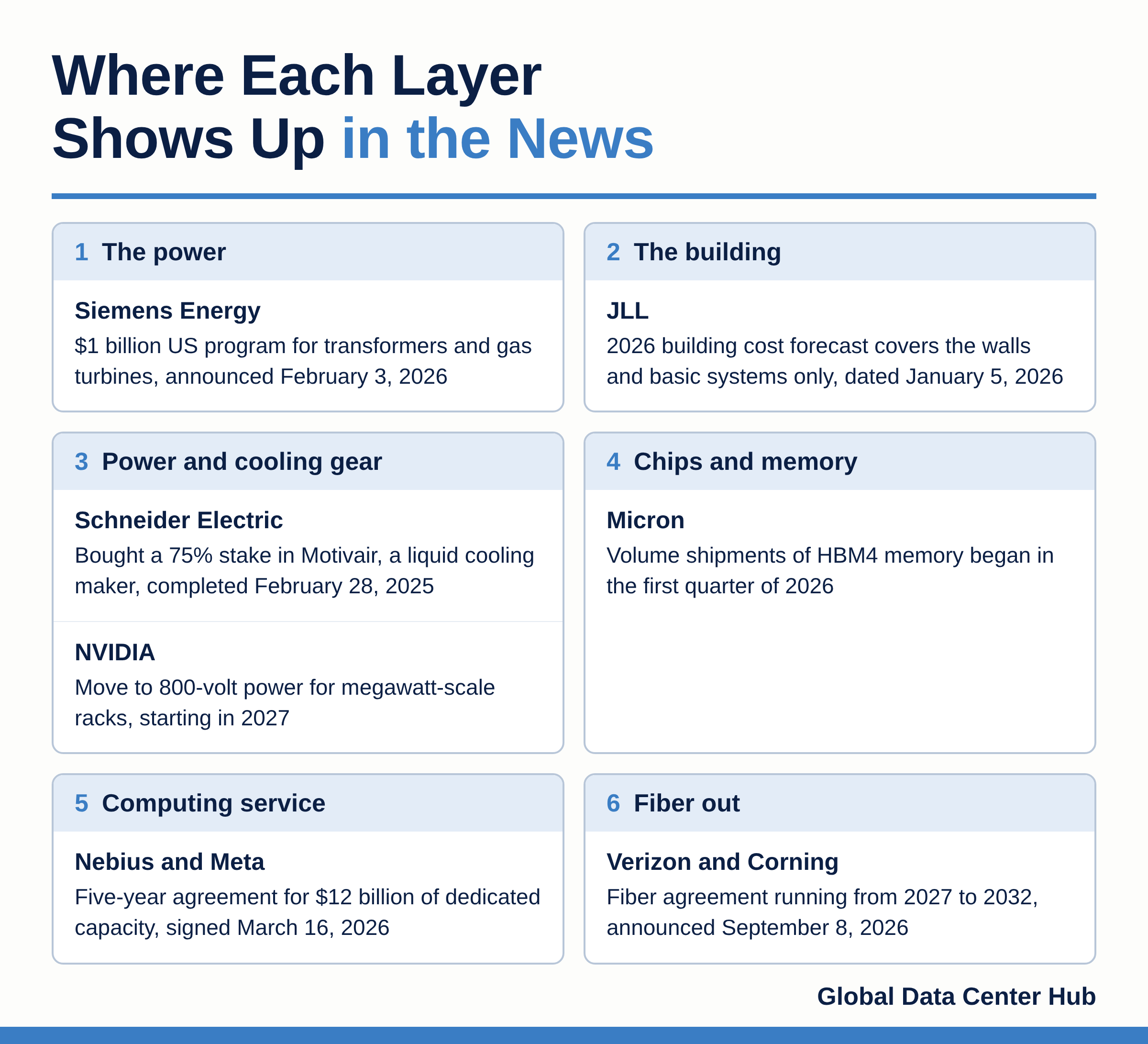
Siemens Energy, the German power equipment maker, announced on February 3, 2026, a $1 billion US program covering transformers, the large machines that turn the very strong electricity in long-distance lines into a level a building can use.
The program also covers gas turbines, which are truck-sized jet engines that burn fuel to make power. The IEA counted a 70% jump in gas turbine orders in 2025.
This layer also carries the most public friction. The IEA reported that communities push back against data center projects, with growing concern about affordability and environmental impact.
That is why a data center you will never visit can still come up in a conversation about the electricity bill on your kitchen counter.
The landlord owns the walls, and the tenant brings the machines
The second layer is the building. Picture an unfurnished apartment: the landlord owns the walls, the plumbing, and the wiring, and the tenant moves in the furniture.
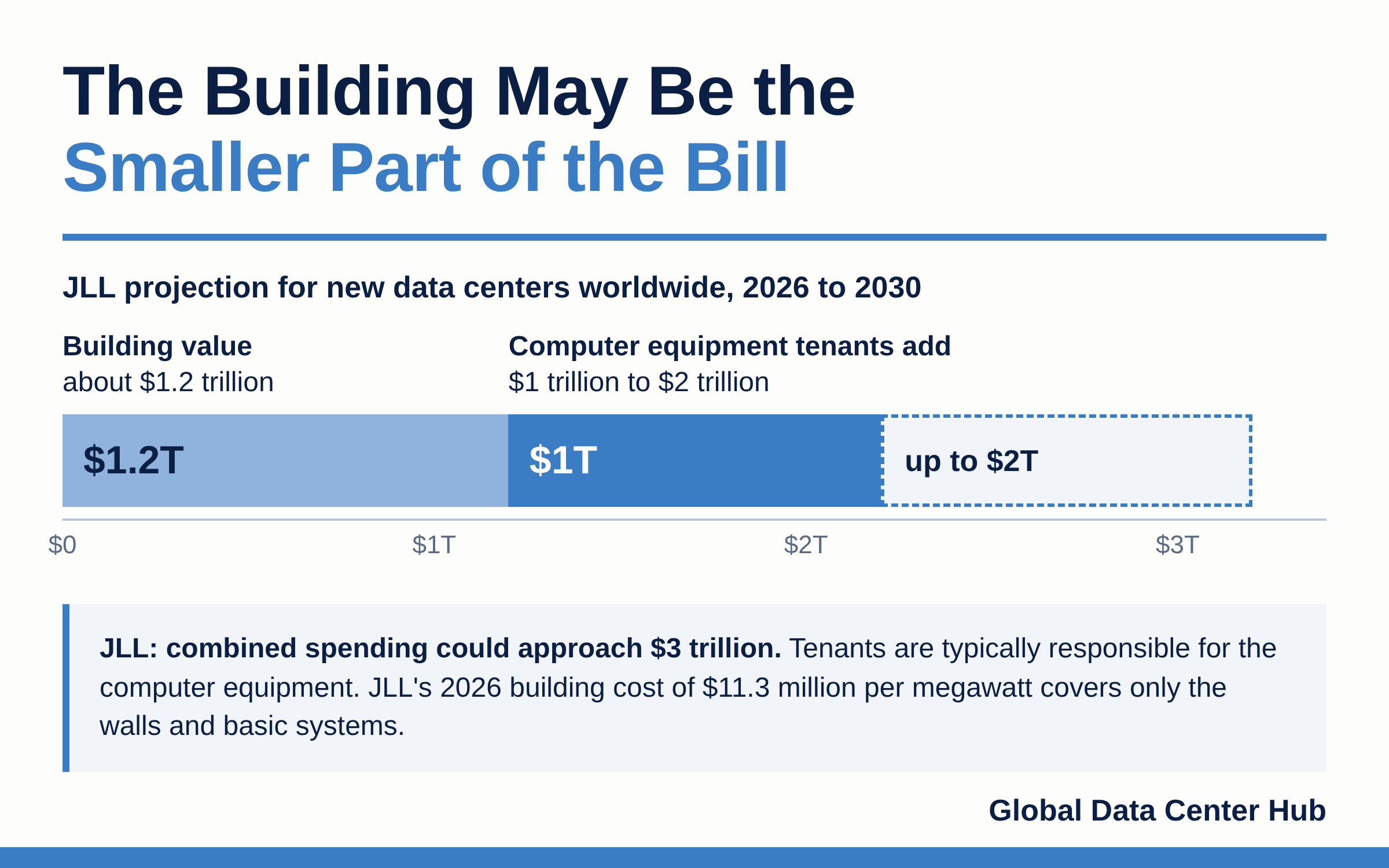
Many data centers work the same way. JLL, the global real estate firm, forecast in its outlook dated January 5, 2026, that the average cost to build a data center worldwide would rise 6% to $11.3 million per megawatt in 2026.
A megawatt here measures how much electricity a building can deliver to its machines at once.
JLL said that figure covers only the shell and core, meaning the structure and its basic systems, and leaves out the computer equipment, because tenants are typically responsible for it.
The tenant’s share is the surprise. JLL projected about $1.2 trillion in new data center property value from 2026 to 2030, and said tenants could spend another $1 trillion to $2 trillion fitting those buildings with computer equipment. Combined, JLL said, spending could approach $3 trillion.
A newcomer would reasonably assume that the company named on a building owns what is inside it. For a building that one company built for its own use, that assumption can hold.
For a leased building, JLL’s split describes two owners: a landlord holding the structure, and a tenant holding the machines, each on its own timetable.
The building in the news photo may be the smaller part of the bill.
The furnace and the fuse box have become their own business
Inside the walls sits a third layer: the equipment that feeds the machines power and carries their heat away. In a house, this is the fuse box and the furnace.
In an AI data center, it increasingly includes liquid cooling, pipes that carry coolant right up against the chips to pull heat away faster than air can.
The companies that make this gear have started buying each other. On February 28, 2025, Schneider Electric, one of the world’s large makers of electrical equipment, completed its purchase of a 75% controlling stake in Motivair, a company that specializes in liquid cooling for high-performance computers.
Schneider said it expects to buy the remaining 25% in 2028. One company now sells both the electrical side and the cooling side of the same room.
The gear also has to match the chips. NVIDIA, the company whose chips the AI boom runs on, says it is leading a move to 800-volt direct current power, starting in 2027, to support racks that draw power on the scale of a megawatt each.
A rack is a tall shelf holding dozens of servers, and a server is a desktop computer with the screen removed, flattened into a tray. A building that wants to host those racks will need power equipment designed for them.
The plumbing and wiring decide which chips a building can take next, and a sound building can still fall behind the machines it was built for.
The chips depend on a memory part most headlines skip
The fourth layer is the computers themselves, and the chips inside them come from a supply line of their own.
NVIDIA designs the best-known AI chips, and each one needs high-bandwidth memory, a fast type of memory stacked right beside the main chip, so data reaches it without delay.
Micron, the American memory maker, said on March 16, 2026, that it had begun volume shipments of its newest high-bandwidth memory, called HBM4, in the first quarter of 2026, designed for NVIDIA’s Vera Rubin platform.
The IEA’s 2026 update expects shortages of this memory to persist through at least the end of 2027 and reported that bottlenecks in advanced chip manufacturing have tightened.
So, the AI tools you use depend on memory supply as well as on buildings and power.
Meta’s $12 billion deal rents computing from another company
The fifth layer is the service: a company that owns AI computers, runs them, and rents out their computing power. A car rental firm works the same way. It owns the fleet, and a traveler pays to use one.
On March 16, 2026, Nebius, an AI cloud company, announced from Amsterdam that it had signed a five-year agreement with Meta, the owner of Facebook and Instagram.
Nebius will deliver $12 billions of dedicated computing capacity to Meta across multiple locations, with delivery beginning in early 2027.
Meta also agreed to buy additional computing from upcoming Nebius clusters, up to $15 billion over five years. Nebius said it intends to sell that extra capacity to other customers, and Meta will buy whatever Nebius does not sell.
A newcomer reading “Meta’s AI capacity” would picture a Meta building filled with Meta computers. That picture is a reasonable first guess. This agreement describes another arrangement.
Nebius delivers the capacity from its own locations, and Meta has committed to $12 billions of it over five years. The capacity serves Meta, and the delivery runs through Nebius.
A headline about a famous AI company can describe computers that a different company delivers and runs.
The fiber leaving the building has its own owner and its own outages
The sixth layer is the connection to everyone else: fiber-optic cables, thin glass strands that carry data as light.
Think of it as the road to a house. The road usually belongs to someone else, and the house is cut off when the road closes.
On September 8, 2026, Verizon, the US phone and internet company, and Corning, the glass and fiber maker, announced a multi-billion-dollar agreement running from 2027 to 2032 for more than 80 million miles of optical fiber and related equipment.
The fiber is meant for home and business broadband, and for the long-distance backbone that the largest cloud companies need for AI.
Failures in this layer travel. Uptime Institute, which publishes reliability ratings for data centers, reported in its May 2026 outage analysis that power remains the leading cause of serious outages.
It also found that failures in infrastructure outside the data center are becoming more prominent in publicly reported outages, and that outages tied to fiber and connectivity are rising and more likely to cause extended disruption.
When an app goes down, the cause can sit outside the data center, in a cable someone else owns.
One question sorts every data center headline
From the road, the six layers look like one building. They belong to utilities, landlords, equipment makers, chip and memory makers, computing rental firms, and network builders, and each move on its own timetable.
The question that sorts them takes seconds. When a data center story names a company, ask which layer it owns: the power, the walls, the gear, the chips, the service, or the cables.
The answer tells you what the company actually did, and how many other companies still have to deliver before an AI answer reaches your screen.
That is the physical ground under the digital life you already live, and many hands hold it.
The open question is which of those hands will be slowest to deliver as data center electricity use climbs toward the IEA’s 2030 projection.