

Welcome to Global Data Center Hub. Join investors, operators, and innovators reading to stay ahead of the latest trends in the data center sector in developed and emerging markets globally.
This article is the 15th article in the series: Ground to Grid: A Free 21-Lesson Guide to Mastering Data Center Development
Why Risk Allocation Is What Capital Is Really Buying
“Capital does not require that a project have no risk. It requires that every risk sit with the party best able to carry it. The EPC, O&M, and SLA contracts are how that allocation gets done, and how a project becomes something a lender will fund.”
This lesson covers the contractual layer, which begins when the construction contracts are signed and runs through the operating life of the facility.
The EPC contract assigns construction risk, the O&M contract assigns operating risk, and the SLA assigns performance risk owed to the tenant.
Underneath all three sits the financing structure, which closes only when lenders judge the allocation acceptable.
That judgment is specific. Lenders require a fixed completion date, a fixed price, output guarantees, liquidated damages for delay and performance, and security from the contractor or its parent.
The ring-fenced SPV holding the project is what supports 60 to 80 percent loan-to-cost.
The Three Contracts That Allocate Risk
1. The EPC Contract
The EPC contract allocates construction risk across cost, schedule, and quality. Design-build and EPC together account for roughly 70 percent of hyperscale project starts.
A fixed-price EPC moves overrun and delay risk to the contractor. The owner buys cost predictability and pays for it, because the contractor prices contingency into the bid.
Pricing follows design maturity. Guaranteed maximum price contracts signed against incomplete designs produced 8–14% change orders, versus 3–5% when design was frozen near 60% completion.
Allocation is a promise; liquidated damages make it collectable. Delay damages accrue daily past a milestone, while performance damages cover capacity, output, PUE, or availability shortfalls and typically reach 10–15% of EPC price.
Overall liability caps commonly reach 30–50%, with carve-outs for indemnities, fraud, and willful misconduct. Delay and performance damages have separate caps and must genuinely pre-estimate the owner’s loss.
2. The O&M Contract
The O&M contract allocates operating risk once the facility is live. It determines who is accountable when the facility underperforms.
The agreement defines key reliability KPIs: uptime, PUE, cooling capacity, and response times. Deductions apply below agreed thresholds, with carve-outs for scheduled maintenance and force majeure.
Publicly filed contracts show the structure. In one Indian state data center O&M agreement, availability below 99.741% triggers deductions of 1% of monthly payment per component, with penalties capped at 10%.
Highest-severity incidents have 15-minute response and 30-minute resolution windows.
Onboarding needs its own treatment, because the operator staffs and trains before revenue begins.
Escalation needs an index across a multi-year term. A long-term service agreement with the equipment vendor covers availability, parts, and response time.
3. The SLA
The SLA allocates performance risk between operator and tenant. It defines the uptime commitment and what a miss costs.
The Uptime Institute Tier Standard links physical topology to availability, and a Tier III facility is capable of roughly 99.982 percent.
Tier classifications describe built infrastructure. They become enforceable only where the SLA defines measurement, exclusions, and remedies.
The remedy is a service credit against monthly recurring charges. Credits typically run 5 to 30 percent of monthly fees per incident, and aggregate credits are commonly capped at 50 percent of one month’s charges as the sole and exclusive remedy.
Measurement often matters more than the headline number. A 99.9 percent commitment measured monthly permits about 43 minutes of downtime. The same 99.9 percent measured annually permits 8.76 hours.
AI tenants now negotiate beyond uptime. Racks running 40 to 140 kW are sensitive to environmental drift, so power quality and thermal tolerances appear alongside availability.
How the Three Fit Together
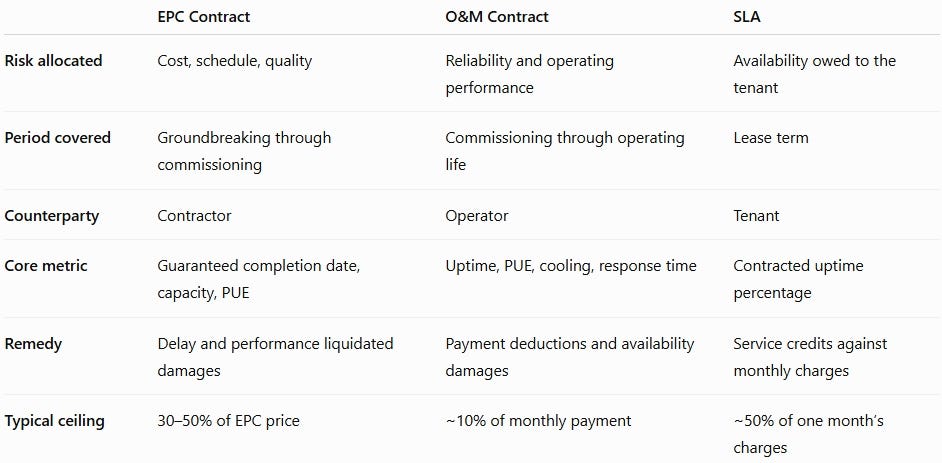
The EPC contract carries the project from ground to commissioning. The O&M contract carries it from commissioning through its operating life.
The SLA defines what the tenant is owed and what a failure costs. Together they distribute risk across construction, operation, and performance.
Back-to-back structuring holds the sequence together.
The technical minimums of the lease are mirrored down into the EPC and O&M scopes, and equivalent relief clauses entitle a contractor or operator to relief only to the extent the project company obtains it upstream.
Where Risk Allocation Breaks Down
An EPC scope that shifts turns a fixed price into a series of change orders, and the 8 to 14 percent range on immature design is the visible cost.
An O&M contract that does not match the promised SLA leaves the operator accountable for an outcome the scope does not fund. Deduction caps often sit below the credits the landlord owes its tenant.
SLA penalties can also exceed what the inherited design supports. An operator asked to hold a Tier IV commitment inside a Tier III topology has accepted a penalty it cannot engineer away.
The fourth pattern is the gap between contracts. Long-lead equipment is often ordered early and novated to the contractor.
The vendor damages cap is then measured against equipment value while the prime contract cap is measured against project value.
Vendor warranties frequently begin at shipment and can expire before energization.
Insurance does not close that gap, because delay-in-startup cover generally responds only to delay caused by insured physical damage.
The construction-to-operations interface works the same way.
Early performance disputes turn on whether the cause was operation or a latent defect. Where nothing governs that interface, the risk sits with nobody until it materializes.
Comparison: What Each Contract Allocates
Real-World Example
“Hyperscalers will not approve a facility until it meets their commissioning standard, and their leases carry SLAs with real penalties. The O&M contract has to be built to meet that SLA, or the operator is signing up for penalties they cannot avoid.”
Trace one event through the stack. The campus transformer slips, and the energization date moves with it.
The tenant’s delay remedy accrues against the developer from the missed service commencement date.
The contractor invokes excusable delay on long-lead equipment. The supplier limits liability to equipment value.
Each counterparty behaves reasonably under its own agreement.
The exposure still lands on the developer, and it lands unfunded unless the allocation was designed around that event.

Strategic Implications
For developers. Assign each risk to the party who controls it and can pay. Freeze the design before signing a guaranteed maximum price contract, as incomplete designs can raise change orders from 3–5% to 8–14%.
Draft long-lead purchase orders for novation so liability caps and warranty dates remain effective after transfer.
For investors. Trace each major risk to a contract and named counterparty. Risk with no owner sits with you.
Test whether recovery arrives, not just whether the clause exists. Run one adverse event through the full stack and calculate actual recovery.
Watch for gaps where liability caps use different bases, or where the longstop date arrives before the delay damages cap is exhausted.
For operators. Align the SLA with the O&M scope. Compare the two ceilings: service credits can reach 50% of monthly recurring charges, while O&M deductions may cap near 10%.
The gap is your exposure. Test the commitment against the inherited topology, because a Tier IV obligation on a Tier III design cannot be solved by operations alone.
For policymakers. Enforceability affects the cost of capital. Lenders assess whether liquidated damages, novated purchase orders, security interests, and interconnection commitments will hold.
Uncertainty can raise coverage requirements, reduce leverage, or block credit.
Key Takeaway
“Bankability is not the absence of risk. It is the clean assignment of every risk to the party best able to carry it. The EPC, O&M, and SLA are how a project proves it has done that.”
Every project carries construction risk, operating risk, and performance risk.
The financing does not depend on removing them. It depends on showing a lender that each one has an owner, a remedy, and a counterparty solvent enough to honor it.
Work through your own stack the way a lender does. Take the three contracts, name the party that carries each risk, and mark the exposures that belong to nobody.
Those unmarked exposures are the real equity in the deal.
Which of the three contracts do you think is most often misaligned with the others, and where have you seen that gap surface?