
Welcome to Global Data Center Hub. Join investors, operators, and innovators reading to stay ahead of the latest trends in the data center sector in developed and emerging markets globally.
This month’s deal log highlights four transactions reshaping the global AI infrastructure landscape across North America, Europe, APAC, and Latin America. Together, they show how power alignment, supported by capital access and platform execution, is determining where the next generation of AI capacity will be deployed.
CoreWeave — 5GW Expansion Plan (North America)
CoreWeave’s plan to add 5GW of data center capacity reflects a structural shift in how AI infrastructure is deployed in the United States. At this scale, infrastructure development is defined by the ability to secure and deliver power across multiple regions rather than by capital availability alone.
A 5GW rollout implies alignment with grid operators, long-term energy procurement strategies, and potentially diversified generation sources. Even without explicit detail, the scale indicates that power has been treated as the primary constraint in development planning.
The capital component reinforces this dynamic. Financing is flowing toward platforms capable of converting capital into powered capacity, rather than toward speculative development. This reflects a broader reclassification of AI infrastructure as a financeable asset class tied to compute delivery.
Strategically, CoreWeave is operating as a capacity aggregator, building in regions where energy can be secured rather than competing within constrained hubs. This signals a shift toward distributed infrastructure aligned with power availability.
The transaction underscores that in North America, competitive advantage is defined by the ability to convert energy into compute at scale with predictable execution timelines.
This evolution toward platform-scale capacity aggregation mirrors the financial and operational model outlined in Is CoreWeave’s $8.5B Deal the GPU Asset Class Moment?.
Amazon — €33.7B Spain Investment (Europe)
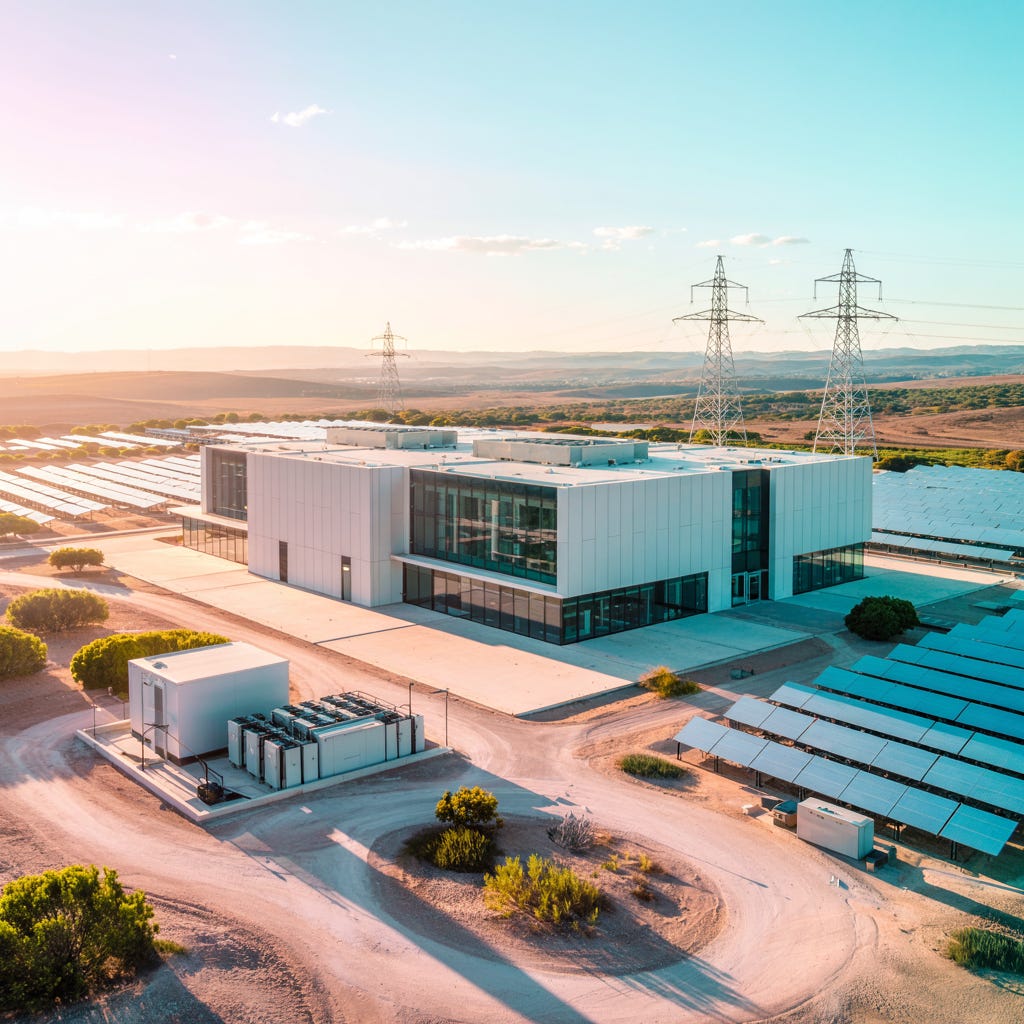
Amazon’s €33.7 billion expansion in Spain highlights how energy availability is reshaping Europe’s data center geography. The scale of capital is significant, but the defining factor is the country’s ability to support large-scale infrastructure through renewable energy.
Spain’s solar and wind capacity provide a structural advantage in a region where grid constraints are limiting expansion in traditional hubs. This enables faster deployment and greater scalability, aligning infrastructure growth with energy availability.
The investment reflects hyperscaler-led capital deployment with long-term demand certainty. Rather than incremental expansion, it represents a strategic repositioning of infrastructure toward a market capable of sustaining AI-driven growth.
Projects such as the Solaria–Merlin 213MW development reinforce this pattern, showing how energy-linked infrastructure models are becoming central to scaling capacity.
Spain is emerging as a core AI infrastructure corridor because it can deliver power at scale. This signals a broader shift in Europe, where infrastructure is moving toward energy-rich markets.
ByteDance — 500MW VNET Capacity Agreement (APAC)
ByteDance’s 500MW agreement with VNET represents a shift toward securing power-linked capacity in advance of development. The defining feature of the transaction is not just its scale, but its structure as a forward capacity commitment tied to future infrastructure deployment.
By securing 500MW, ByteDance is effectively locking in access to energy-enabled infrastructure before power constraints intensify. This reduces execution risk and ensures that future compute deployment can proceed without delays linked to grid availability.
The operator relationship is central. VNET’s platform provides existing infrastructure and implied access to power, allowing capacity to be delivered more predictably.
From a capital perspective, the transaction shifts the role of financing. Instead of directly funding development, ByteDance is using contractual commitments to drive infrastructure buildout, ensuring utilization while transferring execution risk to operators.
Strategically, the deal reflects a broader pattern across APAC. Hyperscalers are moving toward proactive control of power availability, securing capacity before it becomes constrained.
This proactive reservation of power-aligned capacity reflects the emerging AI infrastructure playbook detailed in Is ByteDance’s 500MW China Deal the New AI Infrastructure Playbook?.
Serpro — Data Center Expansion (Brazil, Latin America)
Serpro’s plan to build two data centers in Brazil reflects an early-stage effort to develop sovereign AI infrastructure. The transaction is strategically significant but highlights the limitations of markets where power alignment is not yet clearly defined.
The expansion supports national digital infrastructure capacity, indicating that Brazil is positioning itself to capture a portion of AI-driven demand domestically. However, the dataset provides limited visibility into power sourcing, creating uncertainty around execution.
Capital deployment is moderate and reflects government-backed investment rather than large-scale institutional financing. This is consistent with early-stage market development.
The primary constraint is energy alignment. Without clear power pathways, scaling beyond initial deployments remains uncertain. This contrasts with more advanced markets where energy is embedded within infrastructure strategy.
The transaction illustrates that Latin America’s competitiveness will depend on its ability to translate energy availability into scalable, power-aligned infrastructure platforms.