
Welcome to Global Data Center Hub. Join investors, operators, and innovators reading to stay ahead of the latest trends in the data center sector in developed and emerging markets globally.
Ask ChatGPT a question and the reply appears on your screen in about a second. It feels like the answer comes from your phone, or from somewhere in the air. It does not.
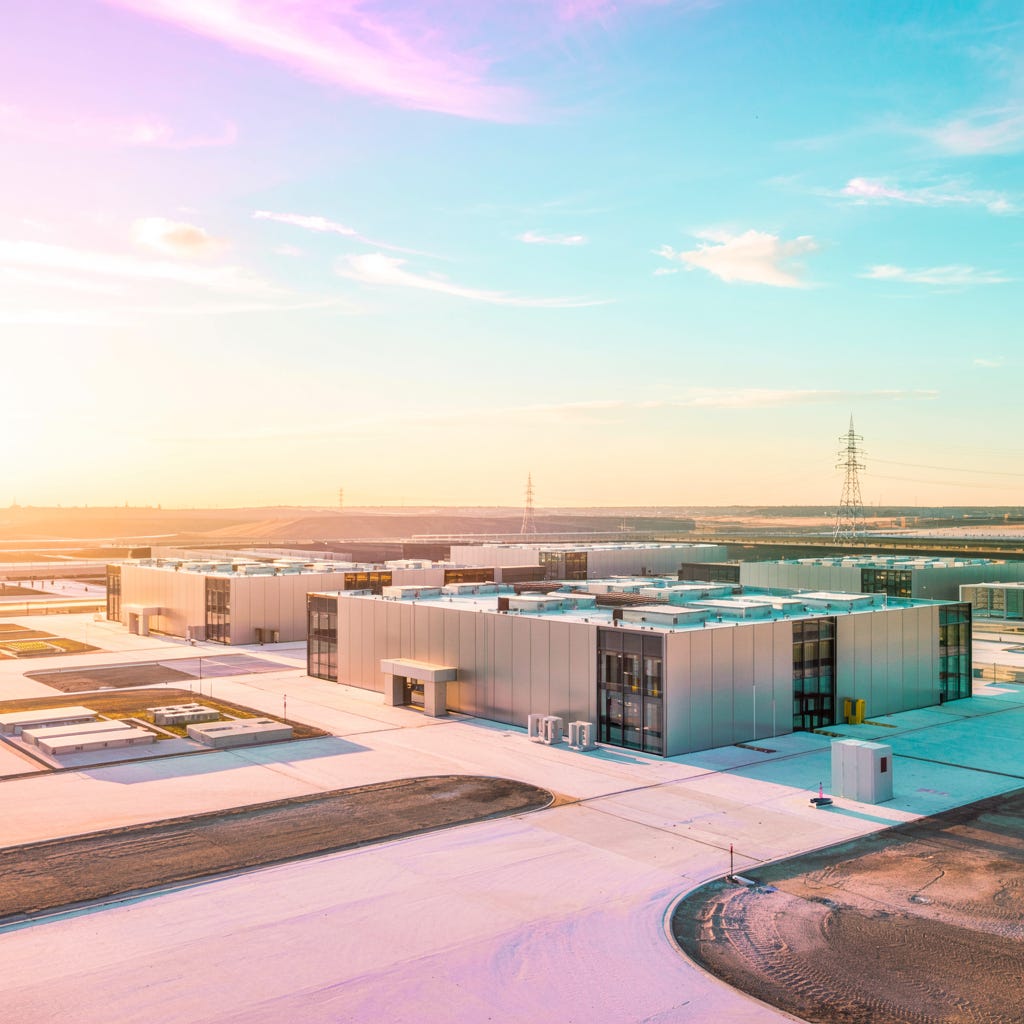
It comes from a specific building, most likely hundreds of miles away, a long windowless box behind a fence with no sign out front.
Your bank runs on one of these buildings. So does Netflix, so does your email, so does the app that holds your photos.
For about twenty years, almost nobody outside the technology business gave these buildings a second thought.
They sat quietly at the edges of towns and did their job, and the rest of us used the internet without ever asking where it physically lived.
That changed almost overnight.
In the last two years, these buildings have shown up in election campaigns, in fights over electricity bills, in warnings from the people who run national power grids, and in the plans of the biggest companies on earth.
To understand why, you first need to know what a data center actually is. It is simpler than it sounds.
Two problems: power in, heat out
A data center is a building with one purpose: to keep a very large number of computers running, all the time, without ever switching off.
The computers themselves are called servers.
Picture a normal desktop computer, then strip away the screen and the keyboard, flatten it into a thin tray, and slide it into a tall metal shelf alongside dozens of others.
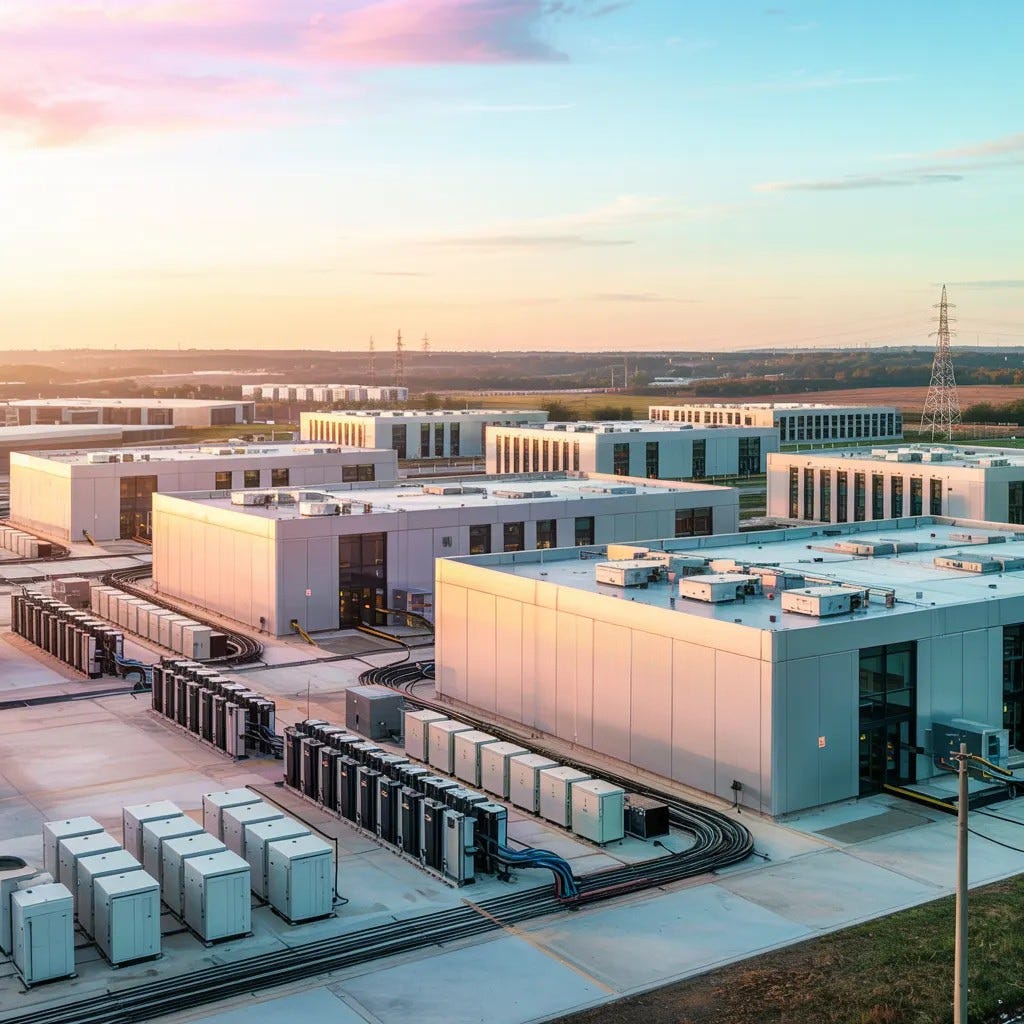
Those shelves are called racks, and a big data center holds thousands of them in long rows, like library stacks made of humming metal.
The servers are the part doing the actual work: storing your files, running the apps, answering the questions.
Everything else in the building exists to keep those servers alive, and it comes down to two problems.
The first problem is power.
A room full of running computers needs a constant, heavy supply of electricity, and it cannot afford to lose it even for a moment, because when these machines go dark, so do the services running on them.
So a data center pulls electricity straight from the power grid, and behind that it keeps banks of batteries and backup generators ready to take over the instant the grid hiccups. Keeping the power flowing is the whole game.
The second problem is heat.
Anyone who has felt the underside of a laptop knows that computers get hot, and heat is what destroys them. Multiply one warm laptop by thousands of servers packed into a room, and you have a furnace.
So a large part of every data center is a cooling system, essentially industrial air conditioning, and increasingly a system that runs liquid coolant right up against the chips to carry the heat away.
Add fiber-optic cables to connect the building to the wider internet, and fences and guards to keep people out, and that is the whole thing.
Power coming in, heat going out, and a small city of computers in between. For most of the internet’s history, that description was enough, and these buildings drew a modest amount of electricity and attracted no attention at all.
Then the thing running inside them changed, and the modest amount of electricity stopped being modest.
The shelf that draws a hundred homes’ worth of power
Here is the part that most people have not been told plainly.
You have probably absorbed the idea that artificial intelligence is a triumph of clever software.
That is true, but it hides something.
The kind of AI behind ChatGPT, Google’s Gemini, and the rest runs on NVIDIA chips that have helped make the company one of the world’s most valuable businesses. These chips consume enormous amounts of electricity.
A standard server rack uses about as much power as a few electric ovens. A rack filled with NVIDIA's latest AI chips can consume more than ten times that up to the equivalent of 100 homes.
The heat this produces is so intense that ordinary air conditioning cannot keep up, which is why the newest AI buildings pipe liquid coolant directly onto the chips.
Now multiply that across an entire building. A large AI data center can draw 100 megawatts or more enough electricity to power roughly 80,000 American homes for a year.
One building, drawing as much power as a small city, poured continuously into a windowless box so that a machine can answer questions and generate images for millions of people at once.
That is the reason everyone suddenly cares.
The AI story looks like a software story, and underneath it is a story about electricity, at a scale the world has never had to supply before.
The largest technology companies, Amazon, Microsoft, Google, and Meta, understood this early and began spending on a scale with no precedent.
The consulting firm McKinsey estimates the world will spend roughly $6.7 trillion building data centers by 2030.
And once you follow the electricity, you arrive at the thing that now controls the entire race.
Building it takes months. Powering it takes years.
You might assume the hard part of building one of these is the machines, or the money to buy them.
It is neither. NVIDIA can make more chips over time, and money, for these companies, is not the constraint.
The constraint is getting enough electricity to a specific patch of ground.
The surge in AI demand has broken old assumptions. The International Energy Agency estimates data centers used about 1.5% of global electricity in 2024 and expects that to nearly double by 2030 growing more than four times faster than overall electricity demand.
In the United States the pressure is sharper. Lawrence Berkeley National Laboratory, a US government research lab, found that data centers used about 4.4 percent of the country’s electricity in 2023 and could reach as much as 12 percent by 2028.
In the thirteen eastern states served by the grid operator known as PJM, data centers are expected to account for almost all of the growth in electricity demand between now and 2030.
The trouble is that a power grid cannot grow as fast as a construction crew.
Connecting a big new source of electricity to the American grid now takes a median of about five years, according to Lawrence Berkeley National Laboratory, and the line of projects waiting to connect is longer than the entire existing power supply of the country.
Building a data center, it turns out, is quick. Powering it is slow. Two real stories show what that gap does to the people building these things.
A supercomputer built in 122 days
In 2024, Elon Musk’s AI company, xAI, needed an enormous computer to train its chatbot, Grok, and it needed it immediately.
The company took over an abandoned appliance factory in Memphis, Tennessee, and set out to fill it with a hundred thousand of NVIDIA’s AI chips wired together into a single machine, which it named Colossus.
The industry estimated this build would take eighteen to twenty-four months.
xAI completed it in just 122 days, transforming an empty factory into a working supercomputer. NVIDIA's CEO called it the fastest build of its kind.
Then came the catch.
The local grid could supply only a fraction of the power Colossus needed. Rather than wait years for a grid connection, xAI installed dozens of portable natural gas turbines to generate power on-site.
That choice let the machine run, and it came at a cost to the surrounding neighborhood: the turbines drew objections from residents and environmental groups over the air pollution they added to a part of Memphis that already carried a heavy burden of it, and the dispute ended up in court.
The lesson sits underneath the whole AI boom.
You can build the building in a matter of months, but the power is so hard to come by that a company will burn its own fuel on the doorstep rather than wait in line for the grid.
Switching a dead nuclear reactor back on
Three-Mile Island is a nuclear plant in Pennsylvania, and to many Americans the name means only one thing: the site of the country’s most serious nuclear accident, in 1979. One of its two reactors was involved in that accident.
The other, Unit 1, kept running safely for decades afterward, until 2019, when its owner shut it down because it was losing money.
It sat cold and closed. That looked like the end of it.
In September 2024, Microsoft signed a twenty-year deal to buy the electricity from that plant, on the condition that its owner, Constellation Energy, bring the reactor back to life.
Constellation is spending about $1.6 billion to restart it, has renamed it the Crane Clean Energy Center, and expects it running again by 2027.
Microsoft is buying the plant’s entire output. Every watt that reactor produces is spoken for, to help power the data centers behind Microsoft’s AI services.
Sit with what that means. A shut-down nuclear reactor, a symbol of an accident older than most people reading this, is being switched back on, and the reason is the electricity appetite of AI.
Microsoft is not alone in this. Amazon has bought a data center site next to another nuclear plant. Google and others have signed their own deals for nuclear power.
When companies this large decide that the cheapest way to feed their buildings is to restart a nuclear reactor, you are watching the constraint of this era operate in the open.
Why this lands on your electricity bill
It is easy to see this as a problem for engineers and utility planners. That would be a mistake, because it is precisely why the story moved from the technology pages to the front page.
These buildings compete with homes, hospitals, factories, and schools for electricity.
As they cluster in one region, they can consume a growing share of local power, affecting both electricity prices and grid reliability.
The quiet buildings became loud the moment they started drawing enough power to change what electricity costs for the people living near them.
That is why a governor now holds a press conference about a data center, and why the people who keep the lights on for whole regions now issue public warnings about how fast these buildings are arriving.
There is a larger point underneath the electricity.
The digital life you already live, every message, payment, photo, and stream, has always run through a physical building somewhere, powered by real electricity drawn from a real grid. AI did not create that dependence.
It made it impossible to ignore, by demanding so much, so fast, that it ran headfirst into the limits of the power system the rest of us also rely on.
These buildings are not a footnote to the AI age. They are its foundation, and the foundation is where the strain now shows.
What is the one everyday thing you rely on, without ever thinking about the building it runs through, that surprised you most to learn about here?