
Welcome to Global Data Center Hub. Join investors, operators, and innovators reading to stay ahead of the latest trends in the data center sector in developed and emerging markets globally.
TL;DR
Amazon, Microsoft, Alphabet and Meta plan to spend roughly $725 billion building AI infrastructure in 2026, and the shortage now slowing them down is electricians. Microsoft president Brad Smith described the electrician shortage in March 2026 as the number one problem slowing the company’s data center expansion in the United States. The Financial Times compiled the $725 billion figure from the four companies’ first-quarter earnings guidance, up about 77 percent from roughly $410 billion in 2025.
Electrical work accounts for 45 to 70 percent of what it costs to build a data center, according to the International Brotherhood of Electrical Workers. A data center is largely an electrical system with a roof over it, since the path power takes from the grid to the computers is the expensive part of the building. A shortage in that one trade therefore sets the schedule for everything else on the site.
A licensed electrician takes four to five years to train, which is longer than most data centers take to plan and build. The standard apprenticeship run by the electrical training ALLIANCE, the training body created by the IBEW and the National Electrical Contractors Association, requires a minimum of 8,000 hours of supervised work on real job sites alongside classroom instruction. Wages can rise overnight, and that clock runs at its own pace.
Somebody wired the room you are sitting in. They pulled cable through the walls, landed it in a panel, and left.
The largest construction program in modern American history now runs on that same trade, and it has run short of people.
This is the part of the AI story that gets almost no coverage, because it does not sound like technology.
Everything you read about the buildout is about chips, models, or money.
The thing actually holding up job sites is a person with a license, a van, and four to five years of training behind them, and there are not enough of them to go around.
That matters because the pace of AI, electricity prices, and career opportunities for the next generation increasingly depend on how many electricians America can produce. None of that is decided by a chip.
Here is how the money ran into the workforce.
Three quarters of a trillion dollars is already committed
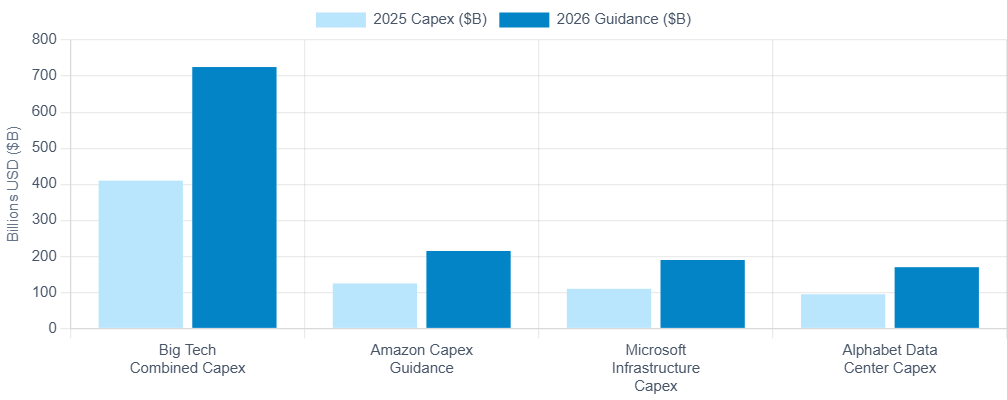
Amazon, Alphabet, Meta and Microsoft together plan to spend roughly $725 billion on capital projects in 2026, according to the Financial Times tally of their first-quarter earnings guidance.
That is up about 77 percent from roughly $410 billion in 2025, and several of the four have raised their guidance again since.
Capital expenditure, or capex, is simply money spent on physical things a company will own for years.
Buildings. Machines. In this case, data centers and the equipment inside them.
Most coverage treats that number as a schedule.
It reads as though $725 billion buys a certain quantity of finished buildings on a certain date, the way a grocery bill buys groceries.
Read it that way and you have mistaken a budget for a delivery plan.
Microsoft is driving electricians in from 75 miles away
In March 2026, Microsoft president Brad Smith said the shortage of electrical talent was the biggest constraint on U.S. data center expansion, ahead of chips and land.
He also described what the company does about it.
Microsoft has been bringing electricians to job sites from more than 75 miles away, and in some cases relocating them temporarily, to keep work moving.
Google’s own policy work says the same thing in flatter language:
“A shortage of electrical workers may constrain America’s ability to build the infrastructure needed to support AI”.
When the two largest builders of data center infrastructure both name the same trade as the thing in their way, the shortage has stopped being a human resources problem.
If you have been reading construction delays as a sign that demand is softening, this is the alternative explanation, and it is the one the builders themselves give.
Nearly half the cost of a data center is electrical work
Electrical systems account for somewhere between 45 and 70 percent of the total cost of building a data center, according to the IBEW.
That figure surprises people, and it is the key to the whole story.
A data center is best understood as an enormous electrical machine. The concrete is there mostly to keep the weather off it.
Think of the electrical panel in your hallway, the gray box with the breakers in it.
A large data center campus is that idea at a scale most people never see. Switchgear the size of shipping containers.
Cable too thick for a person to bend by hand. Backup generators the size of a bus.
Thousands of connections that each have to be made correctly by someone licensed to make them.
All of it is done by hand. The machine that pulls cable and lands terminations has yet to be invented.
So when the trade that does it runs short, the shortage sets the pace of the whole building.
A workforce problem then shows up on a schedule exactly the way a supply problem does.
Wages can rise tonight. An apprenticeship takes five years.
This is the part that money cannot solve quickly, and it is worth being precise about why.
The main path is a registered apprenticeship through the electrical training ALLIANCE, jointly run by IBEW and NECA.
The inside wireman program for commercial, industrial, and data center work requires 8,000 hours of fieldwork plus classroom training, typically over four to five years.
Apprentices are paid, and tuition is generally free.
The pipeline is real, and it is small relative to what has been asked of it.
The Bureau of Labor Statistics projects around 81,000 electrician openings a year over the coming decade, against a workforce of roughly 819,000, with median pay of $62,350 as of May 2024.
Now set the demand beside it. Associated Builders and Contractors estimates the construction industry needs about 349,000 net new workers in 2026 alone.
The Information Technology and Innovation Foundation has put the shortfall specific to data center construction at roughly 439,000 people.
A company can raise a wage on a Tuesday afternoon. The first cohort hired into an apprenticeship this month becomes licensed around 2031.
If you have ever wondered why an industry with unlimited money still misses its dates, this is the mechanism, and it is the one part of the chain that no cheque shortens.
Google is now paying to train electricians in Indiana
There is a straightforward test for whether a company believes a constraint is real: watch whether it spends money on something far outside its own business.
Google.org committed $15 million to the electrical training ALLIANCE to reach 100,000 electrical workers and 30,000 new apprentices.
In September 2025, $400,000 was awarded to three Indiana training centers, aimed at adding 524 apprentices by 2030 a 42% increase in the state’s projected electrician pipeline.
Consider the two numbers together. A company built on search and cloud software is funding trade apprenticeships in the Midwest, yet the state-level result is just 524 people over five years against a national gap of hundreds of thousands.
Both facts are true at once, and the second one does not cancel the first.
The scale of the response tells you the problem is genuine. The scale of the gap tells you it is not going to be closed by philanthropy.
Read the training announcements as a fix and you will be surprised in 2028. Read them as a measurement of the problem and they make sense.
The crew wiring the data center was going to wire something else
This is where the shortage leaves the sector and arrives in your town.
Turner & Townsend surveyed 112 markets across 44 countries for its Global Construction Market Intelligence 2026 report.
It found data center construction to be the most capacity-constrained building sector in the world.
More than 70 percent of those markets reported contractor capacity as tightening or overstretched.
Around 87 percent reported shortages in the mechanical, electrical and plumbing trades, and roughly 71 percent of markets named labor shortages as the leading driver of rising costs.
The report describes a two-speed market.
Contractors and suppliers are moving toward data center work because the margins are better, while housing, hospitality and ordinary commercial developers reassess whether their projects still make financial sense.
That is the honest cost of this buildout, and it is a real one. There is one pool of licensed electricians in any given region.
When a hyperscale campus arrives and can pay above the local rate, the crews that would have wired apartments, schools and hospitals go to the campus instead.
The projects they leave behind get slower and more expensive, and the people who notice are not reading data center coverage.
The AI buildout is happening inside the same economy you live in, competing for the same tradespeople.
Oracle’s completion dates moved a year to the right
Schedules are already moving, and the reporting on why is worth reading carefully.
Oracle is building data center capacity for OpenAI.
Bloomberg reported that the company moved the construction completion date from 2027 to 2028 and cited labor shortages as one reason.
Oracle disputed that account. It told Fortune that its projects remain on schedule and on plan, and that it intends to invest in local workforce training so nearby residents can do the work.
What is not in dispute is the underlying arithmetic, which every builder in the sector faces regardless of whose schedule slips first.
A single large campus can need on the order of a thousand or more workers at peak construction.
Several of them are being built at once, in the same states, drawing from the same halls.
The temptation is to read a delayed data center as evidence that AI demand was overstated.
Sometimes that is what a delay means. In this case there is a simpler explanation available first, and it is that the crew has not finished the last one.
What this actually means
The most heavily funded construction program in the country has run into a limit made of people.
That limit is different from the sector’s usual constraints.
Transformers arrive and grid connections clear, but electricians must be recruited, trained for years, and supervised by qualified workers, meaning each new electrician requires time from an existing one.
There is another point that complicates the good news: construction jobs are large in number but temporary.
A campus may employ over 1,000 workers during construction but only a few dozen once operational. As Louisiana union officials note, the work arrives in a wave and eventually moves on.
Communities should recognize that construction booms have an end date.
What does not have an end date is the reversal underneath all of this. For thirty years the advice was to get a degree and a desk.
The companies that automated the desk are now unable to build their own future fast enough because there are not enough people who can pull wire.
The AI you use answers in a second. Behind it is a building somebody had to wire by hand, and the pace of the whole thing is set by how many hands there are.
Did anyone you know go into the trades in the last few years? What made them pick it?
"Budget versus delivery plan” is the distinction that stuck with me here. We tend to read a giant capex number as though the money itself guarantees the schedule. It doesn’t. The build still has to pass through a limited pool of electricians, transformers, switchgear, permits and utility work. At this scale, labor capacity becomes part of the technology roadmap whether a software company wants it to or not.
Has anyone broken out the share of that 45-70% that is labor, as opposed to transformers and switchgear?