

Welcome to Global Data Center Hub. Join investors, operators, and innovators reading to stay ahead of the latest trends in the data center sector in developed and emerging markets globally.
Every month, a power bill arrives with a total most people pay without reading the lines.
Part of that total now covers power set aside for data centers that exist only on paper.
On December 17, 2025, PJM Interconnection published the results of its yearly power auction.
PJM runs the electric grid for more than 67 million people across 13 states and Washington, D.C.
Each year it pays power plants to stay ready to run three years later. That promise is called capacity.
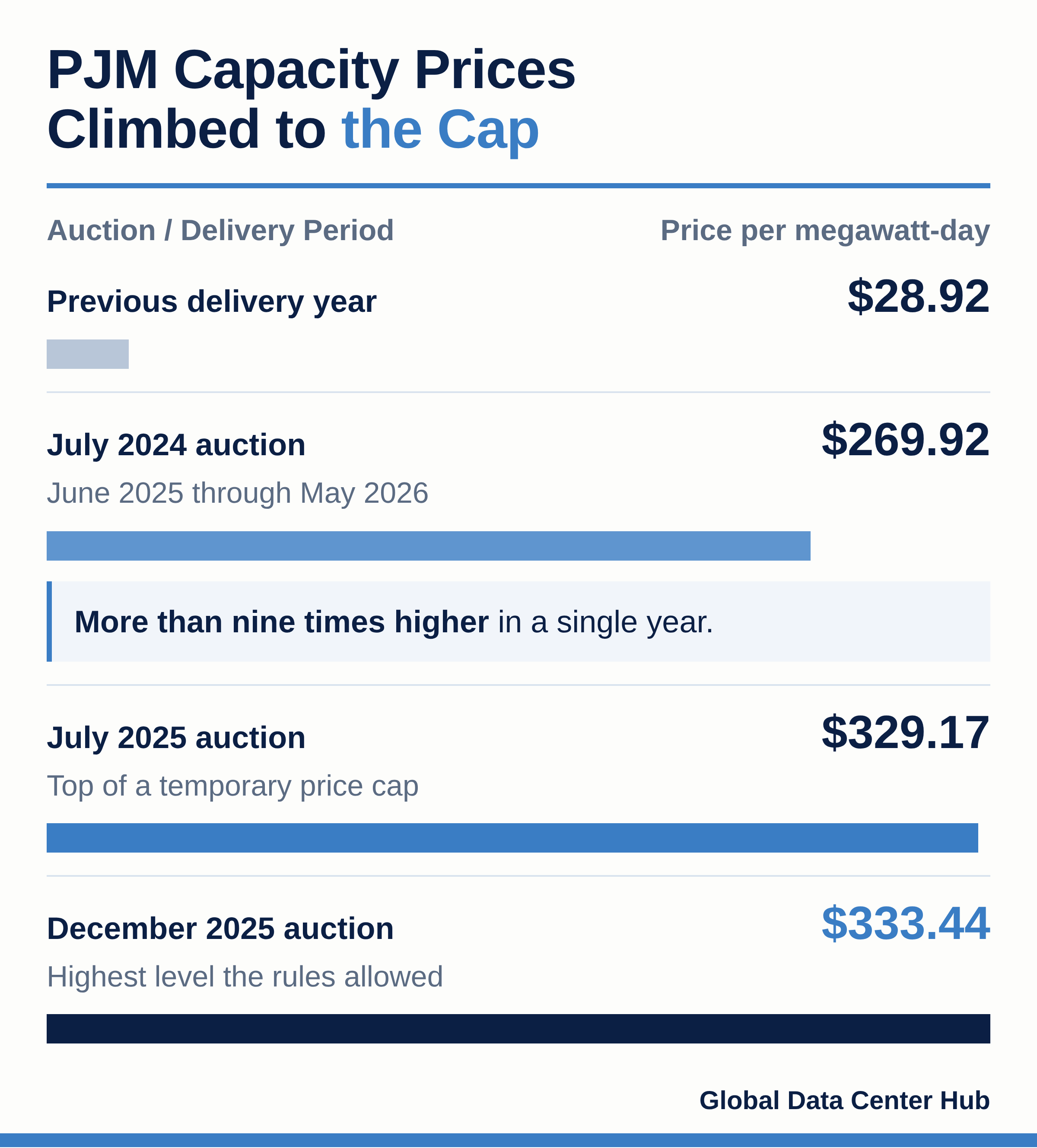
The price hit the highest level the rules allowed, $333.44 per megawatt-day, according to PJM.
A megawatt-day is one megawatt held ready for one day, and a megawatt can run several hundred homes. Even at that price, the grid came up 6,623 megawatts short of its safety target, the first shortfall across the whole PJM grid.
The auction cost $16.4 billion. On January 5, 2026, Monitoring Analytics, PJM’s independent market watchdog, traced $6.5 billion to data centers, including $6.2 billion for facilities not yet built.
Those buildings existed only as forecasts. Homes and businesses across the region still help pay for them through their utilities.
This keeps happening because asking for power is fast and building it is slow.
A company can request a large block of electricity before it pours a foundation. A power plant takes years to build.
Grids must plan for the demand they are told to expect, because running short risks blackouts. So, every inflated forecast becomes a real purchase, paid by everyone connected to the wire.
How a Forecast Turns Into a Price Tag
Picture a caterer who cooks one meal per RSVP. If one guest RSVPs to five dinners the same night, five meals are prepared, but only one is eaten. Someone pays for the other four.
A capacity auction works the same way. Each utility tells PJM how much power its customers will need in three years. Those forecasts include every data center that has asked to connect.
PJM adds them up and buys enough standby power to cover the total, plus a safety margin. When the forecast grows faster than the supply of power plants, the price climbs.
The climb was steep. PJM’s auction in July 2024 set a price of $269.92 per megawatt-day for June 2025 through May 2026.
For the delivery year before, the price had been $28.92, according to PJM’s auction records. That is more than nine times higher in a single year.
The July 2025 auction then reached $329.17, the top of a temporary price cap. The December 2025 auction hit the cap again.
The RSVP problem is real. In testimony to Ohio regulators, AEP Ohio, the utility serving central Ohio, reported inquiries from more than 50 customers at more than 90 sites, totaling more than 30,000 megawatts.
AEP Ohio reported on February 13, 2026, that peak demand across all its customers runs between about 8,000 and 10,500 megawatts.
The requests added up to roughly three times everything the utility delivers on its busiest day.
Fifty customers at ninety sites means many companies asked about more than one location.
A company hunting for the fastest connection can ask about several sites and plan to build on one of them. Each of those requests still shows up in the forecast.
What Ohio Found When Requests Came With a Price
Most people assume their power bill pays for power someone actually used. That assumption made sense for decades.
Demand grew slowly, forecasts were close to reality, and the power a grid reserved was power it soon needed.
The picture has changed. A bill in a capacity market also pays for power reserved against a forecast, and a forecast can include projects that will never be built.
The auction prices were widely reported. The split between built and forecast data centers was reported far less often.
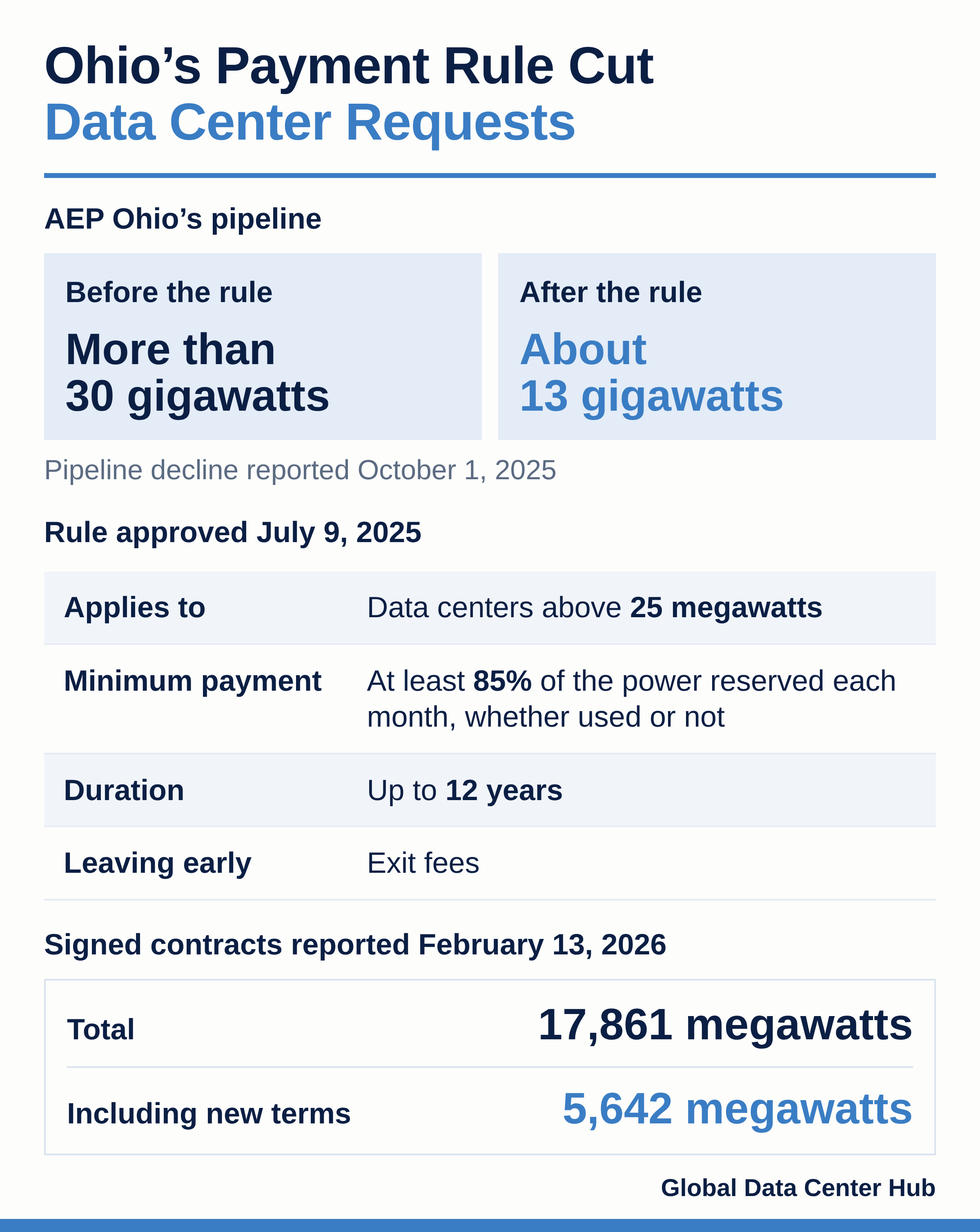
Ohio tested how much of a forecast was real. On July 9, 2025, the Public Utilities Commission of Ohio approved a new rule for AEP Ohio’s largest data center customers.
Data centers above 25 megawatts must pay for at least 85% of the power they reserve each month, whether they use it or not, for up to 12 years. They also face exit fees if they walk away.
The requests shrank fast. Data Center Dynamics reported on October 1, 2025, that AEP Ohio’s pipeline fell from more than 30 gigawatts to about 13 gigawatts after the rule took effect.
A gigawatt is 1,000 megawatts. AEP Ohio said the commitments pushed data center companies to estimate their power needs accurately.
Data center growth in Ohio continued under the rule. AEP Ohio reported on February 13, 2026, that data centers had signed contracts for 17,861 megawatts, including 5,642 megawatts signed under the new terms.
More than half of the requests disappeared once asking for power came with a price.
The rest of the pipeline is what a forecast looks like when someone has to pay for it.
Why Fixing the Numbers Takes Years
The fix is slow because every part of the system runs on long clocks.
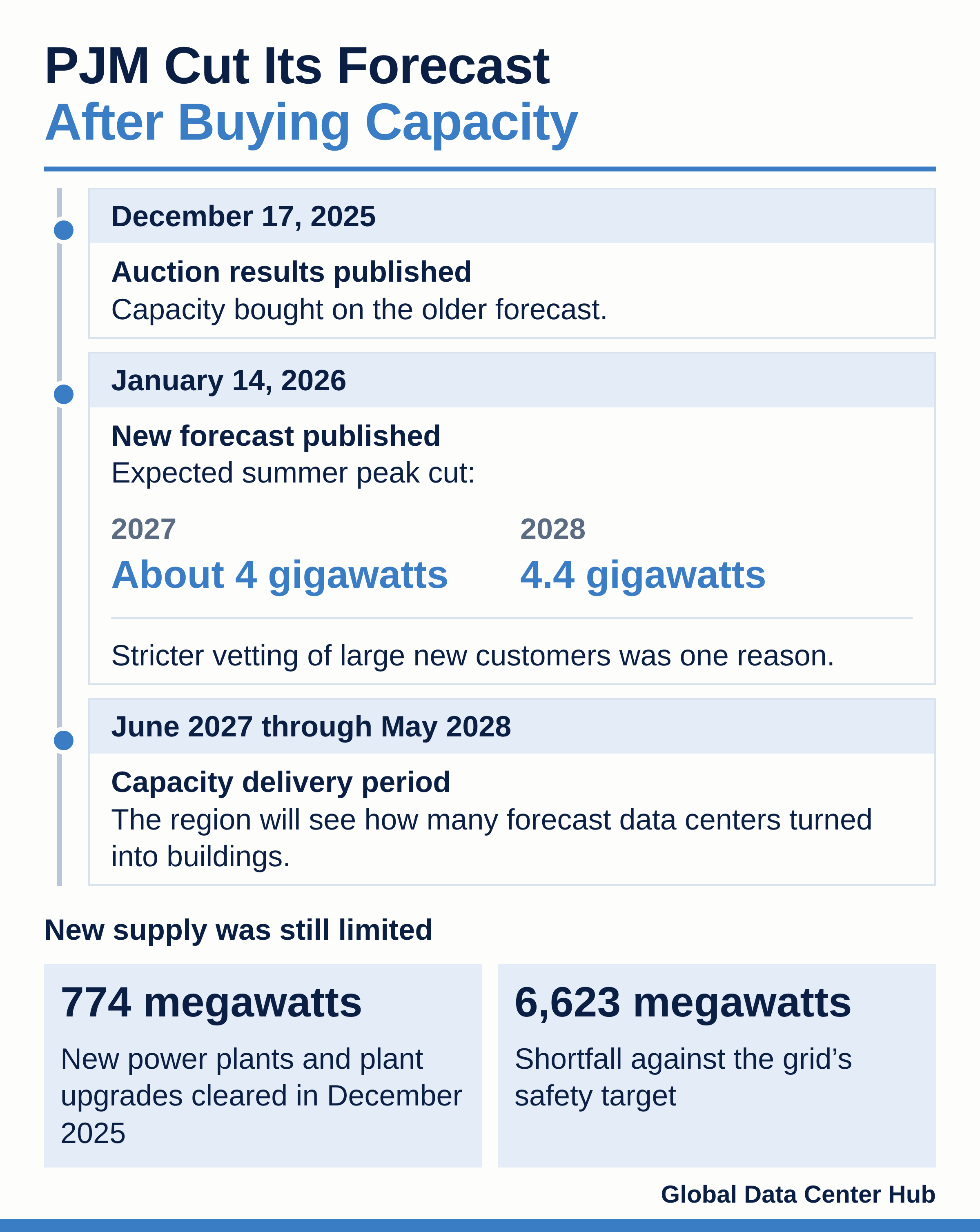
Forecasts get corrected after the money is spent. On January 14, 2026, PJM published a new forecast that cut its expected summer peak for 2027 by about 4 gigawatts and for 2028 by 4.4 gigawatts, according to Utility Dive.
PJM named stricter vetting of large new customers as one reason. The December 2025 auction had run four weeks earlier, on the older numbers.
New supply is slower still. PJM reported that the December 2025 auction cleared 774 megawatts of new power plants and plant upgrades.
The grid needed 6,623 megawatts more than it bought.
A gas plant, a battery site, or a transmission line each needs permits, equipment, and construction crews, and that work takes years.
Rules change one state at a time. Ohio’s rule came out of a case before state regulators and applies to one utility.
PJM serves 13 states and Washington, D.C., and each state regulator decides for its own utilities how data centers should pay.
The Households Paying for Buildings on Paper
The cost lands first on anyone who pays a power bill in the PJM region.
Utilities buy capacity for their customers and pass the cost through to monthly bills.
If you live anywhere from New Jersey to Illinois, part of your bill funds standby power for the grid’s forecast, including the data centers in that forecast.
The same bill also buys something real. Standby power is what keeps the lights on during a heat wave, and a grid that runs short risks rolling blackouts.
It also lands on people who follow AI and wonder where the costs of the boom show up.
The costs appear in chip orders and company earnings. They also appear in a household line item most people never read.
And it reaches anyone watching a data center proposal in their own county. A proposal that never gets built can still shape what the whole region pays for power three years later.

Four Clues to Spot Paper Demand in the News
The first clue is a utility whose data center requests exceed its entire system.
When requests add up to more than the utility delivers on its busiest day, many of them are likely duplicates or early bets.
These numbers appear in utility filings and testimony before state regulators, as they did in AEP Ohio’s case.
The second clue is a forecast cut after new vetting rules.
When a grid operator tightens how it screens large customers and the forecast drops, the old forecast carried projects that could not pass the screen.
PJM publishes its forecast every January, and trade outlets report the changes.
The third clue is a shrinking queue after a new payment rule.
When a state requires data centers to pay for power they reserve and requests fall sharply, the drop shows how much of the queue was never going to be built.
These rules appear in state utility commission decisions.
The fourth clue is a market watchdog splitting costs between built and forecast demand.
PJM’s market monitor publishes this split after each auction. Headlines usually carry the price. The monitor’s report carries who the price was for.
The Delivery Years Will Settle the Question
The forecast years are coming. The power bought in December 2025 covers June 2027 through May 2028, and by then the region will see how many forecast data centers turned into buildings.
If they arrive, households paid for power the grid truly needed, and the lights stayed on. If many never arrive, households paid for the caterer’s extra meals.
The open question is who should carry the cost when a forecast turns out wrong.
Ohio gave one answer: the company that asked for the power.
Every other state that shares a grid with data centers will face the same question, and the answer will show up on the bill.
Interesting contrast with what we’re seeing here in ERCOT. PJM can make speculative load expensive through the capacity market before a data center ever turns on; Texas doesn’t have that same mechanism, so the pressure shows up much more directly in interconnection, transmission planning and now Batch Zero.
Working around these loads in Texas, I think both markets are really wrestling with the same question in different ways: how much of the future data center pipeline is real enough to plan the grid around? Along with how should grids allocate cost due to the influx of LFLs hitting the grid.