
Welcome to Global Data Center Hub. Join investors, operators, and innovators reading to stay ahead of the latest trends in the data center sector in developed and emerging markets globally.
TL;DR
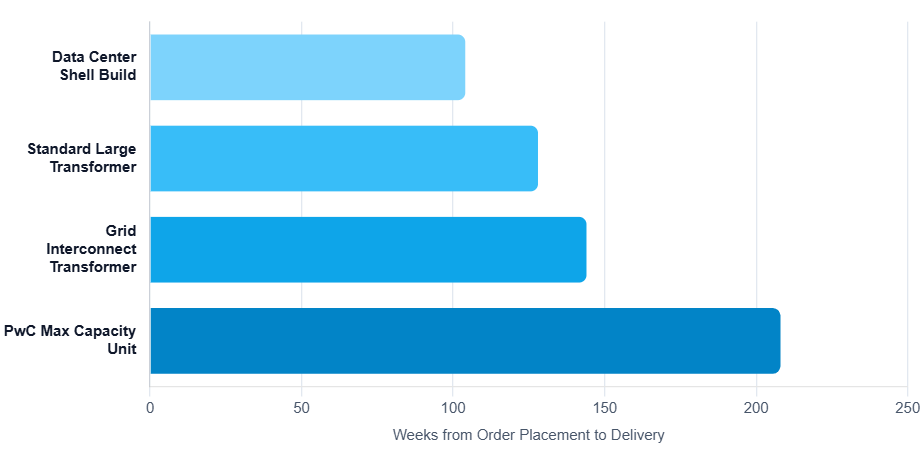
Large power transformers, the equipment that converts the very high voltage carried by long-distance power lines into a voltage a building can actually use, now average 128 weeks from order to delivery, according to a Wood Mackenzie survey of utility and developer orders. The largest units, which connect power plants to the grid, average 144 weeks. A data center building takes roughly two years to construct.
Developers now order power equipment years before a project has a customer or a final go-ahead. Chevron ordered seven large gas turbines from GE Vernova, the power equipment company spun out of General Electric in 2024, roughly two years before signing the twenty-year electricity agreement with Microsoft that those turbines will serve.
The published order books of power equipment makers show whether an announced AI buildout is real. GE Vernova reported $2.4 billion of data center electrical equipment orders in the first quarter of 2026, more than the company booked in all of 2025, and those figures are filed with regulators every quarter while project announcements carry no such requirement.
Somewhere near your house there is a grey drum on a wooden pole, or a green metal cabinet sitting on a concrete pad at the end of the street.
That is a transformer. It takes the very high voltage that travels down long-distance power lines and turns it into the much lower voltage your kitchen can handle.
Every building on earth has one of these standing between it and the grid.
So does every data center, except theirs can be the size of a small house and weigh several hundred tons.
That box is currently the thing the AI boom is waiting for.
Chips are shipping in volume. Money is arriving faster than anyone forecast. Land has been bought across half a dozen states.
The queue that all of it now stands behind runs through a handful of heavy-equipment factories, and it is measured in years.
This is worth a newcomer’s attention for a reason beyond engineering.
AI infrastructure stories often focus on technology companies or massive investments, but neither explains the pace.
The real constraint is less glamorous: factory schedules booked years in advance.
Once you see that layer, the delays and unusual announcements make sense.
Chevron ordered the turbines two years before it had a customer
In June 2026, Chevron announced a deal with Microsoft.
Chevron will build a power plant near Pecos, in West Texas, and sell all of its electricity directly to a Microsoft data center under a twenty-year agreement.
The plant is designed for roughly 2.67 gigawatts, which is about the electricity used by two million American homes. First power is expected in 2028.
Read as a headline, that is a story about an oil company walking into the AI business.
The detail that actually explains it sat in an interview.
Jeff Gustavson, who runs Chevron’s New Energies business, said the company began thinking about the project about three years earlier and committed to it about two years earlier.
What that commitment consisted of was placing the equipment order.
A gas turbine is essentially a truck-sized jet engine that burns natural gas to spin a generator.
Chevron ordered seven large ones from GE Vernova, the power equipment company spun out of General Electric in 2024.
It placed that order before it had a signed customer, before its own board had given the project a final approval, and before the design was settled.
That order was the deal.
By the time Microsoft was deciding where to put a very large data center, land was available in several places, natural gas was available in several places, and money was available almost everywhere.
A delivery slot for seven large turbines was available from almost nowhere. Chevron was holding one.
The project has a public cost attached to it.
The plant burns natural gas, and Microsoft has a standing pledge to remove more carbon from the atmosphere than it emits by 2030, a target this makes harder to reach.
Chevron has said the plant will run separately from the regional grid so that local households are not competing with it for power.
If you read that announcement as an oil company discovering technology, you missed the part that decided it, which is that the winner was whoever had joined the queue earliest.
The building takes two years. The equipment takes longer.
Here is the number that reorganizes everything.
Wood Mackenzie, an energy research firm, surveyed actual utility and developer orders and found that standard large power transformers average 128 weeks between order and delivery.
That is close to two and a half years. The largest units, the ones that connect a power plant to the grid, average 144 weeks.
Analysts at PwC have put the wait for the highest-capacity units as long as four years.
Now hold that against the building itself, which takes roughly two years to put up.
The reason is unglamorous and hard to fix.
A large power transformer needs a specialized electrical steel that only a few mills in the world produce, plus copper, plus custom engineering, plus months of testing before it ships.
Adding factory capacity takes years, because a transformer plant is itself a heavy industrial building.
And three separate waves of demand arrived at those same factories at once.
Data centers need them. Older grid equipment installed decades ago needs replacing.
Factories and vehicle fleets switching from fuel to electricity need them too. None of those three has any reason to slow down for the others.
So when you read that an AI project has been delayed, the cause is usually a delivery date agreed years ago rather than anything happening on the construction site.
You can now reserve a place in a factory line for power you have not designed yet
Because the wait got long enough, the industry invented a way to buy a spot in it.
GE Vernova calls these slot reservation agreements.
A customer pays to hold a place in the manufacturing schedule before knowing exactly what it will need, in the same way a person books a table months ahead and works out later who is coming.
The scale of this is easy to miss. In the first quarter of 2026 alone, GE Vernova signed 21 gigawatts of new gas equipment agreements.
Only 2 gigawatts of that were firm orders. The other 19 gigawatts were reservations.
The company’s reserved slots rose from 43 to 56 gigawatts in a single quarter, and it told investors it expects to reach at least 110 gigawatts of combined orders and reservations by the end of 2026.
For context, 110 gigawatts is roughly a tenth of all the electricity generating capacity in the United States, held on one manufacturer’s books as future work.
This changes how a headline should be read.
When a company announces gigawatts of new AI capacity, a portion of that number may be a place in a line rather than a machine that exists.
That is why announced capacity and delivered capacity have drifted so far apart.
The factory built to fix the shortage opens in 2028
The obvious response to a shortage is to build more factories, and that is happening.
In South Boston, Virginia, Hitachi Energy has made transformers since 1968. In 2026, it began a $457 million expansion to make the site the largest power transformer factory in the U.S.
The project adds around 825 jobs to a workforce of about 850, close to doubling the place.
It is part of a wider investment of more than a billion dollars in American grid manufacturing.
The plant is expected to begin operating in 2028.
Sit with that timeline. A factory announced to ease today’s shortage may take two years to start production, with transformers requiring another two years to build and deliver.
Relief may not arrive until the end of the decade.
Virginia is a fitting place for it. Northern Virginia holds the largest concentration of data centers on earth.
Data centers already account for roughly a quarter of the electricity sold by the state’s main utility.
The useful correction here is about time.
This shortage is shaped like a decade-long industrial rebuild, and if you read it as a news story that a strong quarter settles, almost every forecast you meet will look more optimistic than it should.
$2.4 billion in one quarter, more than all of last year
There is a practical skill buried in all of this, and it costs nothing to use.
Equipment makers are public companies, so they report what customers actually bought, every three months, in filings that carry legal consequences if they are wrong.
Announcements carry no such requirement.
In the first quarter of 2026, GE Vernova’s electrification division, which makes transformers, switchgear, and the substations that connect large buildings to the grid, booked $2.4 billion of orders tied to data centers.
That was more than the division booked from data centers in the whole of 2025.
Total orders across the company reached $18.3 billion for the quarter, up 71 percent on the year before, and its order backlog, meaning work sold but not yet delivered, stood at $163 billion.
Those numbers say something that a press release cannot. Somebody signed for the equipment, and somebody is paying for it.
So, the next time a very large AI project is announced, the fastest way to know whether it is real is to wait a quarter and look at what the equipment makers say they sold.
The slowest part of the fastest thing
The AI boom is described almost everywhere as a story about speed.
Models improve in months. Companies are built in a year. Announcements arrive weekly.
Underneath that sits an industry moving at the speed of heavy manufacturing. A decision made in 2026 shows up as electricity in 2030.
The scarcest thing in the whole chain is a place in a factory schedule, and somebody else may already be holding yours.
Every answer you get from an AI tool travelled through one of those grey boxes on its way to you.
The chain that ends in a chip begins in a steel mill, and the whole of it moves at the pace of the slowest link.
Before reading this, what did you assume was the slowest part of building a data center?