
Welcome to Global Data Center Hub. Join investors, operators, and innovators reading to stay ahead of the latest trends in the data center sector in developed and emerging markets globally.
TL;DR
A data center is a building that runs five systems at once: power, cooling, computers, networking, and storage. Every AI answer, streamed video, and saved photo passes through all five. The computers are the reason the building exists, and the other four systems exist to keep the computers alive.
AI computers have grown so power-hungry that one rack now draws roughly the electricity of a hundred American homes. NVIDIA, the company whose chips the AI boom runs on, sells a rack called the GB200 NVL72 that uses about 120 kilowatts, against an industry average near 8 kilowatts per rack. That jump forced data centers to replace air conditioning with liquid cooling piped directly onto the chips.
The five systems used to be designed separately, and AI has fused them into a single problem. A data center that cannot secure enough electricity, cooling, and water cannot run modern AI chips at all, which is why companies like Google and xAI now build power plants and water systems alongside their computers.
You ask ChatGPT a question and the answer comes back in a second or two.
Somewhere, a building the size of several football fields just did the work.
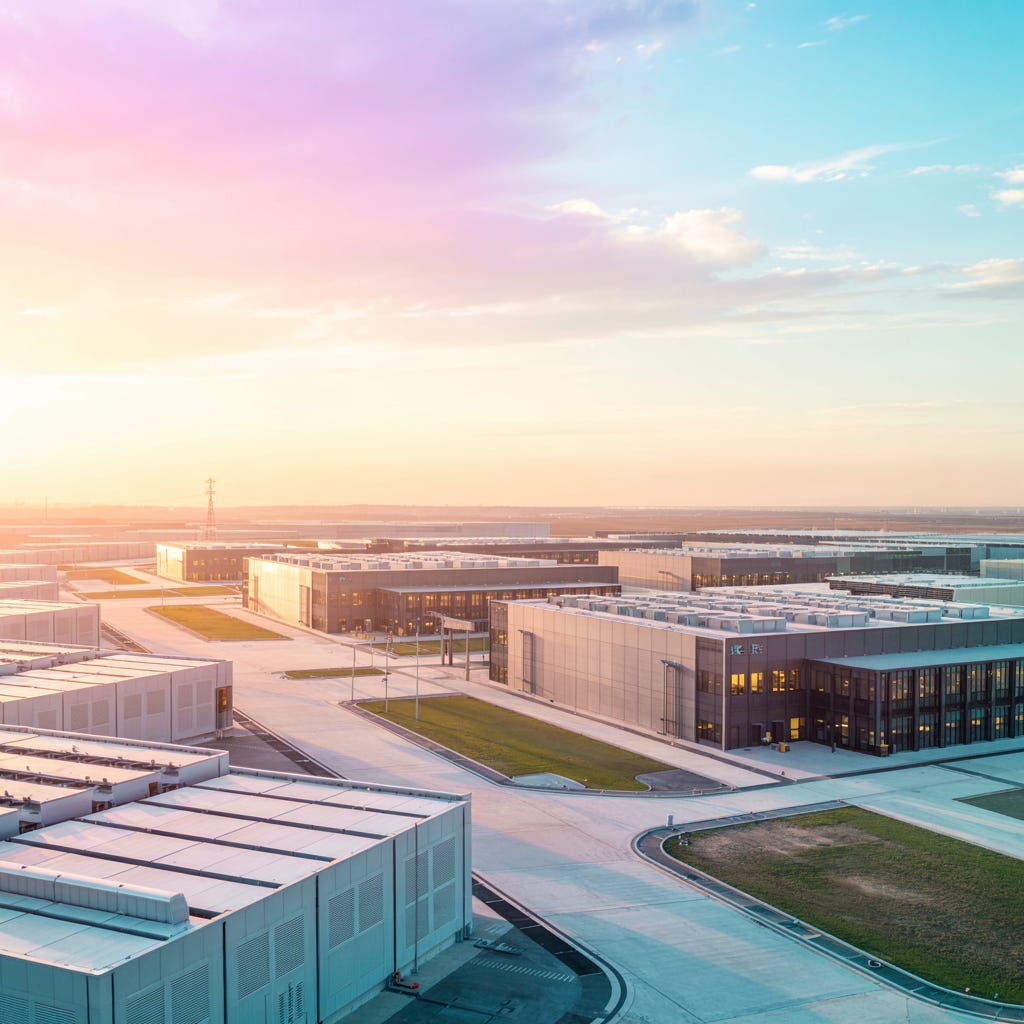
From the outside it looks like a warehouse: concrete walls, no windows, a fence.
Inside, five separate systems are running at once, every hour of every day, and AI has pushed each one past what it was designed to do.
This is worth understanding for a plain reason.
These buildings have started showing up in the news near where people actually live: in fights over electricity prices, in disputes over water, in town meetings about air quality.
Those stories make more sense once you can see the building the way an engineer does.
Each of the five systems looks simple on its own.
The interesting part is what the AI boom did to every one of them.
1. One rack of AI chips now draws the electricity of a hundred homes
A reasonable first guess is that a data center is a building full of computers, so the hard part must be the computers.
The harder part is feeding them.
Electricity arrives from the grid at a strength no machine could use directly, so the building lowers it in stages until a computer can drink it.
The electrical panel in your garage does the same job for your house.
A data center does it for something closer to a small city, with room-sized transformers instead of a grey box on the wall.
The scale is the story here.
For most of the industry’s history, a rack, the tall shelf that holds a few dozen computers, drew about 8 kilowatts, roughly what six or seven homes use at once.
The new AI racks changed that. NVIDIA’s flagship AI rack, the GB200 NVL72, draws about 120 kilowatts.
One shelf of computers now pulls roughly the electricity of a hundred American homes, and a large AI campus of many such racks draws 100 megawatts or more, about the demand of 80,000 homes.
Sometimes the grid cannot keep up, and Memphis showed what happens next.
In 2024, xAI began building its 150-megawatt Colossus AI facility, but the local utility could initially supply only 8 megawatts.
The company brought in dozens of natural gas turbines for on-site power, with aerial photos showing about 35 operating more than double the 15 permitted.
The move sparked strong opposition from South Memphis residents, and the NAACP filed a lawsuit over the unpermitted turbines and their impact on local air quality.
So when you hear that AI is raising electricity bills, or that a town is fighting a new power plant, this is the system the fight is about, and your utility bill is part of the same grid those buildings are drawing from.
2. Every watt that goes in comes back out as heat
Here is a piece of physics that explains half the building: almost every watt of electricity a computer uses turns into heat.
A rack drawing 120 kilowatts is giving off the heat of about 80 hair dryers running at full blast, packed into a cabinet you could wrap your arms around.
For decades, moving that heat was an air problem.
Data centers were built as giant air conditioning exercises: cold air pushed through the front of the racks, hot air pulled out the back, over and over.
Then the chips got too hot for air.
Modern AI chips give off so much heat in so small a space that blown air can no longer carry it away fast enough.
The industry’s answer was to bring liquid to the chip: water or coolant piped through the building and across a metal plate that sits directly on each processor, soaking up heat the way a car’s radiator does.
NVIDIA’s AI racks require this by design. The newest AI computers are plumbed, not just wired.
The plumbing has a cost that shows up outside the building.
Many data centers cool themselves partly by evaporating water, and the amounts are large.
Google reported in its 2026 Environmental Report that its data centers consumed 10.9 billion gallons of water in 2025, up 34 percent in one year, roughly what 100,000 American homes use annually. In dry regions, towns have started asking hard questions about who gets the water.
The price of every AI answer is paid partly in electricity and partly in water, and the communities hosting these buildings have noticed even if most users never do.
3. The computer is now the whole rack, and it weighs as much as a car
Strip the mystery from the word “server” and it is a desktop computer with the screen removed, flattened into a tray.
A rack is the shelf that holds a few dozen of those trays. For most of computing history, that was the unit: one tray, one computer, easy to swap.
AI changed the unit of the machine itself.
NVIDIA’s GB200 NVL72 wires 72 of its most powerful chips together so tightly that the entire rack behaves as one enormous computer.
It arrives as a single liquid-cooled machine, weighs about 1.4 tonnes, roughly a small car, and sells for around 3 million dollars. Companies do not buy one.
Training a leading AI model takes thousands of such racks working in concert for months.
This is why the economics of AI feel strange from the outside.
Every answer you get from a free chatbot is being produced on some of the most expensive machines ever built and understanding that gap explains why the free version of any AI product is never the whole story.
4. The chips spend most of their time talking to each other
The natural picture of a data center’s traffic is a building talking to the internet: your request goes in, an answer comes out.
What actually dominates an AI building is traffic that never leaves it.
Training or running a large AI model splits one giant job across thousands of chips, and those chips have to coordinate constantly, like thousands of coworkers passing notes on the same project every few milliseconds.
The volume of that internal conversation is hard to overstate.
A single NVIDIA AI rack contains about two miles of copper cabling just to let its own 72 chips talk among themselves, and specialized high-speed networks then link rack to rack across the hall.
If you picture the AI boom as a story about cables across oceans, this system corrects the picture.
Most of the action is wiring inside single buildings, which is part of why companies concentrate so much computing in one place instead of spreading it around.
5. Your photos have a street address
The last system is the one you already use most directly.
“The cloud” is the everyday name for storage, and storage is rows of drives inside these same buildings, holding the world’s photos, files, messages, and the mountains of data AI models learn from.
Storage is organized the way a home is. Things needed constantly sit on fast, expensive drives, the desk drawer. Things rarely touched move to slower, cheaper drives, the attic.
When you save a photo to Google Photos or iCloud, it lands on a physical drive, in a specific building, in a specific town, usually copied to a second location in case the first fails.
The misunderstanding worth correcting here is the word “cloud” itself, which makes your data sound like it lives nowhere in particular.
It lives somewhere very particular, and everything you trust to it depends on the four systems above holding up around the clock.
Five systems, one problem
These systems used to be designed almost independently.
The power team sized the electrical gear, the cooling team sized the air conditioning, and the computers changed slowly enough that the building could stay ahead of them.
AI collapsed that separation. Choosing a chip now dictates the power system, which dictates the cooling system, which dictates the water, which dictates where the building can be built at all.
That is why AI companies have started to behave like power and water companies, signing deals for nuclear plants and building gas turbines and pipelines alongside their computers.
The building became one machine.
Seen that way, a data center stops being an anonymous warehouse.
It is the physical foundation of the digital life you already live: five systems humming in concert so that a question typed on a phone comes back answered before you look up.
Which of the five did you not realize you were using every day?